There’s a saying that “Hospitality is the tenacity to stay human in a business that often forgets how.” Well, I had forgotten how. and it was during the five years I worked at Almond that I was able to relearn.
In 2017, I had firm beliefs on how things were supposed to work in my industry, which was restaurants, and especially restaurants in the Hamptons. For me, the goal every time I approached a new table or greeted a bar guest was to provide perfect service without getting too close and definitely without making the experience too personal. Most of my tenure as a waitress over the years was, first and foremost, transactional in nature. My style was always polite and efficient but it had grown a bit rigid, artificial and cold… and I could feel it.
Almond — the bustling Bridgehampton bistro now in its 25th year and a leading staple of the East End dining world, is none of those things. The dining room is almost too dimly lit and inescapably noisy. The menu’s verbiage is untraditional, to say the least, and often reads at least in part like an insider’s guest list: “Suzannah’s tat soi.” “Jayme’s venison sausage.” “Isabel’s warm baby carrots.”


Renowned for blending bistro classics with more modern fare, Almond is the iconic East End friendly neighborhood joint open all year-round. (Photos by Doug Young)
It doesn’t really matter, though, because the vibe at Almond is, without fail, warm and welcoming — and, probably most important, deeply personal. A palpably pleasant energy buzzes within the restaurant’s walls no matter the time of year, serving as a consistent reminder that you’re in the right place, you’re going to have a great meal and, above all, you’re going to have a good time.
Brooklyn boys do California
The founding duo behind Almond — chef Jason Weiner and Eric Lemonides — goes way back. Growing up, the Brooklyn-born friends, who met as children at a holiday party held by mutual friends of their parents, became familiar at early ages about the importance of food as a means of connection — and subsequently, the importance of restaurants as a vehicle to facilitate and express those bonds.
“I think that kind of helps things,” Weiner says. “The people — our employees and our guests, multiple generations… who come in here as children and then end up working for us at the host stand or in the kitchen. And then they bring their kids in… after 25 years, you see it all.”
For Weiner, a Park Slope native, that understanding first came from absorbing what his parents exposed him to (which was a lot, both culturally and culinarily) and cooking dinner for himself and his two older brothers after school before he even turned 10. For Lemonides, who as a child regularly rode the subway from his mom’s house in Flatbush to his dad’s place above a restaurant in SoHo, an interest in hospitality was piqued while observing bar life while bellied up to one. As a pre-teen he could frequently be found hanging out, eating and drinking (his preferred beverage at the time was cola with a heavy splash of red wine) while making small talk with regulars and the bartenders serving them.


Co-owner Eric Lemonides fosters an ethos of hospitality that’s not too formal but still deeply personal and intentional. (Photos by Doug Young)
Lemonides and Weiner both started earning money at restaurants in their late teens, when, like most who work in the business, they were trying to figure out what they wanted to do with their lives.
“I went to college for a year but I came back. I wasn’t ready for that,” Weiner says. “I’m still not ready for that.” He started working in restaurants at 19. “I thought, ‘Okay, I’m going to do this until I kind of figure out a more conventional path.’ And after a couple of years, I was like, ‘You know what, I think this is what I’m doing.’”
Similarly, Lemonides began waiting tables while attending Brooklyn College but says “it got to the point where I was applying for jobs and no one would hire me because I was too young. Nobody wanted to hire an 18-year-old waiter.”
At least not in New York. It was a different story in California.
In the early ‘90s, the pair moved to San Francisco, living as roommates in the Bay Area and working at separate establishments where they each found, and then nurtured, their respective personal styles for running a restaurant. Weiner helped open Aqua, an acclaimed landmark San Francisco seafood restaurant where using locally sourced fish and farm-fresh ingredients was not only paramount but an everyday occurrence. Lemonides became general manager at Piemonte Ovest, where he started to develop his signature laid-back yet highly intuitive practice of interacting with guests.
More than almost a decade after cultivating and curating their individual restaurant repertoires, the time was right for a return to the East Coast — but not to their hometown of New York City. Instead, the destination was the white-hot Hamptons. Weiner, who earned impressive culinary stripes during his time on the West Coast, quickly landed a sous chef position at Nick & Toni’s in East Hampton, while Lemonides was hired as manager at the now-closed Della Femina. Both prestigious and renowned restaurants were standard setters in the area’s ever-growing dining scene and where the men’s reputations garnered rapid recognition.
A year-round spot in a summertime town
For Lemonides and Weiner, who for years regularly met up after restaurant shifts and discussed opening their own spot, the East End seemed to be the place they could actually accomplish that dream. Pooling together their savings, they eventually found a vacant spot on Montauk Highway, adjacent to Bridehampton Commons, in the space formerly occupied by the Woodshed restaurant. It was rustic and cozy and very un-Hamptons-like — exactly what they wanted.


“Everything need to feel close to perfect, but calm and inviting and really, really friendly,” says Eric Lemonides of opening his Bridgehamton restaurant. (Photos by Doug Young)
“When we were opening we both had a lot of advantages,” Lemonides says. “The biggest one was working in San Francisco. Back then, in the late ‘90s, New York service and California service were pretty different. New York was a bit more formal and almost everything that was opening out here in the Hamptons reflected that. It was all pretty high-end and fancy and it was all geared toward summer. White billowing curtains, beautiful white walls, that sort of thing. We knew we could do that, but we knew we wanted to be open in the winter, too.”
Armed with a straightforward yet artisanal, locally sourced, bistro-heavy menu, Almond — named for Weiner’s then-girlfriend (and now-wife), the Brooklyn-born artist Almond Zigmund — opened in April 2001. Highlights included bistro classics like hanger steak frites with au poivre, Le Grande macaroni and cheese baked with shaved truffles and sliced prosciutto, and shallow round dishes of sizzling de-shelled escargot smothered in Pernod-infused butter. Quickly, through word-of-mouth and unyielding support from close friends and family, the Hamptons got a fresh, cool, sexy new spot that effortlessly transitioned into everyone’s favorite year-round neighborhood joint.
“We knew we wanted to open a place that had really great, serious food but was really approachable [and] sort of informal feeling,” Lemonides says. “Everything needed to feel close to perfect but calm and inviting and really, really friendly.”
A Bridgehampton staple with worldwide clout
The pair has opened and closed at least three other businesses: two Almond outposts in New York City and Palm Beach and L&W Oyster Co. in NYC. In 2011, Almond’s flagship moved to its current home in a significantly larger, historic building on the corner of Ocean Road and Montauk Highway. Their Bridgehampton sister operation, L&W Market, opened next door in 2018 and is a daytime establishment where folks can get all their favorite Almond items, plus much more, when the restaurant is closed.
At the end of the party, Rick started walking around going, ‘Alright, everybody, good night. Everybody, good night. Everybody should go to Eric’s place.’ And they did, so all of a sudden we had 400 people at our restaurant.”
Eric Lemonides
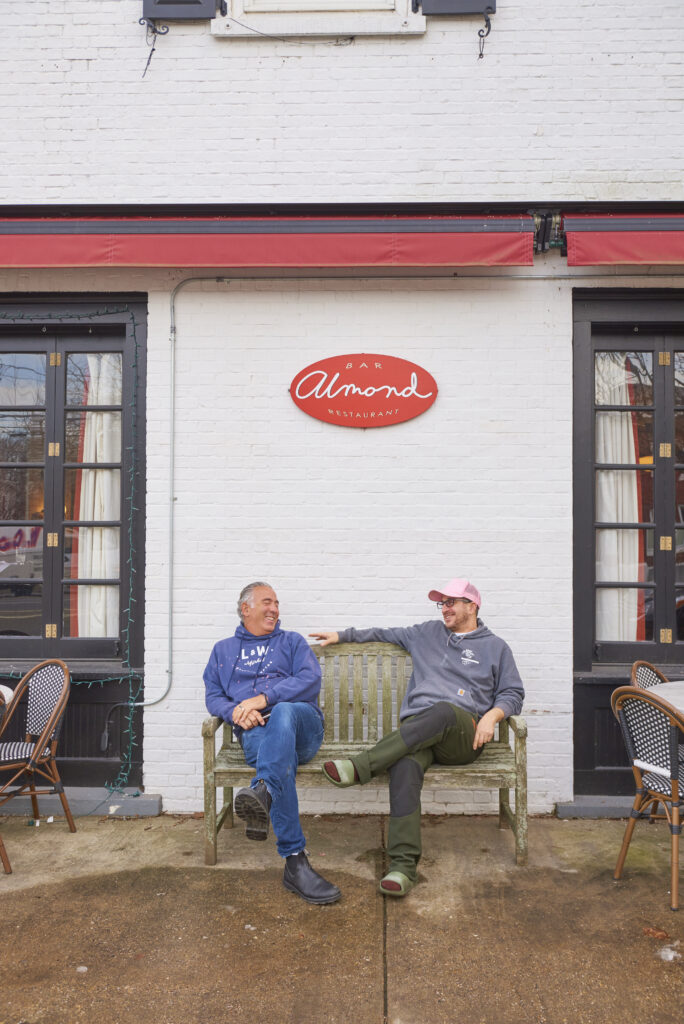
But the mothership where they’ve resided for the past 15 years seems tailor-made for Weiner and Lemonides’s brand of casual and consistent hospitality. Built at the turn of the 20th century, ornate 120-year-old tin ceilings, shiny white subway tile walls and dark reclaimed wood floors set the tone. Upon entering the front door, a small, faded green table acts as a host stand. Adjacent to the phone and reservation table, a white plate with the words “Best Day Ever” sits next to a small silver bucket filled with canary-yellow matchbooks adorned with Almond’s red logo. Behind it, one of the room’s four large, French-style casement windows offers a glimpse of an outdoor bluestone patio. On Friday nights in the summer, hundreds of people spill out from the bar and onto that patio as they chit-chat over vodka sodas and Cosmopolitans and listen to Abba blasting in the background. They’ll be there until at least 2 a.m.
“When we first opened, it was before cell phones,” Lemonides says. “And my friends from the city would be coming out for the weekend, a lot of the time on Friday nights. They’d come here because I was here. It really exploded when Rick Marek, an old customer of ours, had his annual Fourth of July party. At the end of the party, Rick started walking around going, ‘Alright, everybody, good night. Everybody, good night. Everybody should go to Eric’s place.’ And they did, so all of a sudden we had 400 people at our restaurant.”
That night turned into a tradition, one that has made the restaurant a beacon of fun and inclusivity.
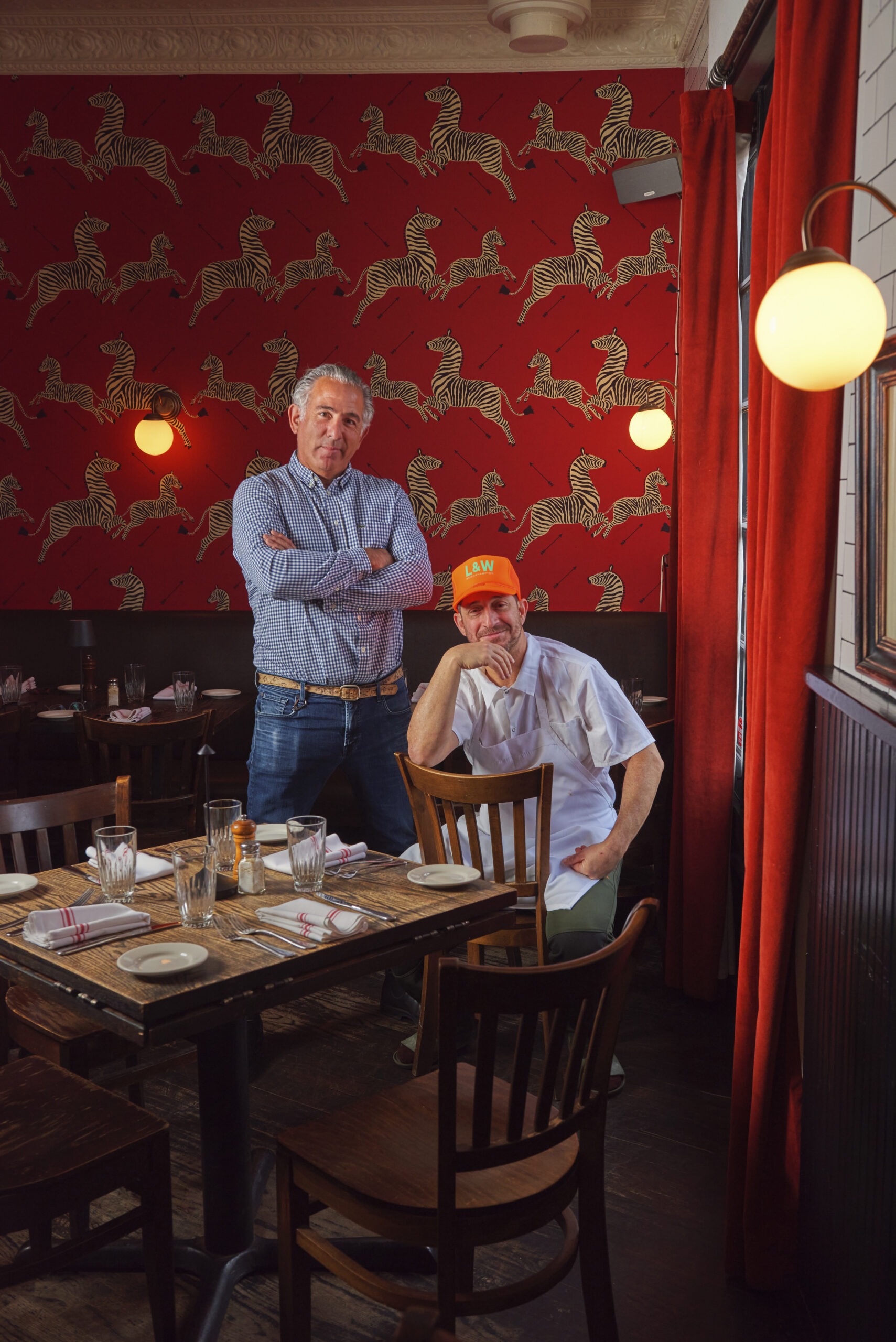
Across from the entrance is a 30-foot blue steel-topped bar set with a dozen barstools. The space is armed with rows of spirits that practically rise to the ceiling. A glass-topped partition separates the almost 100-seat dining room dotted with wooden-topped tables and anchored along the back wall by red zebra-print Scalamandré wallpaper (the very same that adorned the walls at now-closed Manhattan restaurant Gino’s). Perched in the back corner, above a chocolate-colored banquette, are shelves with stacks of cookbooks and Mason jars of homemade harissa, tomato sauce and various pickled foods. Authentic championship-level ribbons, given as gifts from friends at the annual Hampton Classic Horse Show, hang from the top.
Past the far end of the bar sits an out-of-order payphone, a favorite relic for guests to play with while waiting in line for the bathroom. On a recent evening the restaurant’s real phone, back at the host stand, starts ringing and is quickly answered by Lemonides. He scans the room while inputting a new reservation and smiles at the family of five walking in.
He greets the kids first, with high fives, before grabbing a rocks glass filled with crayons and a few sheets of paper and starts walking toward the dining room. Since they’re the first table that night, he tells the family they can pick where they’d like to sit. Once settled, Lemonides crouches to their level, a signature move he’s put into practice for years and one he was initially told not to do by an old strict, super-formal manager. Something funny happens and Lemonides lets out a distinct, operatic laugh that resonates through the space, out the open windows and onto the street, where dozens more guests are filing in.
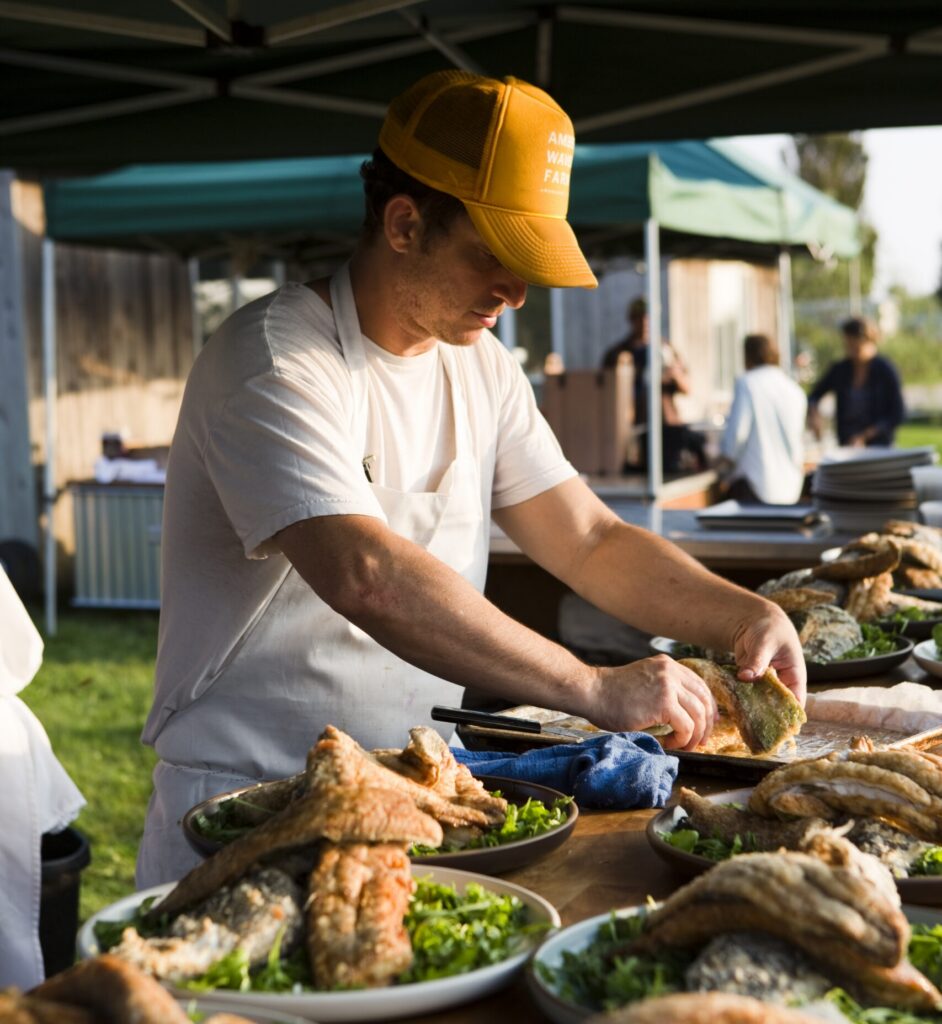
In the kitchen is Weiner, who ditched the chef’s coat years ago and can now be found in his new “uniform” — Adidas slides, a T-shirt, board shorts draped in an untied apron and a trucker hat usually sporting the logo of Amber Waves Farm, Balsam or one of the other dozen or so über-local purveyors he’s consistently incorporated into Almond’s menu for nearly two decades. He’s preparing to snap a photo of whatever that day’s plat du jour is to upload to the restaurant’s Instagram account before putting it in the arms of one of his food runners, who’s already carrying plates with Korean-style short ribs and house-made kimchi in one hand and a roast chicken with garlic smashed potatoes and sauteed greens in the other. The latter has been a staple of Weiner’s since day one.
Over the years, the familiar French bistro-style menu at Almond has grown to include both traditional and modern riffs on dishes ranging from street food classics (Mexican street corn, south-of-the-border tacos, Halal-inspired gyros) and technique-driven items (duck pastrami; handmade ravioli with smoked beets and house-made ricotta).
“Being in Northern California getting abalone and mushrooms, and whatever else through the back door was always in my head,” Weiner says. “When I got here I didn’t know anybody, so it took a while for the food to evolve. And obviously, the kind of French bistro thing is part of the backbone of what we are… letting the ingredients kind of lead us to where we go and having these amazing relationships. They’re so important to us.”
Localism, always at the heart, is punctuated by the cutesy written shoutouts given to each purveyor throughout the menu. Most are close longtime friends of Weiner and Lemonides, bound together by the strong connection and shared love of good food and good times that’s so central to the restaurant’s ethos. You may well find some of them sitting at the bar on any given night.
“It’s definitely gotten harder,” Lemonides says of running a business in 2026. “But this, this place is simply a place of joy.”
Almond is located at 1 Ocean Road in Bridgehampton, 631-537-5665.