
A certain kind of magic settles over the East End as the calendar flips toward early winter. The bustling main drags quiet and quell. Stacks of firewood appear on once produce-abundant farm stands. This time of year, the light turns that sharp, silvery shade unique to the East Coast. And, maybe most markedly, our homes become sanctuaries.
When the holidays arrive, the front door opens wide, turning the season into a story told in slow-simmered meals, candles burning low into the night and thoughtful decorative touches that make any room a haven for gathering.
How we dress our spaces—from the surface of the dining table to the boughs draped across the mantel—depends entirely on perspective. Do you lean into high-octane glamour with beaded silks and gleaming metals that catch every flicker of candlelight? Do you strip away the excess, letting the honest, unadorned beauty of pine boughs, white pottery and historic restraint take center stage? Or do you invite the wild, untamed serenity of the garden indoors, wrapping your rooms in living greens, foraged pods and organic textures?
To explore these myriad approaches for the winter season, we spoke with three master design voices: lifestyle and East Hampton entertaining expert Kim Seybert, whose tablescapes bring runway-level dazzle to the dining room; designer and preservationist Tricia Foley, a self-described purist who finds profound elegance in natural, unadorned elements; and Anastasia Casale, founder and creative director of Sag Harbor Florist, whose verdant approach bridges tabletop and interior decor with wild, botanical grace.
Three distinct philosophies, three ways to welcome the season, and countless ways to make your rooms places people want to linger. Here’s how they approach the art of holiday design.
Kim Seybert:
Bringing Fashion to the Table
When it comes to dressing the holiday table with showstopping flair, Kim Seybert is your ultimate guide. Before she became synonymous with a well-dressed dining room, Seybert spent her early career designing dresses and beaded evening gowns. That haute couture background is evident in every piece she creates, from shimmering, hand-embroidered placemats to intricately beaded napkin rings that look as though they belong more on a Paris runway than a sideboard.
For Seybert, the holiday season is an opportunity to embrace luxury, texture and unapologetic sparkle.


Kim Seybert collections are available at Current Home in Bridgehampton, 2411 Main St., and kimseybert.com. (Photos by Doug Young and courtesy of Kim Seybert)
“This is the time of the year to go GLAM!” she says. “I do love a very dressy table for this season, and I usually start with a high-shine or metallic beaded placemat. It’s the ideal moment to bring out the sparkle. I also love using gold glasses. Sometimes I will mix a clear glass with gold, but I definitely love to bring out the gold glasses.”
Achieving that level of opulence without tipping into chaos, however, requires a practiced hand. Mixing polished brass, silver, and rich metallic accents can easily look cluttered if you don’t edit carefully. Seybert’s secret lies in thoughtful textile design and a meticulous eye for balance.
“Mixing gold and silver is a signature look for us, especially this time of year,” she notes. “Many of our beaded placemats, embroidered napkins and napkin rings will have a combination of silver and gold. When I am designing, I spend time looking for the perfect combination of gold and silver threads and beads so it gives an ‘ombre’ effect that is soft and not too harsh. I think this also applies to mixing metals in vases, glasses and candlesticks. If anything starts to look overpowering, then it gets removed.”
When laying the groundwork for a breathtaking vignette, Seybert champions the power of mixing patterns and textiles, drawing on decades of experience to successfully bend the rules.
“I am never afraid to mix colors, prints and patterns,” she says. “I also try my ideas in advance to see if I like the direction when I am getting really creative. If you try a few different looks, you will know right away which one is the right fit, especially if you use a printed or patterned tablecloth with a different-patterned napkin. Don’t be afraid to experiment, but edit in advance for the best result.”
Lighting completes the high-end tableau. Rather than relying on harsh overhead fixtures, Seybert builds an enchanting, party-ready glow through layered illumination and tactile tablescape elements.
“I absolutely love candles on my table. I will mix different sets of candlesticks in varying heights. Sometimes I combine glass candlesticks with metallic ones,” she says. “I also have so much fun with novelty candles. I will try a color or a fun shape. I’m never afraid to experiment. I always use the dimmers in my dining room to make sure the ambiance is warm and inviting for cozy conversation.”
Tricia Foley:
The Art of Elegant Simplicity
As a designer, author and champion of historic preservation on Long Island—informed by years spent in her former home, a beautifully restored 1820s farmhouse in Bellport—Foley’s ethos is rooted in restraint, tradition and the quiet power of nature. For her, an unhurried, pared-down approach to holiday styling keeps entertaining grounded and entirely stress-free.
“I tend to have only functional accessories, like assorted glass cylinders I use for flowers, nuts and candles,” she explains. “Everything has to earn its keep!”
The holidays, greenery and flowers play a central role to Foley. The scent of pine and fir from Christmas trees, wreaths, arrangements and candles add to the natural festive feel.


For designer Tricia Foley, the quiet power of nature, paired with a clean, monochrome palette, adds a breath of fresh, seasonal air to holiday design. (Photos by Doug Young and Marili Fotastieri)
Rather than buying single-use holiday decor that sits in cupboards 11 months of the year, Foley lets raw, seasonal materials carry a room’s visual weight. Her approach relies on thoughtful scale, patience, and living elements that evolve throughout the season.
“I like to use natural greens, branches and berries, and lots of white flowering bulbs, and scale is important,” she says. “I like to use branches as a structure and build up with greens for taller arrangements and enjoy watching the paperwhites and amaryllis start with bulbs at Thanksgiving and bloom about Christmastime.”
To elevate the dining space and table without excess, Foley relies on a foundational “wardrobe” of everyday pieces she can dress up or down with minimal effort.
“I have a wardrobe of white dinnerware, which I mix and match, and use oversized white linen napkins for proper dinners, and big red-and-white checked linen tea towels for casual suppers,” she notes. “I use simple touches like a sprig of holly or rosemary tied around a napkin that make it perfect for the holiday, lots of candlelight and low bouquets of white flowers on the table.”
That sense of grounded tradition extends deeply into how Foley gathers with family, bridging historical perspective with modern, airy hospitality.
“I think the sense of tradition is important. In our family, I’ve always hosted Christmas Eve supper, and with Christmas carols in the background and the fire blazing, a buffet supper for all the generations. It is a reassuring ritual,” she says. “The stockings are pulled out and the candles lit, and these simple things become something to look forward to. In the historic houses I’ve lived in the interiors were spare, and that style suits me. A few simple touches are all that’s needed to create a serene setting.”
Anastasia Casale:
The Verdant, Garden-Inspired Table
As the founder and creative director of Sag Harbor Florist—a fixture on Bay Street for over 25 years—Casale’s ethos is capturing nature’s beauty through the unfiltered, abundant flora of the East End.
Her passion for flowers first bloomed in childhood while sitting at her mother’s kitchen table, capturing wildflowers on paper. Today, that same organic, field-to-table sensibility defines her approach to holiday botanicals across both tabletops and mantels.
For Casale, a holiday interior should feel like an extension of the natural world: verdant and alive, yet meticulously balanced so it never feels heavy or stiff.
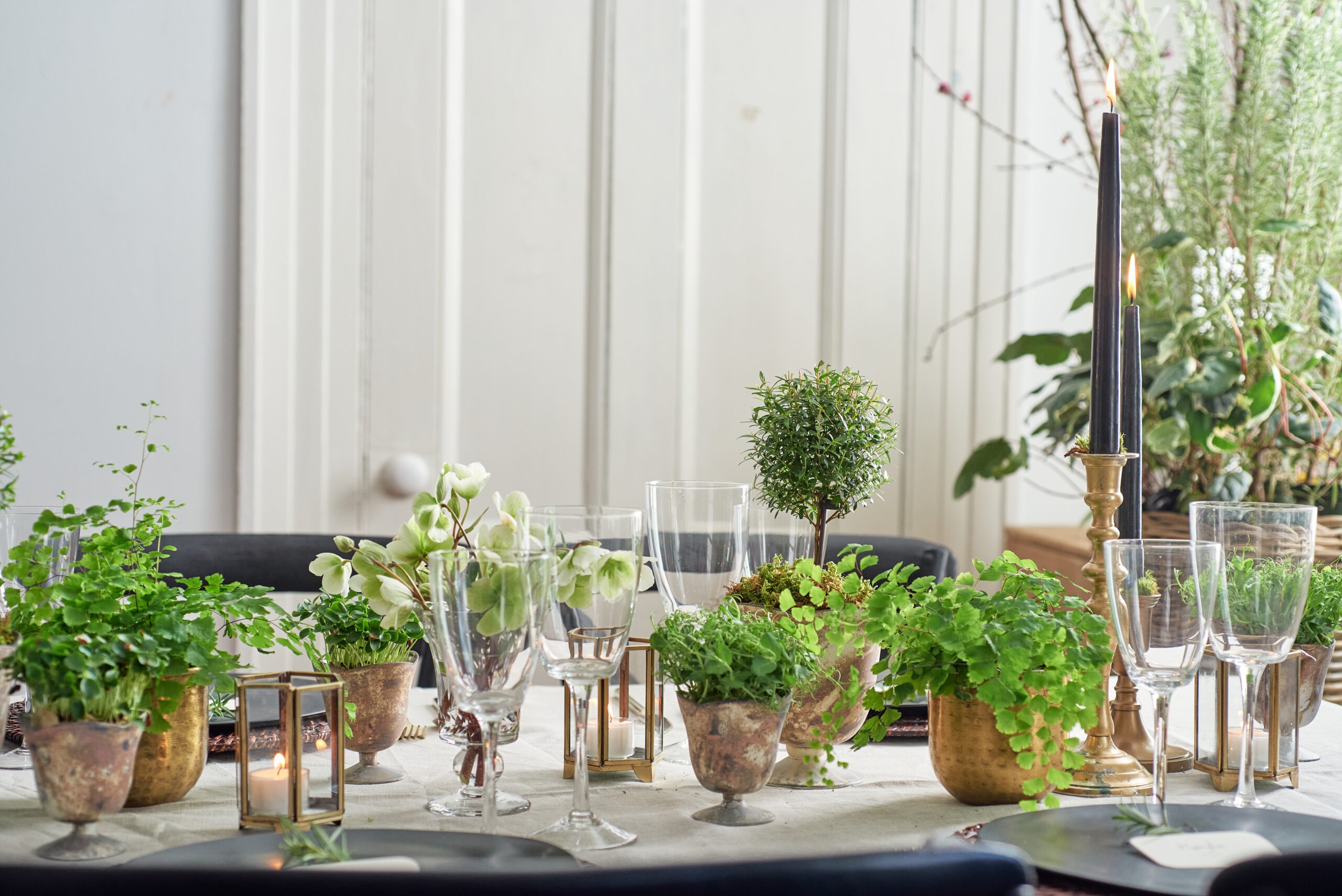
“To soften the look, I use textural containers at different heights and finishes along with layers of candlelight,” she explains.
Achieving that effortless, organic movement requires looking beyond traditional holiday greenery and incorporating unexpected textures and botanicals that evoke a living landscape.
“I fill the containers with various shades of green such as delicate maidenhair fern, topiaries and winter seasonal florals like winter bell hellebore and eucalyptus pods, as well as utilizing fresh moss and locally grown microgreens,” she says. “By bringing the outside in, I create a serene tablescape.”
That same organic layering extends beyond the tabletop to architectural elements like the mantel, where structural variety creates depth across the room.


Sag Harbor Florist owner Anastasia Casale has been inspired by outdoor gardens since childhood. “By bringing the outside in,” she says, “ I create a serene landscape.” (Photos by Doug Young)
“When styling the mantel, I build a layered, textural garland accented with bare branches, clusters of eucalyptus pods, cinnamon sticks and pinecones,” Casale notes. “I like to use different foraged evergreens that range in color from celadon to silver spruce. I want to create an environment that feels natural and beautiful to me.”
When designing lush botanical displays for dinner parties, Casale has found that the biggest hazard is accidentally building a green wall that cuts guests off from one another. To offset this, she relies on a strict rule of thumb to keep open spaces available so that conversations can flow freely across the table without the need to bob and weave around the holiday flora and greenery.
“Negative space is just as important as positive space, especially when choosing the flowers and vessels,” she emphasizes. “There is a tender balance between grounding your table with the proper vessels and choosing the right florals, keeping in mind the layers of candlelight that flicker and cast warm shadows.”
Finally, while living elements bring an unmatched vitality to an interior, Casale is careful to manage the sensory experience around the meal itself, ensuring that fragrance enhances rather than overwhelms.
“I tend to keep fragrant flowers for other areas of the house,” she advises, “such as powder rooms and guest bedrooms.”
Whether you are drawn to the runway-ready shimmer of a gilded tablescape, the quiet restraint of historic tradition or the untamed grace of winter greens, the true art of holiday design lies in expression. Ultimately, the common thread is giving yourself permission to style your home on your own terms, creating a signature look that reflects who you are and what brings comfort, joy and a true sense of welcome to the season.

