
Live
The Architect of the Living Vessel: potscaping with Kathleen Marder
by Doug Young
Photography by Doug Young
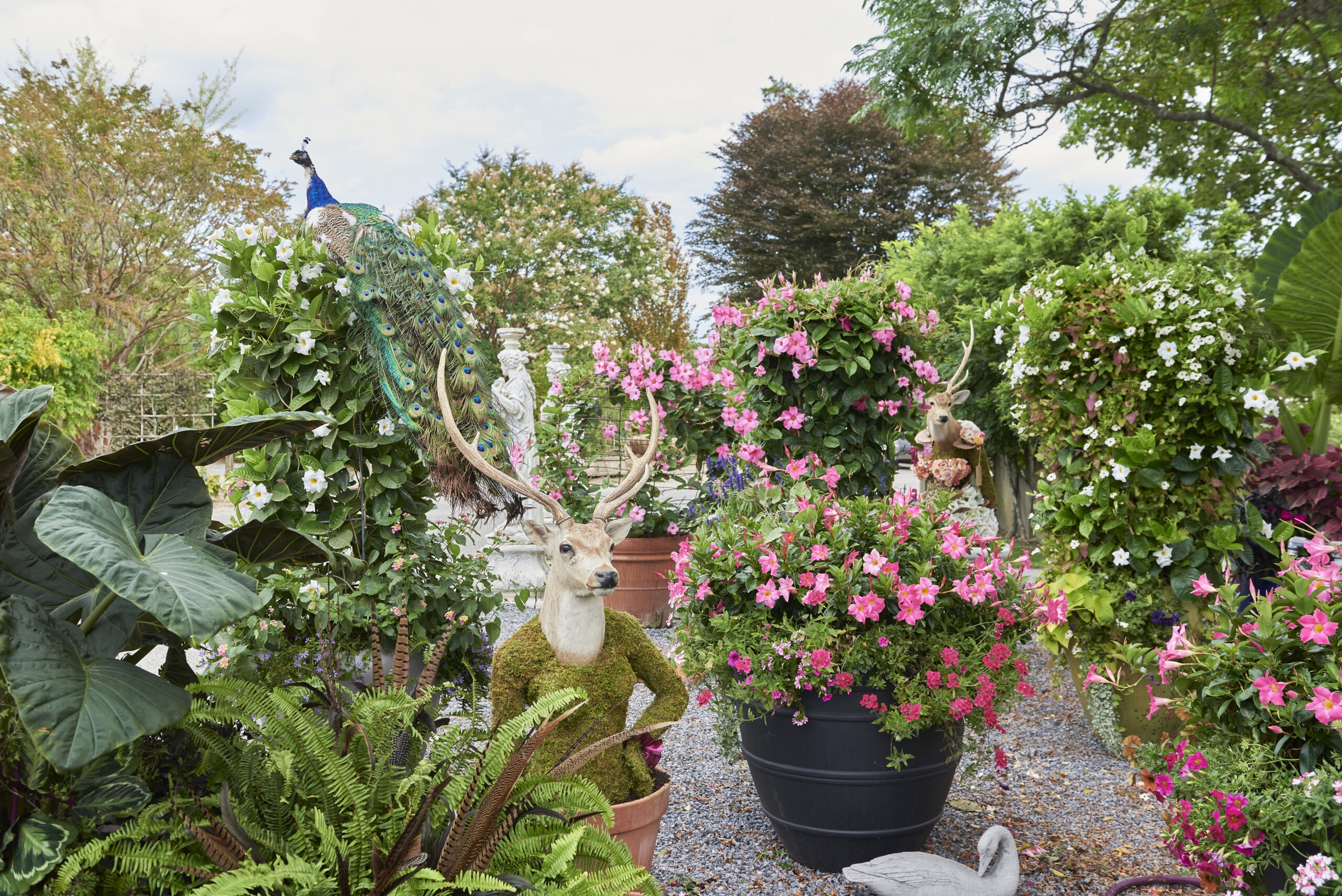
Walking into Marders in Bridgehampton isn’t like walking into your average garden-variety garden center. It’s more like stepping backstage at a high-fashion editorial shoot where the models just happen to be rooted in soil.
Ten-foot arches of greenery tower over the yard, torsos of chicken wire draped in live moss. Myriad vessels, all different types, look as though a crane dropped them in from the estate of a European aristocrat.
At the center of this botanical whirlwind stands Kathleen Marder. Despite her petite stature, she — and her husband, Charlie — are titans of East End landscaping. Once Kathleen starts talking about a 24-inch glazed terracotta pot, you realize she isn’t just a gardener. She’s an architect. She’s a couturier. And she’s the primary defender of a term she helped coin back in 1982: potscaping.
“We’ve called it that since the beginning,” Kathleen says, her eyes sparking at the introduction of the topic. “My mother and I were doing mixed containers long before it was a trend. Landscaping, potscaping — it just made sense. Now you Google it and everyone uses it. I asked Charlie, who actually owns the term, and he just shrugged and said, ‘Take it if you want it.’ So we did.”
No shrinking violets
To understand the Marder approach to potscaping, you have to understand the family lineage. Potscaping isn’t a quiet, solo hobby; it’s a contact sport born of a family of creators who prioritize design over customers’ feelings — no matter how famous those customers are. Kathleen recalls the early days with a laugh as she describes her mother’s intensity.
“Jann Wenner [co-owner of Rolling Stone Magazine] and his wife [Jane] came in, and my mother was doing all the potscaping then. And she was a crazy maniac,” Kathleen says. She vividly remembers her mother’s iconic, if eccentric, work uniform for these high-stakes installations. “She would wear Keds sneakers and stockings — and then she had stretch pants, and she would roll them up because it was hot. You could see her bony legs in the pantyhose. She was out there in the heat, working in the dirt, focusing completely on the plant and nothing else.”
The story goes that after Kathleen’s mother finished a “crazy” pot for the Wenners, Jane asked for a simple color change — pink to white. Most business owners would swap the petals and smile. Not a Marder.
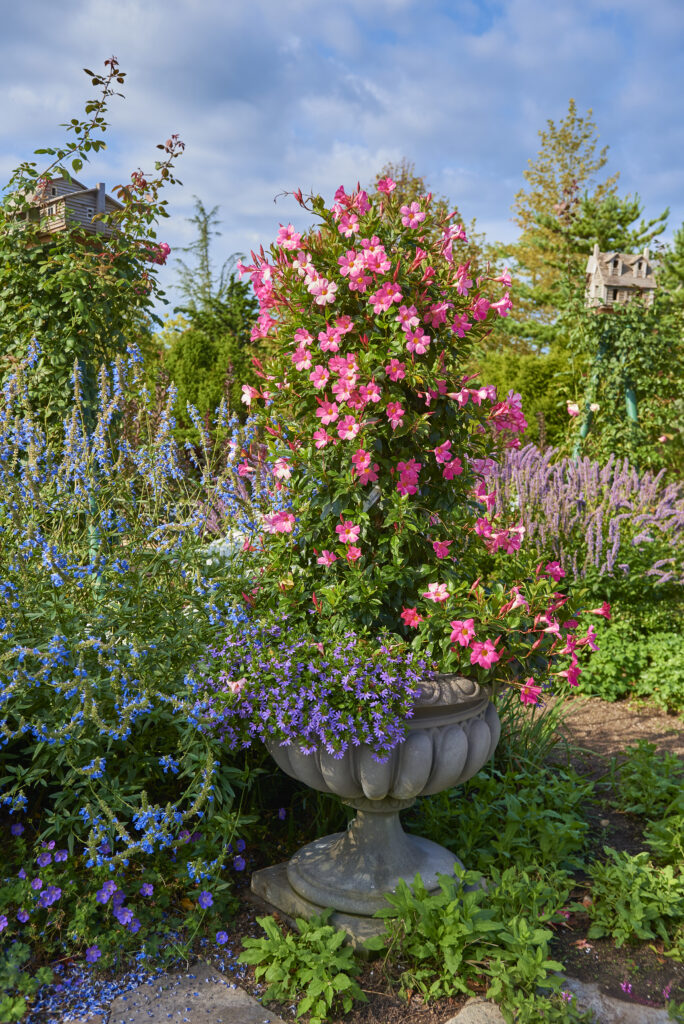
“My mother was like, ‘How dare you!’ Charlie literally had to hold my mother back from Jane Wenner because they were arguing, but it was an insane design. She took eight-foot bamboo and stripped them so she could bind them. Then she used bricks inside to weigh down the heart-shaped arches for the mandevilla. It was a masterpiece. You don’t just change the color on a masterpiece.”
As a former employee having served as a visual merchandiser under Kathleen’s guidance, I’m intimately familiar with the rigors of her creative evolution — the journey from a frantic sketch pad to a finished, flourishing pot. When I asked her recently about the process — whether it’s a consultation or a diagnosis — she was characteristically blunt: “All of the above. What’s your light? Sun or shade? That’s really key.”
But the real magic happens before the first scoop of soil moves. Kathleen approaches a container the way a structural engineer approaches a skyscraper. She sketches with intent, noting cascading elements, climbing vines and the “hidden skeletons” drafted in the margins. For the massive, gravity-defying designs Marders is known for, the structure is everything. They sink bamboo, heavy-gauge wire, forged metal hoops with stakes and aluminum piping deep into the pots. Sometimes, they bury a third of the container itself just to provide ballast for the vertical height they aim to achieve.


An important aspect of the magical effect of a Marders-built pot is scale, considering and respecting proportions of the creation at hand. “Proper sizing and proportions are critical,” Kathleen Marder says. “If you don’t get the scale right, the whole thing looks off. If you use baskets that are too large, you crowd out the star and ruin the silhouette.”
Lately, Kathleen has moved away from the “miniature garden” trend of the ‘90s, those pots stuffed with fifteen different varieties of annuals that look more like a floral explosion than a curated thought. “In the industry, they use this really stupid terminology: ‘spiller, thriller and filler.’ It drives me up a wall. We don’t talk like that here,” she says.
Instead, she leans into a bold Maximalism. “I think craziness is the prediction for spring. We want to do pots of collaborative collections in mass [quantities].”
This spring, that “craziness” means relying on proven heavyweights like Colocasia esculenta, a tropical powerhouse with massive heart-shaped leaves often called “Elephant Ears” for their dramatic scale. For Kathleen, it’s about returning to “character plants,” those wacko deformities that tell a story. “Like a branch broke off a fern and it grew back looking like something out of Dr. Seuss,” she says. “That’s what we’re looking for.”
Strike a posy
Kathleen defines her signature style as “The Edit.” If you want to know where she gets her inspiration, don’t look at a seed catalog. Look at the runway.
“I’ve gotten into Alexander McQueen lately,” she says. “He did this show that was the coolest ever. It got me brainstorming about creating a living hat with trailers like Cordata or Lysimachia. It could be a torso. It could be full-length. I just want to get some crazy things going.”


This “Edit” allows Kathleen to take a smooth, handcrafted Belgian Domani pot — renowned for its one-of-a-kind quality — and pair it with just one or two “great performers.” Rather than a tangled mess of color, the final product is defined by its silhouette.
But even for an artist of her caliber, the success of a potscape often comes down to the “frickin’ mandevillas,” Kathleen says, as if speaking about a perennially late runway model instead of a plant. A tropical woody vine characterized by its glossy emerald leaves and showy, trumpet-shaped blooms that thrive in the summer heat, the mandevilla is a relentless climber that demands a stage. Kathleen treats them like high-maintenance starlets. “They are the best performers if you do it right. But it’s a lot of labor,” she advises. “Tip-wise: if you are very careful about how you unravel that vine, it’s going to pay off big time. It’s all in the care of the unraveling.”
Marders’ masterclass
Sitting with Kathleen, you realize that while she plays at a McQueen level, the principles of potscaping remain accessible if you respect the proportions. She’s adamant about the vessel’s math. For a signature 22-inch pot, she insists on using two 8-inch baskets of seasonal annuals; for a 24-inch pot, she bumps it up to two 10-inch baskets.
“Proper sizing and proportions are critical,” Kathleen says. “If you don’t get the scale right, the whole thing looks off. If you use baskets that are too large, you crowd out the star and ruin the silhouette.”
Then there’s the “Mother’s Day trap.” In Bridgehampton, the frost date remains a moving target. “You’ve got to watch the weather,” she says. “If it gets bitten, it sets them back a while. It ruins the momentum.”


For Marder, inspiration isn’t just from the natural world; she eagerly draws from the angles and edges of both art and fashion. A recent Alexander McQueen runway show got her dreaming about creating a living hat with trailers like Cordata or Lysimachia. “It could be a torso. It could be full-length. I just want to get some crazy things going,” Marder says.
Maintenance is equally rigorous: a strict Monday-Wednesday-Friday watering schedule and a commitment to deadheading. If the plants go bald in the center, Kathleen says, you aren’t pruning hard enough.
As Marders has grown from its original 18-acre site to a massive 33-acre botanical haven on Snake Hollow Road, the philosophy remains the same. It’s about the “prowl for unusual finds,” Kathleen says, and the willingness to fail in the name of innovation. In a world of sameness, Marders remains a place where the landscape, as well as the pots flagging the entranceway, is approached with the eye of a designer and the soul of a rebel.
Kathleen isn’t looking back, though. She’s already on to the next test.
“I don’t know how we’ll do it yet,” she says, referring to a sketched idea where two mannequins form an arch of climbing vines inviting you to pass under. “But I think we can do it. God, I just want to get some crazy things going.”
