The work of Abstract Expressionists Jackson Pollock and Lee Krasner will be celebrated at the Metropolitan Museum of Art when that institution’s first-ever dual exhibition of their work opens Oct. 4. “Krasner and Pollock: Past Continuous” is the first major show of either artist’s work in New York City in more than 20 years. It aims, according to the official announcement, to introduce their work “to a new generation while reassessing their enduring impacts on modern and contemporary art.”
A hundred-something miles to the east, one scholarly institution in East Hampton has been quietly carrying out a similar mission for close to four decades.
“The house is going to be included in the story that the Met exhibition tells,” says Matthew Ward, executive director of the Pollock-Krasner House and Study Center (830 Springs Fireplace Road, East Hampton, 631-324-4929). “It’s an opportunity for us. There will be a lot of attention on us for that show.”


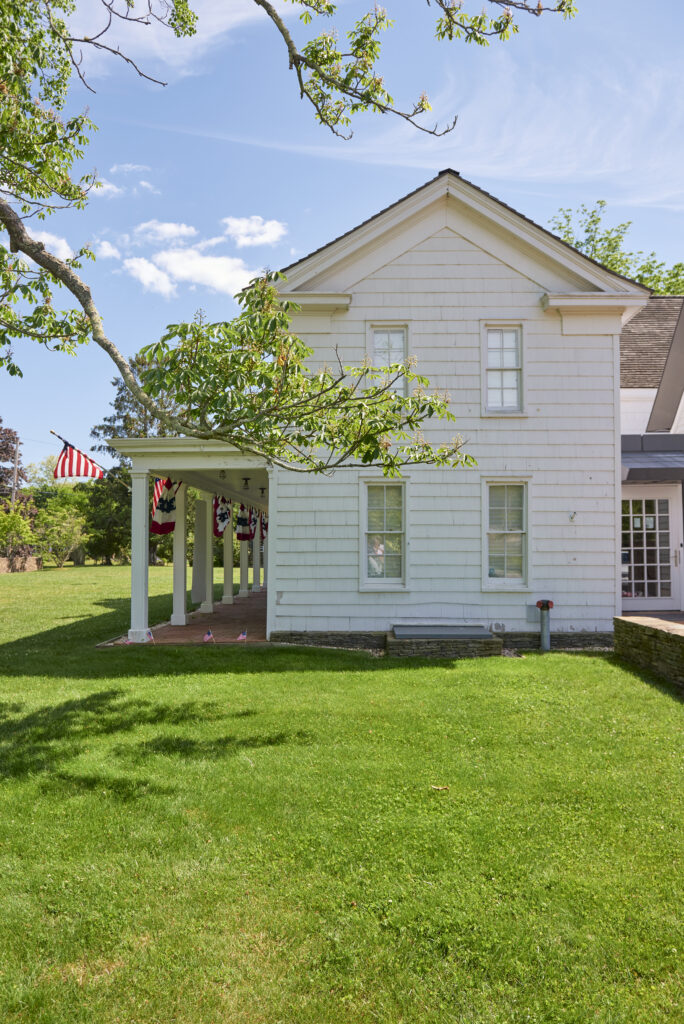
Built in 1879, the classic Springs farmhouse sits on an acre and a half alongside Accabonac Creek. (Photos courtesy of Pollock-Krasner House)
The seeds of the local institution were planted in 1987, three years after Krasner’s death, when a now-common philanthropic exchange occurred. The Pollock-Krasner Foundation donated the couple’s Springs house and studio to the Stony Brook Foundation to carry out a desire Krasner had expressed in her will — that the preserved spaces would forever tell their stories as artists and as human beings, while also engaging future generations of artists and visitors in continued dialogue and enjoyment.
“We try to strike that balance between past and present,” says Ward, who took over in mid-2024 as executive director from Helen Harrison, the writer and art historian who held the title for 34 years. “We are more tied to the artistic process than the finished product. We’re not the White Cube gallery; this is a real home where people were doing the work before it went off to the gallery.”
Today, the Springs museum hosts three or four rotating exhibits a year. Its fall 2026 presentation is by East Hampton artist Susan Vecsey, who, working in the Color Field and landscape genres, “continues a tradition of abstraction informed by nature that is this region’s legacy,” according to the P-K House website. Her work will be on display from Sept. 16 to Nov. 28 and a concert by the musical duo Lina Maxine will take place at 7 p.m. on Sept. 25 (tickets are $25).
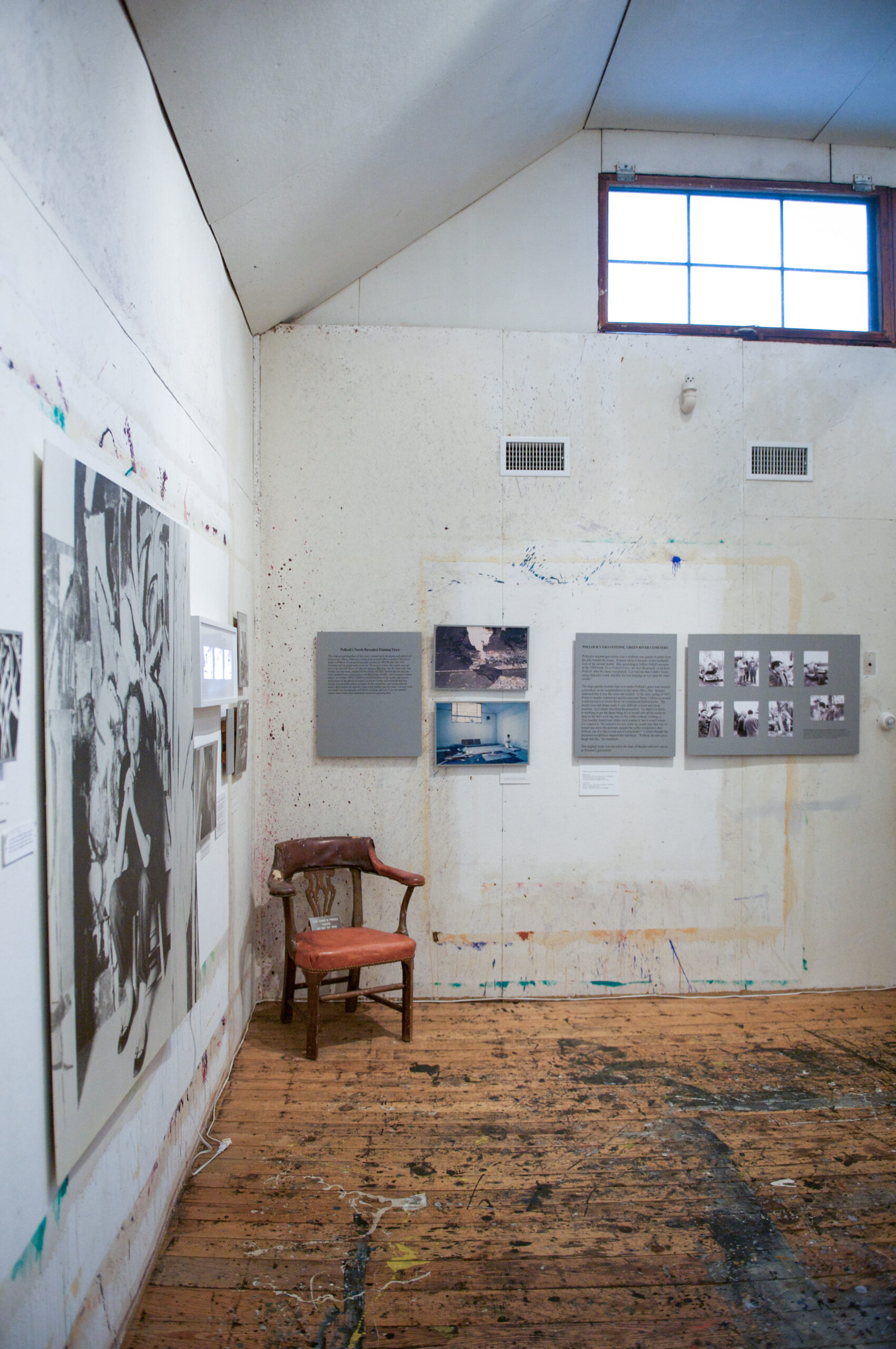
Visitors to the studio itself can don protective slippers and walk out onto the famous floor bearing the artistic evidence of Pollock’s drip and pour style. For now, anyway. “We are evaluating whether that can go on ad infinitum,” Ward says. “Preserving the floor as an artifact and as a quasi-work of art itself is important.”
Drip-painting workshops for kids are ongoing and next year the museum will debut a puppetry performance series created by Liz Joyce of Goat on a Boat Puppet Theatre. For adults, there are jazz nights in which a docent will play selected records from the Pollock-Krasner’s collection on their original record player and restored stereo system, originally built by Pollock himself.
The house and studio typically attract around 10,000 visitors each year. Between May and October, guided tours take place at noon and 2 p.m. Thursdays, Fridays, Saturdays and Sundays ($20 for adults, $10 for kids). From 4 to 5 p.m., visitors can sign up for a self-guided tour ($15) and take their time chatting with docents or reading the guides; it’s not uncommon to see people with sketchbooks. All events can be found here.


A National Historic Landmark, the house is a well-preserved time capsule, containing artifacts that were in the house at the time of Krasner’s death in 1984. (Photos courtesy of Pollock-Krasner House)
Oddly, onsite there is only one actual finished Pollock painting, and an early one at that. But there are shelves containing about 100 books that speak volumes of his and Krasner’s interests. Of those books, Ward marvels at one in particular: Systems and Dialectics of Art, published in 1937 by John Graham, “an eccentric Russian ex-pat who curated the exhibition through which Jackson and Lee met properly for the first time,” he says, and where, notably, Willem de Kooning was also featured. “It was a really influential text when it came out, and it’s quite rare now,” Ward notes.
The study center, where researchers are welcomed by appointment, is located on the Stony Brook Southampton University campus. However, they are also permitted to access materials kept at the house and studio with prior arrangement. An artist-in-residence program was established in 2025 via a partnership with a sister institution: the Elaine de Kooning House, also in East Hampton. Selected professionals live there while making art at the Pollock-Krasner House. Coming in 2027: a book documenting the history of the house itself, which Ward says was built in 1879 as a traditional, rustic fisherman’s home.
“Sometimes, if it’s a historic house-museum, maybe people think it is staid or frozen or crystallized in the past,” he says. “That’s not the case here. While we celebrate the past, we still see ourselves as a haven for artists and appreciators of art to come together and have conversations. That’s what Jackson and Lee did in their home as well.”