

Declan Blackmore of Summerhill Landscapes in Sag Harbor has spent the brunt of his life working on and with the land — that is, shaping it; collaborating with renowned landscape architects, designers, builders, arborists and horticulturists; growing stunning tree, shrub and other plant specimens from his 250 acres of farmland where he and his team foster up to 150 species; and also dreaming about what the future of horticulture holds here in the Hamptons and in the Northeast in general. This past spring, he got to see what others of his ilk are dreaming about, too.
Blackmore took a 3,000-plus mile trek over to London in May to attend the prestigious horticultural who’s who of the plant world, the RHS Chelsea Flower Show, which has been held annually since 1827 and is chock-a-block with the most important creative, artistic and plant-science minds in the world at large.
“It was my first time at the Chelsea Flower Show. It’s a big deal — to get the gold medal at Chelsea Flower Show is a big deal,” says Blackmore. Held on the grounds of 23 acres of the historic Royal Hospital Chelsea by the Royal Horticultural Society (this is an aristocratic country, after all — there’s lots of royal involved), the multi-day, ever-sold-out event has the best growers, florists and designers in the world coming together to compete in the event’s judged competitions across multiple categories.
For Blackmore, the design aspect was the focus of the trip. “They have about 30 designers who create show gardens and they have three weeks to build a garden and bring in stone elements, lighting elements, plant elements, sculpture elements. It’s a very serious competition.”
One such competitor at the event is a familiar name here on the East End: in-demand landscape designer Edmund Hollander of Hollander Design Landscape Architects who collaborated with renowned British craftsman and sculptor David Harber, and came home with a Best in Show nod from the work of Hollander Design partner Melissa Reavis and collaborator Giulia Piccini of London-based Puccini Garden Design.
But more than just a showcase of think-outside-the-greenhouse talent, the Chelsea Flower Show is also a compass pointing to the trends we can expect to see in our gardens and landscapes this coming year and in the years ahead. Blackmore tuned into the elements and facets of this year’s design showcase gardens that pointed to future trends, and here’s what he told Southforker:


Clockwise from top left: Edmund Hollander’s collaboration with David Harber won a Best in Show; grasses, native flowers, garden decor sculpted from natural elements, and stone pathways the grip were trends spotted by Summerhill Landscapes owner Declan Blackmore. (Photos courtesy of Summerhill Landscapes)
Sustainable Plantings
A continuous thread Blackmore noticed throughout the two days he spent traversing myriad exhibits: Sustainability is big, and finding plants that require less watering and fussiness will continue to be big on the East End. “The judges have to be intrigued, and they have to see something that’s new and unique, incorporating a little bit of climate control and sustainability,” says Blackmore. “There was a lot of grasses this year, which need less water, less mowing, less care and are more sustainable.”
Native Species
While what’s native to England isn’t the same plant culture native to the East Coast of the United States, there was definitely a localized trend in plantings. “There’s probably less flowery flowers,” he says. “[Designers] incorporated more natural, native flowers rather than that English style garden.”
Water Preservation
Re-use and recycling of water was a big trend — it certainly is on the East End, where water tables have been continuously looming around dangerously low levels. “Collecting water I would say is a huge thing,” says Blackmore, who saw multiple designs with recyclable and rain-collecting water elements.
Masonry That Gives
While pretty stone paths are still popular, Blackmore noticed a trend toward mixing clay into gravel or stone dust to create a natural look that doesn’t shift around. “I did notice a lot of stone paths and walkways, but instead of using hardcore masonry that isn’t pervious, I saw a lot of gravel or stone dust, and they’re even mixing clay with small grit to bind, so there’s less movement of paths. I found that quite interesting, and something we will experiment with here,” he says. “If you put down gravel paths, it moves, so [designers] took a sticky kind of a clay mixed with the stone, and it created enough of a friction to bind but still allow drainage. That was quite fascinating.”
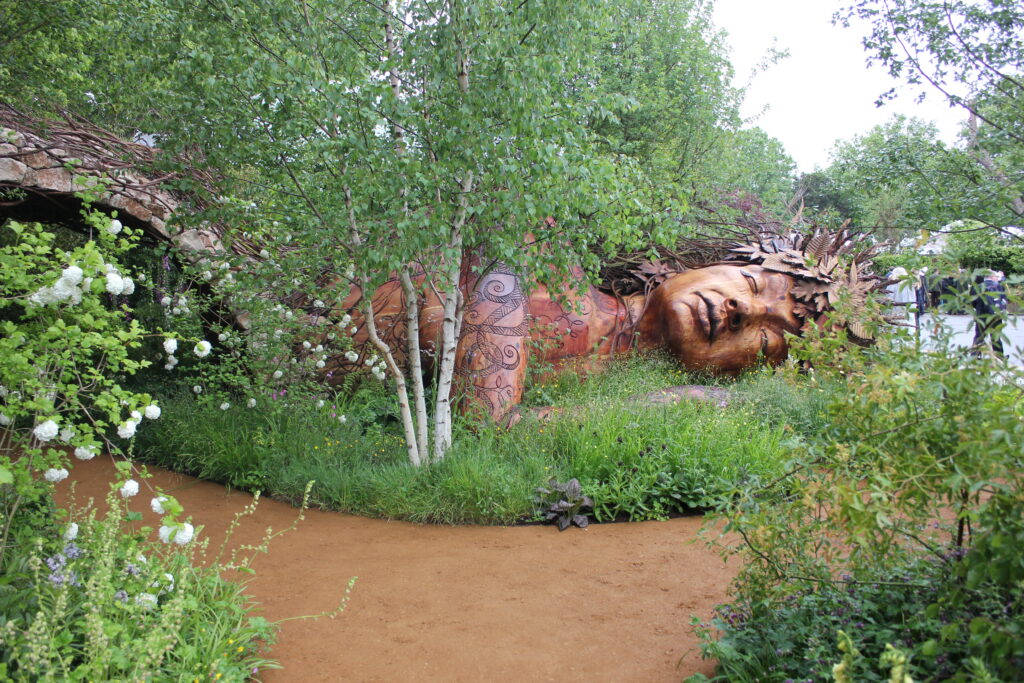
Nature as Art
The Gold Medal “Garden of the Year” winner this year was awarded to designer Sarah Eberle, who won for her exhibit entitled “On the Edge,” which used a a giant fallen sequoia tree carved into a sculpture of a sleeping woman meant to be a representative nod to Mother Nature. “It was amazing,” says Blackmore. “It looked like fallen lady in the middle of the garden, and then [she] landscaped all around it.” Using elements like this as treasure instead of post-storm trash is something to watch for as well, he says.
Shaping Trees to Your Needs
“I went to Europe two years ago and traveled all around, visiting the best tree growers and the best tree sculptures, and they were so gracious to share wisdom and knowledge with me on how [tree sculpting] is done. We’re actively doing that here on the East End now, and there was quite a bit of that at the Chelsea Flower Show,” says Blackmore. “Pollarded, espalier, parasol — you can create a parasol of trees so if you’re at a swim pool outside, instead of having umbrellas we can create living umbrellas.”

