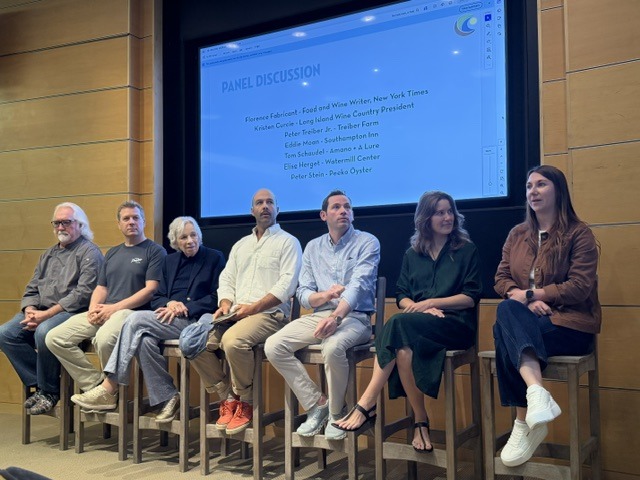
For over five decades, Florence Fabricant has been the portal and guide to good food for many of us, most notably from her perch as a food reporter and columnist for the New York Times, author of multiple cookbooks (among the many, The Ladies Village Improvement Society Cookbook: Eating and Entertaining in East Hampton shot by our very own Doug Young) and as a keen, gimlet-eyed observer of culture through the lens of dining with nearly every chef you could ever want to know on speed dial. She’s the subject of clear-eyed Q&A in one of the features in our current mag (stay tuned for that!), but here we take a deeper dive on a few topics that couldn’t fit into the rest of the story. Here’s a little Flo Fab bonus round to whet your appetite.
1. What changes would you like to see in how people eat?
People have to pay more attention to their food choices. I have been a proponent of more fiber and more whole grains for as long as I can remember. I remember growing up, loving things like buckwheat and loving whole wheat bread and that kind of thing. I now really try and avoid white flour products, except maybe pastries. But today, fiber has become a big thing and people have to wake up to what’s wrong with the way they eat. You can enjoy products that have whole grains and high fiber and all of that and more fruits and vegetables. I mean, that’s where I’ve always gone; none of this is new to me, but it deserves being repeated over and over and over.
2. What are some of the shake-outs from COVID in the dining world?
I think the effect of it was most keenly felt with great difficulty in the restaurant world. You know, the whole separation thing and the masking and the eating outdoors and all of that still linger. We used to scoff at the early bird special at 5 p.m. in Miami with the old folks. Well, what the walker set was doing was replicated when COVID came along, because people wanted to eat outside, and they didn’t want to eat outside necessarily late and in the dark, so you had people eating out and dining earlier. That stuck. But the fact is that restaurants still have trouble turning the tables, in other words, getting a second or third seating after the preliminary crowd has left. It’s still a challenge for restaurants.
3. What about for restaurant workers?
At the same time, there’s been a lot of publicity surrounding Me Too, the treatment of workers, the kind of salaries and benefits that the guy who roasts your chicken gets. You can complain about the $40 dollar rotisserie chicken, but what is the guy roasting the chicken getting paid? These are things that I think about. I don’t think everybody thinks about them, but everybody’s not a food professional.
4. As food cultures become more easily accessible to all of us, even without travel involved, there’s a lot of talk about appropriation. What’s your view on this?
You know, I think it’s really hard. I know that there have been accusations of appropriation, for instance, that a woman who is not a native of India has no right preparing a curry. I think that’s nonsense, and I think that kind of extreme view just absolutely doesn’t pay attention to what food does and where it’s gone. Look, you go to a Japanese restaurant and you have a Japanese chef preparing tempura, right? Common as can be. You know what tempura is? It’s Portuguese. The Portuguese who came to Japan introduced the technique, the batter frying of tempura, and it stuck. And it’s just one example of a gazillion you can name. So this idea of authentic? I just take it with a grain of salt.
5. If you were allowed only three items in your refrigerator and three in your pantry, what would they be?
In my refrigerator, there will be scallions. There will be half and half, organic. And there will be eggs. In my pantry, anchovies, mustard and good olive oil. But that doesn’t scratch the surface. I’ve got some really weird things in my pantry. How many people do you know who have three different kinds of harissa?