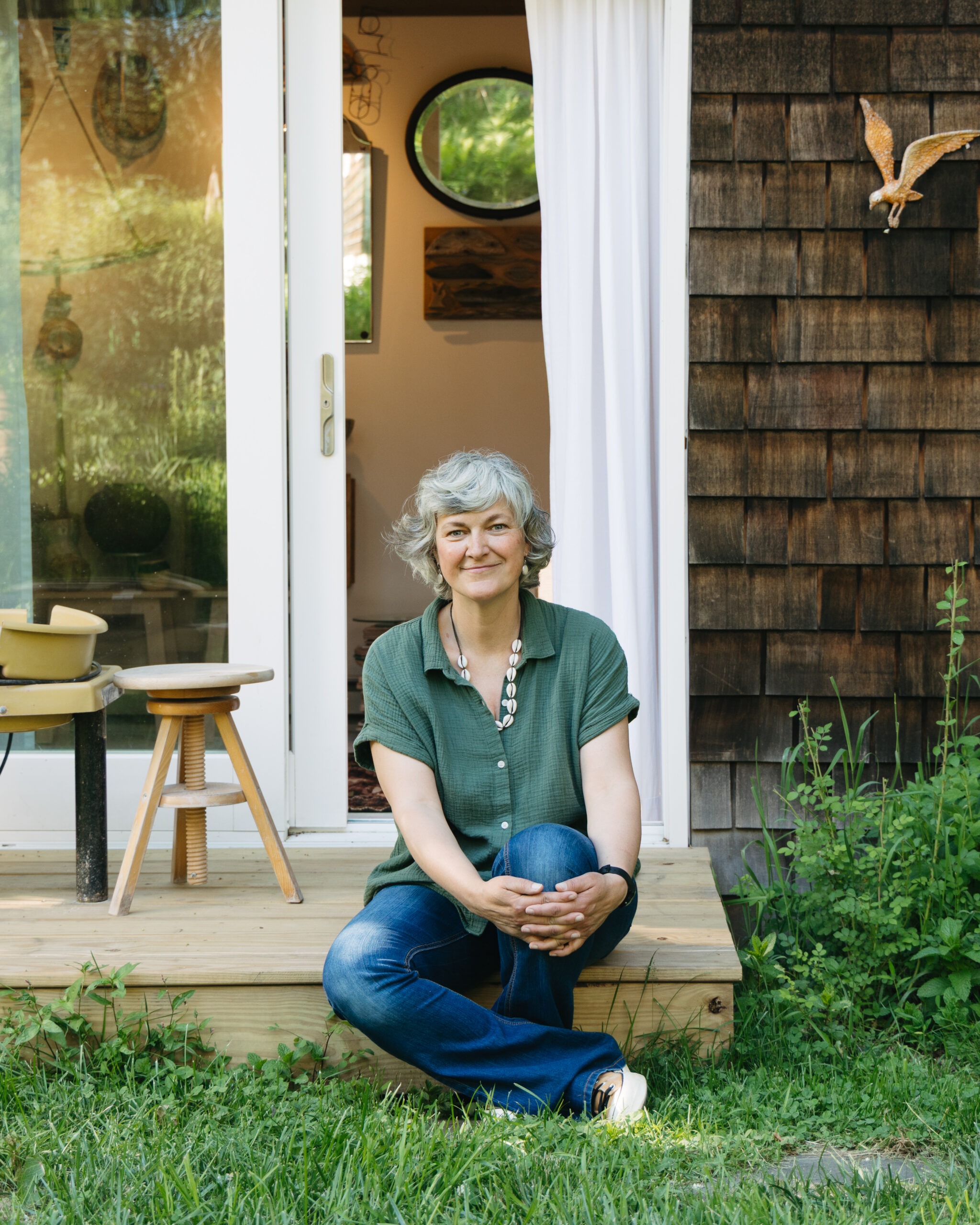
Lora Lomuscio stands in front of the glass doors that slide open to her studio, a one-room shed in the front yard of her Shelter Island home that’s big enough for two workbenches, a potter’s wheel and shelves full of ceramics. Every object in sight, including the studio, was made by her and by hand.
On a table just inside sits a sea-blue ceramic tangle that forms a shape similar to a nest or perhaps a bowl, but with a tug toward nature that’s unmistakable here and in much of her work.
“It came from looking at, and thinking about, coral or a cluster of barnacles or sponges; natural, organic forms that just grow,” she says. “I started with some holes and just kept going.”
Lomuscio is a serial creator who has designed lighting, made useful objects out of clay and educated students from elementary school to college with her two hands and her imagination. Connection is the true muse of her work, perhaps born of her own life’s struggles but always with the goal of finding the beauty, the peace and the thread that runs between us all in the here and now.
“The clay has its own voice, and it will tell you what it wants,” she says. “You might have an idea, and the clay will just start doing something else. You have to listen to the clay.”


“I stick to more neutral colors now. Bone or a brown clay that can come through the glaze,” says Lomuscio. “Maybe an accent or two of color, like the aqua or blue.” (Photo credit: Madison Fender)
The Art in Life
Lomuscio started out in upstate New York, where her parents, Richard Lomuscio and Karen Rensberger, taught at Hoosac, a preparatory school in Rensselaer County. During their years at Hoosac, the family were frequent visitors to Shelter Island, buying a house and finally moving there full-time in 1978.
“My parents purchased the house from my great-aunt and -uncle,” Lomuscio says. “The insulation was seaweed, and the windows were so old they were that kind of wobbly glass.”
The ‘80s were tumultuous years for the artist, whose mother died of breast cancer in 1983. When her father was asked to return to Hoosac School in the mid-80s, Lora was 12 and finished high school at Emma Willard in Troy, N.Y. It was there that she had her first intensive experience with ceramics and other tactile art forms — raku firing, weaving on large looms — although she had been creating art all her life.
When they moved back upstate, Richard Lomuscio held on to the Shelter Island house, and in 1987, Lora and her brother were both at home when a propane explosion blew the house off its foundation and destroyed it, leaving them unhurt but shaken.
With a B.A. in art history from Vassar, Lomuscio began looking for a way to use art in a useful way. She got a master’s in design from Pratt Institute in Brooklyn in 2001, taught design at Pratt and Parsons, worked in lighting design and exhibited her work in Milan and New York.


Lomuscio lives and works on Shelter Island, a place that holds both deep family ties and inspiration. (Photo credit: Madison Fender)
She married fellow Vassar student Bran Dougherty-Johnson, a motion graphic designer, and in 2006 they moved to a house they had built on Shelter Island with their children, Leonardo and Myla. Although she worked in many forms of media, Lomuscio began to focus on ceramics, getting involved with the Clay Art Guild of the Hamptons. She taught ceramics at the Shelter Island History Museum and ran a summer art camp at a studio and gallery in Greenport.
That experience resonated with her. So much so that, in 2023, Lomuscio began teaching early childhood education at the Hayground School in Bridgehampton.
“Kids are wonderful, their minds are open and they give me hope. I feel that I’m doing something important,” she says. “What more can I do for the world but be an example of someone who is kind and patient?”
No Spin, Just Listening
The fastest way to make pottery is with a wheel that spins the clay beneath your hands as you shape it. Lomuscio prefers hand building, coiling and slab building, techniques that are slower and more hands-on. She is drawn to forms inspired by nature that lean toward symmetry but are imperfect, like shells, leaves, stems, fruits and rocks, and a palette that echoes nature.
“I stick to more neutral colors now,” she says. “Bone, or a brown clay that can come through the glaze. Maybe an accent or two of color, like aqua or blue.”
Lomuscio believes in a kind of communication between her and the object she’s making, and that communication resonates far beyond the object at hand.
Interior designer Cristina Peffer sells Lomuscio’s work at her home design store, Ram Design Home on Bridge Street on Shelter Island, and has featured her in two exhibitions.


Part of Lomuscio’s’s never-ending fascination with ceramics is the unpredictability of the final outcome. (Photo credit: Madison Fender)
“Lora’s work appeals to me for so many reasons. I love her use of color, the way she shapes things, and the earthy finishes that give her pieces so much depth, along with the fact that so much of what she makes is truly functional while still feeling like art, including her lamps,” Peffer says. “Everything she does — from vases and bowls to lighting — has a clear point of view, and you can always tell it’s made by her. That kind of authorship is rare, and it’s why people actively collect her work and continue to seek it out.”
Clay, which starts out wet, gets drier and more stable with each stage of the process. “The clay is alive at the early steps, when you are forming it,” Lomuscio says. “In each stage, you lose something of the vitality of the raw clay, but you get something useful.”
Once the object is shaped and dried, it’s ready for glazing in the kiln, an unpredictable process that changes the color and texture of the piece with extreme heat. Lomuscio says, “You never know. That’s the magic and the beauty of ceramics. You let it go out of your own hands into the kiln.”
When she signs an object she makes, whether it’s a vase, platter, cup or dish, her mark usually includes a sun or stars.
“Everything in the world is made up of the same essential elements,” she says. “It goes back to that idea that we are all stardust, and the kiln is a small-scale version of the Big Bang.”
The distinct lack of preciousness in her art and craft, her view of creating art that links it to the very beginning of matter, is what makes it so special; the key that opens a perspective that art indeed can be useful and an integrated, beautiful part of daily life.