Arriving south on North Sea Road, it is entirely possible to blink and miss the Clamman Seafood Market, a low, tidy box of a building painted driftwood gray. But if you believe that big things come in small packages, such as the bivalve that is its namesake, there’s an abundance of treasure to be found here — including the shop’s origin story, the family who built it and the matriarch who keeps it alive and well to this day.
Clamman owner Jean Mackenzie couldn’t have known this was her destiny nearly 50 years ago or that she’d find herself in the flow of small-business ownership, trading her nursing scrubs for a life saturated by sea creatures. But one look at Paul Koster, the man who would become her future partner in life and business, at a party in the early ‘80s changed everything. Together, they’d turn his burgeoning swimmy side hustle — and the nickname he was dubbed by locals because of it — into a business that has stood the test of time and tide. And Southampton is all the better for it.


Longtime Clamman employee Chris Dubritz shucks clams while Jean picks up an order from the kitchen at Southampton’s Clamman. (Photo credit: Doug Young)
A Long and Winding Road to Southampton
While not everyone has a good meet-cute story, Jean felt that proverbial bolt of lightning the very first time she laid eyes on Paul at a party in Manhattan: quick and absolutely immediate. But the circuitous route she took to get there was far less direct than the ride she hitched with a friend from Southampton to attend the fated fête in SoHo.
“I’m a Jersey girl born and raised in Hasbrouck Heights, where Frank Sinatra kept his airplane. Burt Bacharach wrote a song about Hasbrouck Heights,” says Jean. “It was a bedroom community of Manhattan.”
But in the foundation-shaking tail end of the 1960s, it was one that wasn’t big enough for her dreams and curiosity about the world. Jean hitchhiked across the country, finding adventure in the music, protests and energy of the era. Eventually, she made her way back to the East Coast, finding a job as a secretary at Paine Webber and living in what she calls a “really deadbeat place on Avenue D.”
She had ambitions beyond the typing pool, and when she was told in no uncertain terms there was nowhere for a woman to grow at the investment bank, she found another job that rewarded her hard work and chutzpah. After another year as a secretary at the now-defunct brokerage firm Hayden, Stone & Co., she entered the training program to become a commodities broker, working on the exciting trading floor for the next decade until she saved enough money to embark on her next dream: nursing school.
“I really wanted to be a nurse all my life, since I was a little girl. I used to read [the book series] Cherry Ames, Student Nurse, she laughs. She took the money she saved as a broker and enrolled at Pace University, where she got her nursing degree. At night, she waited tables at a restaurant called J.P.’s on First Avenue, a hot spot for big-name visiting musicians like Mick Jagger and Billy Joel, not to mention a lucrative (and fun) counterpoint to the hard work of her studies.
Jean befriended another waitress who happened to be from a little place called East Hampton. After much cajoling, she convinced Jean to come out and visit.
“She kept saying to me, ‘You’ve got to come out to my house. I live in East Hampton in Long Island.’ I go, ‘Where’s that? Long Island? It’s all concrete!’ My family went to Long Island every year for Christmas my whole childhood, and all I knew about it was you go through the Midtown Tunnel, and you get off and all it is are cemeteries and these houses that are all attached,” she says. “So she convinced me and we’re driving out and I’m looking out the window and I’m going, ‘Oh! It’s grass and fields.’ I had no clue. I loved it.”
After graduating from nursing school, Jean got a job at Southampton Hospital and moved out east. Not long after, that same friend invited her to a birthday party in the city for a chef who was originally from the East End. She decided to tag along and, soon after arriving, spied Paul — a tall drink of water with a great smile, a giant laugh and a friendly demeaner — and she couldn’t take her eyes off him.
“I said to my friend, ‘Who’s that guy over there in the blue blazer?’ And she goes, ‘Oh, just some farmer from Southampton,’” Jean says. “I thought he was very handsome, so I struck up a conversation with him and I gave him my phone number.”
Weeks later, Jean’s friend rang her to say she’d just spied the cute guy she’d met at the party hanging out at the old Sea Wolf in East Hampton. She seized the moment and hustled over.
“I found him there and said, ‘Hey, how are you?’ and that was it,” she remembers.
From Farmer to Clamman
Paul was working in agriculture but found a little side work with all the baymen he knew who didn’t have time to sell their wares to the local restaurants that didn’t have time to hunt them down. When chefs and kitchen staff saw him coming, a common refrain rang out: “The clam man is here!” The name stuck.
Jean and Paul opened their first shop — wholesale clams, lobsters and fish with just a little bit of retail, selling cooked lobsters and lobster salads to those in the know — when the old Cockles and Mussels fish store on Montauk Highway became vacant in 1982. Jean was about to give birth to their first child, Mackenzie. In 1983, she set nursing aside and went to work for the family business.
Within a few years, two more shops would enter the fold: one on Jagger Lane and the current (and now only) store on North Sea Road, each one coinciding neatly with the birth of each of the Kosters’ children: Roxanne in 1984 and Cutter in 1986.
“I wasn’t a fish person. I ran the books,” says Jean. “I never even ate a lobster or a clam until I met [Paul]. My mother would make filet of sole every Friday night — that was all the fish I ate. The first time I saw a shark be dragged into that little store from the door all the way to the other side of the building I said, ‘Where’d that come from?’ And Paul goes, ‘The ocean!’”
For over a decade, the family worked together, building the business through Paul’s relationships with baymen, chefs and restaurant owners, and in the 1990s even starting what became a popular catering piece of their foray into fish. Things were humming along; the little middle-man clam shuffle had turned into a respected local fishmonger with deep ties to the community.
On the evening of Wednesday, March 15, 2000, Jean and Paul got the opportunity for a rare dinner date on their own. Jean waited for her husband to return home from work for their night on the town, but he never arrived. Late that afternoon, Paul had been killed in a tragic accident when, according to a Southampton Press article from March 23, 2000, he lost control of the front-end loader he was operating and it toppled down an embankment in North Sea. He was only 51.
“I was at home, getting ready to go out to dinner and he never came back. He was just down the road,” Jean remembers.
For days, the shock of Paul’s loss was numbing, reverberating throughout the community at large and with the most jolting fault line right underneath their home. Jean’s husband was a man larger than life. The tributes poured in from friends and relatives: memories of his enormous, boisterous laugh; his hijinks; his love for his family. His big, loving personality filled the spaces of their world, and for days Jean sat in their home, not knowing how to fill them. And then the phone rang.
“It was one of the guys that works here, and he goes, ‘Who’s going to come down here and tell us what to do?’” Jean says. “So, I went to the shop and I walked in and I just said to everybody, okay, we just have to make sure that we have fresh fish to sell; that’s what we’ve got to do, right?”
Everyone pulled together. Jean and the kids, the staff, the community. An older digger helped her keep the clam room organized by date. Another would come down and help Jean go through the fish when deliveries came, teaching her to identify what was what. Another helped her keep the lobster tank running, making sure the filters and pumps were working as they should.
On one of her first days stepping into the role of solo shop owner, the phone rang. On the line was a fisherman from New England who Paul had worked with. He had 600 pounds of cod to offer.
“He said to me that Paul always bought everything he caught; did I want it? You know, I was like, oh! Six-hundred pounds? I hung up the phone and I sat there with my head in my hands for a minute. And then I thought to myself, this is a commodity. I’m going to take delivery and I have to sell it, just like the gold market I used to work in as a broker.”
She called every fish market she knew and sold 500 pounds of the haul, keeping 100 for the shop, and it began to dawn on her: Maybe, just maybe, she was better at this then she thought.


Handling the catering end of the business, Jean’s daughter Mackenzie oversees everything from elegant parties to traditional beach-bound clam bakes. (Photo credit: Doug Young)
Shore Things
While the North Sea Road spot is the remaining brick and mortar of the three, this tiny but mighty business is firmly anchored in the fabric of Southampton Town. The wholesale portion has been mostly swapped for a swift retail operation, cases neatly filled with freshly fileted cuts of black sea bass, tuna, swordfish, snapper, fluke; stainless-steel trays abundant with oysters, mussels and, of course, clams. A pretty little white and blue rowboat serves as a whole fish station, filled with all sorts of fresh, yet-to-be fileted fish.
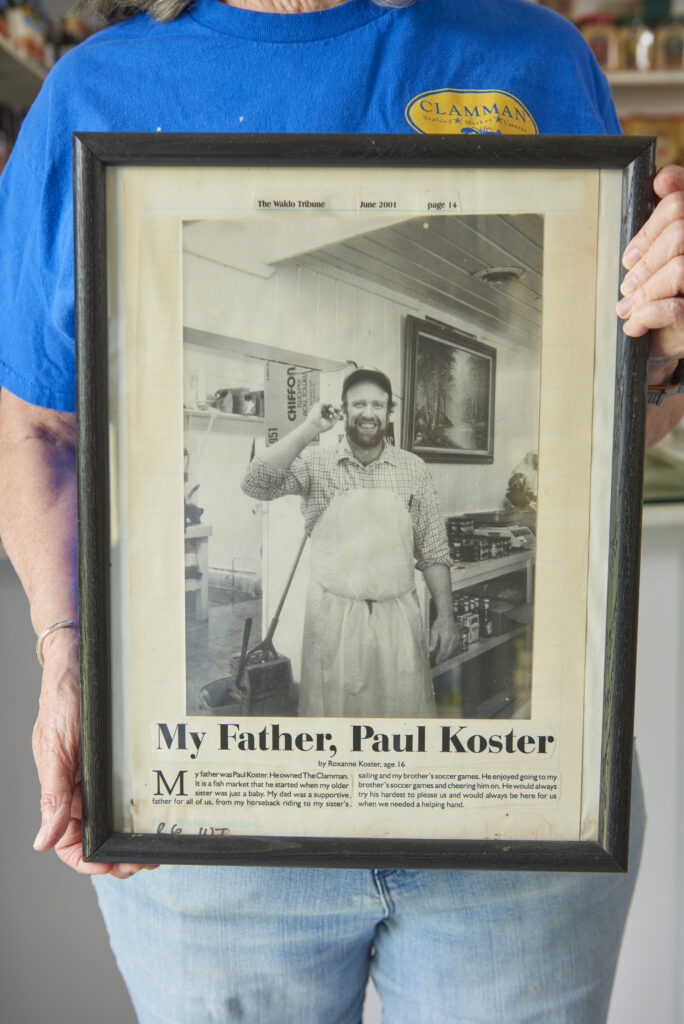
Opposite the broad fish cases are a series of refrigerators with grab-and-go soups, dips, sauces, Crimson Bay cans of crab and a host of other edible accoutrements, like miso paste and butter with which to make a fine meal. On the wall, just inside the front door, hang several framed pictures: an illustration of Paul; an article about Jean and Paul in The Waldo Tribune a year after his passing; and an essay written by their daughter Roxanne about her dad, also featured in The Waldo, when she was just 16. It features a large photo of a grinning Paul clad in an apron and baseball cap, almost like he’s keeping watch over the shop and his brood.
In the early days after Paul’s passing, Jean, who hadn’t worked day-to-day in the shop before, faced a steep learning curve. But as she had done many times before, she rose to meet the challenge.
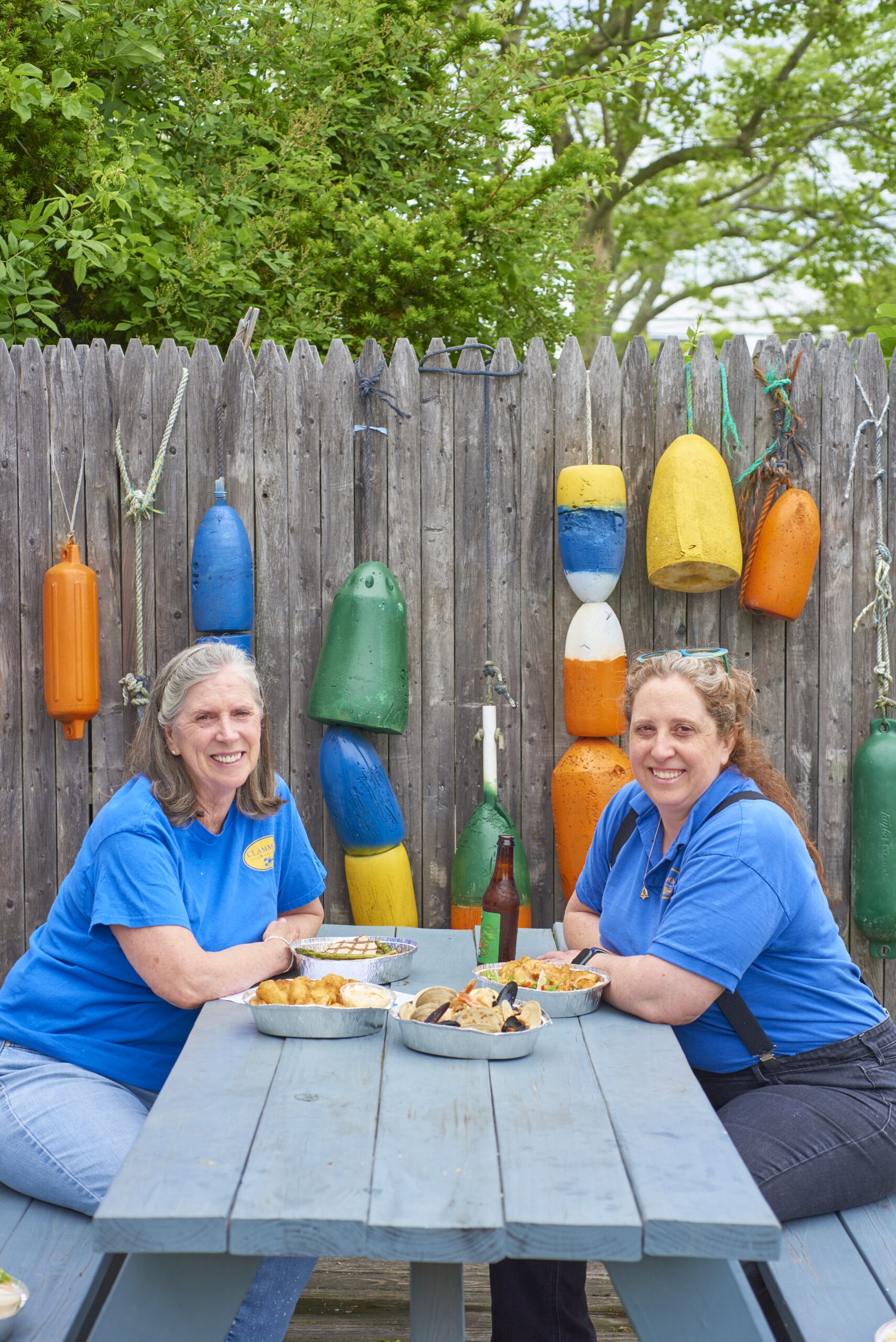
Today, Clamman has become so much more than the sum of its original parts. Rimming the flat roof line on the shop’s exterior is a series of pretty hand-painted square tiles festooned with fish mid-swim; to the left of the front door is a large painting of a fisherman pulling in his haul from a wooden boat in choppy waters. All of them were gifts from family friend and artist Paton Miller. Two picnic tables are an easygoing respite for happy, hungry customers grabbing po’ boys or buckets of mussels or filling up fisherman’s platters. Just to the right of the parking lot is Peconic Prime Meats, a convenient and convivial situation of the surf-and-turf kind.
Daughter Mackenzie runs the catering wing of the business, working side by side with her mom and handling everything from dinners to clambakes on the beach to anything else customers can throw her way, enjoying the logistical challenge that catering demands. Occasionally, her brother Cutter, now a local real estate agent with Corcoran, comes down to keep his fileting skills sharp, helping out the family when need be.
The same year her husband passed, Jean started a not-for-profit in his name, raising funds every year through the Paul Koster Foundation’s annual spring benefit. It rewards each recipient with a $4,000 scholarship toward studies at a university, junior college or trade school for graduating seniors from the villages and hamlets within Southampton Town.
Like the nature of the shop, the fishing industry has changed, too, with many longtime older fishermen having hung up their rod and reels. But for Jean and her crew, it’s all part of steering the ship.
“I still have the baymen that come, yeah, I buy all my clams from the diggers, and I have several diggers that bring their clams to the door still,” she says, gingerly taking a bite from a plate of salmon. “We just have to roll with the punches.”