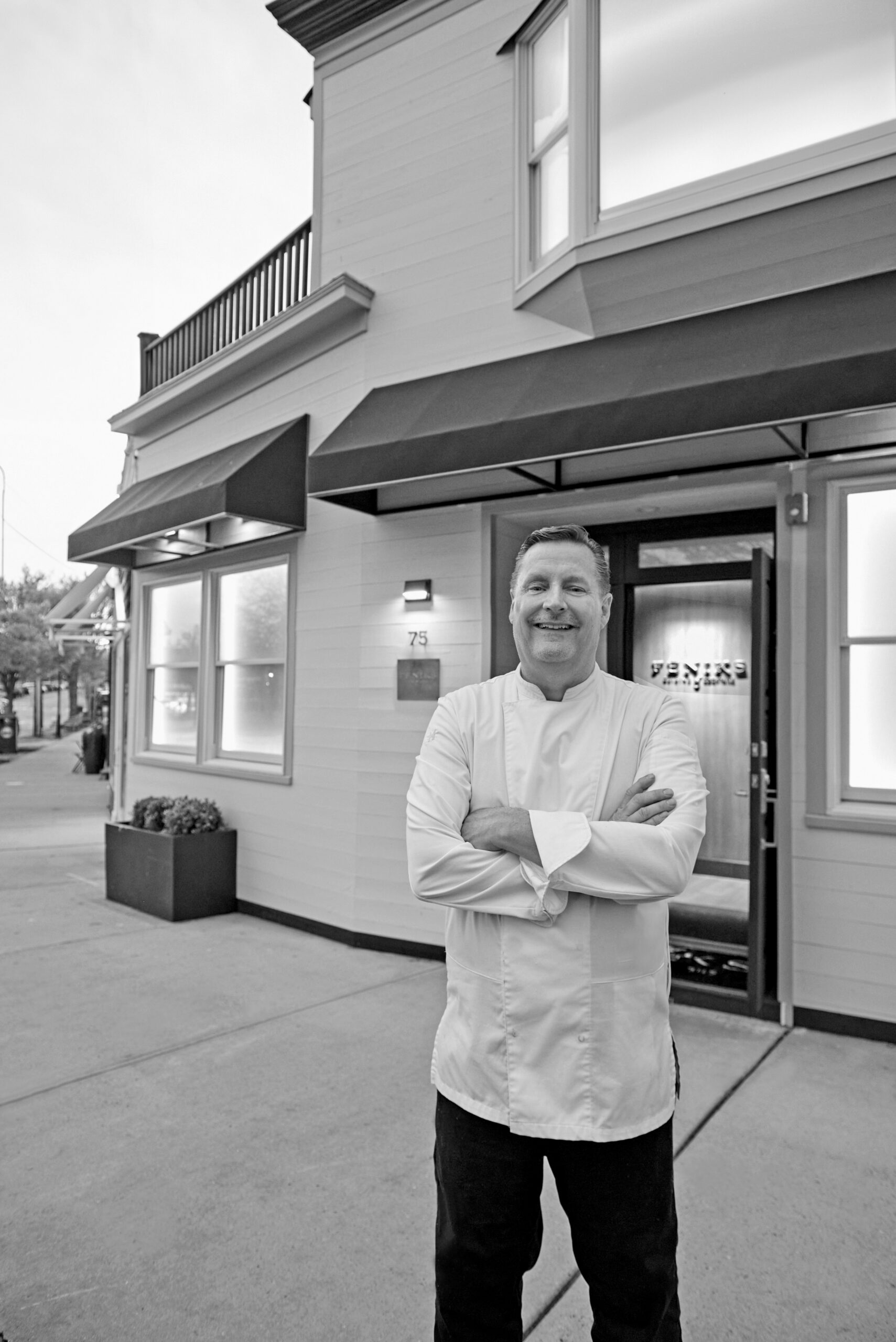
Veteran Southampton chef Douglas Gulija didn’t think he’d be at the helm of a new restaurant at this stage of his life.
When his tenure as chef and owner at the Plaza Café was set to come to an end in the middle of 2025 his future, as he saw it, seemed unsettled and unstable. Located in the Southampton Inn property just off Hill Street, Plaza Café was one of the village’s fine-dining gems, a place where Gulija’s culinary talents were expressed and ultimately revered by East End diners for three decades.
But he didn’t feel finished. So instead of packing up his knives and riding off into the sweet, albeit forced, sunset of retirement, Gulija shifted his efforts to another restaurant just down the block on Jobs Lane.
If you’re inclined to quip that the phoenix rises from the ashes, well, there is certainly some truth to that flame-licked symbolism. But for Gulija, the real fire that took flight from his return to the kitchen at Southampton’s fine-dining destination Fēniks is pure and simple: You can’t keep a great chef down.
A new family business
Not long ago, Gulija’s cousin the late Emil “Skip” Norsic, who died in December 2025 — shortly after Fēniks opened its doors in September — had purchased the space at 75 Jobs Lane. It formerly housed Le Chef, a longstanding bistro and institution in its own right for 40 years. After buying the property from longtime owners Frank and Amy Lenahan in January 2024 for $2.3 million, Norsic began funding an extensive year-and-a-half-long renovation of the 100-plus-year-old building, reimagining the space and creating a two-story fine-dining establishment unlike any found across the Hamptons.


Fēniks brings elegant eating to Southampton, from chef-owner Douglas Gulija’s outstanding dishes to the gorgeous interiors. “People do a double take,” says Gulija. “they think they walked into the wrong building .” (Photo credit: Doug Young)
Norsic, a longtime pillar of the community beloved for his humble, no-frills attitude and generous nature, had sold his family’s carting company, Emil Norsic and Son, in 2022. And while passing down his third generation-owned family business to a younger relative wasn’t in the cards, continuing his family’s legacy was. Only in this scenario, it would be with his talented cousin in the form of a new, state-of-the-art dining destination that Gulija would helm.
“I just looked at him and said, ‘I hope I turn out to be half the man you are,’” Gulija says of his late family member. “And he just looked at me and said, ‘You will. That’s why I did this with you, because you needed a fresh start.’”
Late last summer, the pair opened Fēniks. Its name, the Croatian spelling of the mythical bird phoenix, honors their shared Croatian ancestry and symbolizes rebirth and renewal. It was the fulfillment of Norsic’s three dying wishes: that his hometown of Southampton receive a stunningly unique fine-dining spot, that the Jobs Lane location continued to operate as a restaurant and, above all, that it provided a new culinary chapter for Gulija.
A Restaurant’s Renaissance
Initially, when he learned that Norsic had purchased the Le Chef space, Gulija didn’t think it was going to be as grand an endeavor as it became.
“I thought we were coming here to take Le Chef and tighten it up,” he says. “I knew I wasn’t going to do a bistro because the numbers didn’t make sense, but I didn’t think we were going to do this,” he says, stretching his arms and gesturing to the restaurant’s glamourous interiors.
A noticeable departure from the typical resort-themed dining spots ubiquitous throughout the East End, as well as the much more casual vibe of the building’s previous iteration, stepping into Fēniks is comparable to setting foot into the swankiest, most sophisticated eateries found in affluent areas of Manhattan. It’s fresh and clean, with a modern yet soft chicness and inviting warmth that immediately drowns out noise from the street and evokes a visceral sense of calming elegance.
Guests enter through a solid, coal-colored door subtly marked by a small bronze phoenix, while a plaque bearing the restaurant’s name sits to the left on the building’s white facade.
Designed by Dallago Associates, a hospitality design firm based in East Rockaway, earthy tones of taupe, lush cream and silver-flecked charcoal run throughout the space, broken up by glowing wall sconces and details of glimmering bronze and muted olive-gold.
Across from the entrance is a gray staircase partially enclosed by glass that leads up to the lounge; the 20-seat dining room sits to the right. Bottles of wine are tidily stored and displayed on sections of the dining room walls as well as below the stairs, emitting a gentle glow. Tables are exquisitely set with freshly pressed white linens, polished silver and sparkling glassware.


Fēniks is outfitted with a 20-seat dining room offering an elegant a la carte menu, a six-seat chef’s counter where an eight-course tasting menu is served, and an upstairs lounge offering cocktails and slightly more casual bites. (Photo credit: Doug Young)
Upstairs, in the aptly named “Skip’s Lounge,” an upholstered, mocha-colored, L-shaped banquette set with at least a dozen deeper-hued throw pillows is situated underneath a gold-fringe chandelier. The space is anchored by a large dark-brown coffee table set simply with a bouquet of pink, white and green flowers bookended by a pair of small table lamps. Tucked behind, on the other side of a partially mirrored wall, is the restaurant’s neatly stocked service bar. Across from the banquette are a pair of small, round, white-topped tables, each set with a pair of plum-hued bucket-seat chairs. Two more white linen-topped tables can be found across the mezzanine, on the other side of another chandelier, only this one extends down below the second floor and is embellished with at least two dozen luminous baubles.
“People do a double take. They think they walked into the wrong building. I hear it probably, no exaggeration, a half a dozen times a week,” Gulija says. “One time, I was cooking behind the counter and this guy walks in and goes, ‘I didn’t know this was going to be like Park Avenue.’ Then he left! He went home and got a jacket and tie because he felt bad being in a polo shirt and jeans. And when he walked back in, he said, ‘We needed this.’”
Honoring a Culinary Legacy
Toward the back at Fēniks is a glossy black marble-topped chef’s counter adorned with plush, sea-blue clubby bar chairs. Here, Gulija curates, prepares and personally serves eight-course tasting menus for up to six people. The counter overlooks an open kitchen anchored by a state-of-the-art, bespoke Athanor cooking suite, a specialized, industrial-grade French stove with multiple cooking stations.
“Everything builds around that oven. I had worked on one in Paris and I always said, ‘One day I’m going to work on a suite rather than a traditional American line.’ So Skip goes, ‘Let’s get one,’ and we start pricing them in and of course they’re in the stratosphere, but he wanted one,” Gulija remembers with a smile. “And then I get a call from [chef] Daniel [Boulud] and he says, ‘I hear you’re looking at the suite. You talk to my friend from Athanor.’ He acted like I didn’t know who he was; meanwhile, I got 10 cookbooks of his staring me in the face.”
Decades earlier, Gulija had staged at Restaurant Daniel, Boulud’s flagship eatery in Manhattan. The oven he has at Fēniks is the same kind Boulud uses.
“He’s got four or five of them that kind of come to a triangle in the kitchen. And I ended up buying one of those. The deal was that if I went with this instead of Heston, Daniel would come out and do a guest chef experience,” Gulija recalls with a laugh. “I got to remind them about that. One of these days I’m going to get him here because I want to steal some ideas.
Standing on Shoulders to Raise Up Others
For the menu at Fēniks, Gulija took his award-winning signature style of cooking that he nurtured at Plaza Cafē and modernized it, drawing inspiration from some of his renowned contemporaries from around the world. Gulija’s classic French training has brought him to a place where he reinvents classics by doing less with them, allowing his craft and the quality of the ingredients to shine through.


Armed with a tiny but mighty staff, including sous chef Mark Fasciana, pastry chef Imaan Khaild, chef de cuisine Bradley Drubych and general manager Xavier Cridland, Gulija’s culinary vision and drive for exquisite service is not only deftly executed, but collectively nurtured. (Photo credit: Doug Young)
Offering a heavily seafood-centric dinner menu, Japanese, French and New American preparations are expertly fused, resulting in satiating and sophisticated plates. In the lounge, handcrafted cocktails are served along with a slightly more casual small-plates menu, which includes samples of tuna poke nachos, a Kobe beef slider and mahi-mahi tacos.
“We’re not at that point yet, but we will do a vegetarian tasting at the counter,” he says. It’s a hat tip to Norsic, who was a vegetarian.
Gulija is inspired by the likes of Michelin star-holding chefs Daniel Humm of Eleven Madison Park in New York and Alain Passard of L’Apèrge in Paris, both of whom put vegetables at the center of their respective menus and food philosophies. “What they did, that’s a totally different realm,” Gulija says. “I was just so blown away that they would make that jump to do that. But it’s reminded me that you can change as you keep going. That’s important to remember. It’s certainly what’s happened here.
Testament to the idea of change, being at the helm at Fēniks provides Gulija with an opportunity to not only reinvent his culinary career but the careers of his employees, too. Every night during dinner service while Gulija is manning the chef’s counter, at least three people support him in the kitchen — most notably his pastry chef, sous chef and chef de cuisine, among other staff in the tiny but mighty team.
“Yeah, I’m the chef, but the reality of it is, if I don’t show up, the show will go on. But if my dishwasher doesn’t show up, we’re screwed. It’s so cool to be humble,” he says. “I’m going to own this place in the sense that I’m going to take responsibility for it, but I’m not going to own it in the sense where I’m going to take all the credit. I want to see people come out of this place and, someday, to get a place of their own. And, maybe, to say they learned something from me to help them get it.”