
Breathe
And Then SAAM: Telling the stories of black pioneers at Southampton African American Museum
Pyrrhus Concer was born in 1814 to a family of Black indentured servants.
Historical accounts say he was sold into enslavement at age 5, gained his freedom at 26 and took to the seas as a crewman aboard a whaling vessel. Concer later returned to Southampton, bought a piece of land in 1891 to build a house, and began the first ferry boat service across Lake Agawam. Today, a blue-and-gold sign marks the site of his torn-down homestead and a memorial stands at his gravesite in Southampton’s North End Graveyard.
Like Concer, some of Southampton’s earliest and most prominent Black residents were trailblazers of their time, earning their place in history. Preserving that history, however, has become the life’s work of Brenda Simmons, co-founder of Southampton African American Museum.
Here, their stories are told through art, artifacts and animation. Concer’s tale is just one of dozens of examples of determination and triumph immortalized at SAAM. And intertwined with these narratives is Simmons’s own story of perseverance.
It Takes a (Southampton) Village
The founding director and president of SAAM, Simmons spent 16 long years bringing it to completion. The effort included many hands that helped along the way, including Gloria Cannon and her daughter, Bonnie Cannon, co-founders with Simmons who stepped away from the project in 2011. After that, more grassroots energy and assistance was found in Nancy Stevens-Smith, Cheryl Buck and Charles Certain. For Simmons and these enterprising, won’t-take-no-for-an-answer community members, there was much to do, starting with the initial heavy lift of convincing the village and town in 2006 to buy the property at 245 North Sea Road in Southampton with Community Preservation Fund money. Once that was settled, Simmons had to wear multiple hats (and still does), working closely with friends and volunteers, vetting and securing an architect and multiple contractors, conceiving and planning exhibits, fundraising for the museum’s future, and all the details in between.
Setbacks were part of her plight, too. In 2019, when an unnamed contractor’s defective workmanship was discovered, Simmons says she “had to start all over again.” Then the Covid-19 pandemic paused the project once more. Finally, at a gathering on June 18, 2021, she and a crowd of elected officials and supporters cut the ribbon and began welcoming visitors. Fittingly, on the next day — Juneteenth, the holiday that commemorates the official end of slavery in the United States in 1865 — Simmons and her fellow founders, volunteers, stakeholders and partners in seeing SAAM to fruition gathered for a celebratory barbecue complete with musical performances and an awful lot of joy.
Simmons is a born-and-bred resident of Southampton Village, where she raised her kids and worked as the assistant to Mayor Mark Epley for 11 years. She also loves to travel the world, and when she tells others where she’s from, people invariably (inarguably, shockingly) ask: “There are Black people in Southampton?” Invariably she tells them yes, indeed there are.
It is exactly the kind of inquiry (and so much more at this point in history, when recent governing figures are continually erasing the Black experience from national museums, monuments and honorary namings) that makes an institution like SAAM important.
Certainly, the Hamptons have a particular reputation — one of summer fun enjoyed in the salty breezes and sandy shores, but another that more often than not conjures images of wealthy white people in giant homes that cost more to build than most of us will earn in a lifetime.
“This isn’t just a museum,” says Simmons. “This used to be a Black community, this neighborhood. As much as it was a challenge to do this, I was determined to leave a legacy for our community here.”
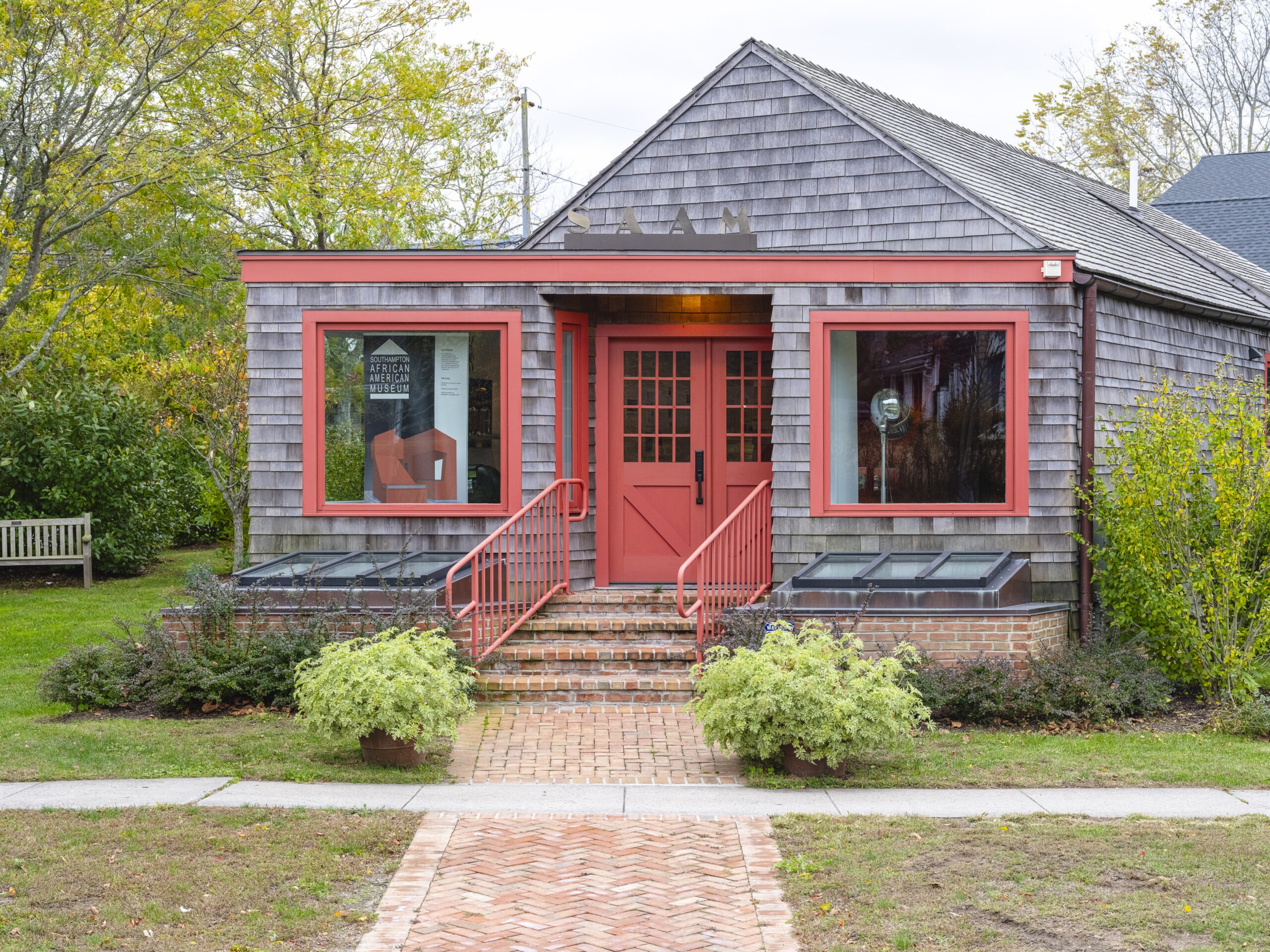
The petite, cedar-shingled building that houses SAAM was once owned by Emanuel Seymore, who in the Great Migration of the early 20th century left North Carolina for Southampton Village “and had the audacity to buy this property,” Simmons says. There, he built a barbershop and a beauty parlor, divided down the middle so that Black men and women could enjoy their own spaces in a time when they still weren’t very welcome elsewhere.


The history of the Southampton African American Museum building itself is part of the art project: It used to be a popular barber shop for Black residents of the area, serving as both a place to curate your coif and catch up on all the local buzz. Many artifacts on display are from the original mom-and-pop shop. (Photos by Jeremy Garretson)
One of Simmons’s aunts, Evelyn Baxter, worked as a beautician in the shop and went on to marry Seymore’s cousin.
The shop’s most recent iteration of barbering was Randy’s Barber Shop, run by Randy Conquest. He took over from Seymore in 1979 and cut both men’s and women’s hair there until he retired in 2006. Conquest is now 88 and still lives locally, Simmons happily reports.
Over the years the building fell into disrepair, and while Simmons was working for Mayor Epley, a letter crossed his desk indicating a teardown was on the table. She knew the real history. There was no way she was going to let it get demolished.
Designing a Future
One of Simmons’s first moves was to bring on an architect, Siamak Samii, a 30-year resident of Southampton Village who also sits on the board of directors of the Southampton Arts Center and is a former chairman of the village’s planning commission. He believed in the project as much as Simmons did.
“It’s a great asset for the community and a place for education going forward for the public,” says Samii. “Generations of African Americans here will know their history, and the rest of the community will know the history of African Americans. I think that history doesn’t belong to the past. It should be studied for the future.”
When he designed the façade of the SAAM building, Samii says, that philosophy was at the forefront of his mind. “You can’t just plop a modern building in the heart of a historic place, so I was sensitive to the context and I developed it in line with that for continuity of architecture in the village,” he says. “The exterior of it is more of a traditional structure, but if you go inside, it’s a completely modern layout.”
Indeed, the contemporary interior features exhibition spaces painted a shade of red as bold as Simmons’s original vision. A spotless glass case of antique barbering tools — scissors, brushes, combs, razorblades, Emanuel Seymore’s original barbering license and more — is a centerpiece thanks to the artifacts donated by Seymore’s grandchildren.
“They’d saved so many wonderful things,” Simmons says. There’s even a barber chair. Although it’s not Seymore’s original, it stands as a symbol of the community that once gathered here, and is now able to once again.


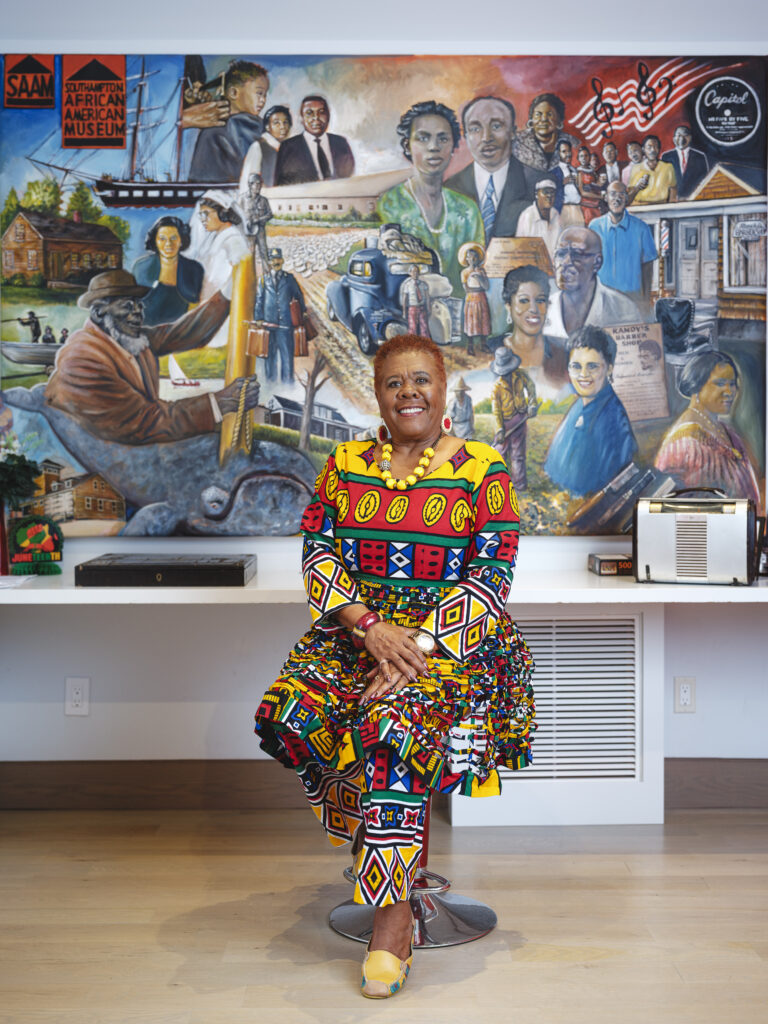
As the co-founder and current executive director of SAAM, Simmons and her team dovetail the woven stories of Southampton’s longstanding Black community with international art that looks to the future. “This isn’t just a museum,” says Simmons. “This used to be a Black community, this neighborhood.” (Photos by Jeremy Garretson)
Posters, pictures and paintings on the walls continue to tell the story of the African American barbering tradition in the United States leading up to, and also following, the Civil Rights movement.
A gallery in the basement hosts rotating shows, most recently a collection called “Beyond the Canvas,” a mixed-media series of portrayals of Black women’s faces by Indianapolis-based artist Shaunt’e Lewis.
One of the museum’s most striking features is an enormous mural by David Martine, a painter and historian from the Shinnecock Nation, that depicts major characters in local African American history. In addition to Concer and Seymore, he went on to illustrate several other key figures who arrived here during the Great Migration. Simmons speaks of them as if they are close friends still alive today.
“People came here with a serious purpose, to make things and do business,” she says, noting her own relatives traveled to the Bronx from Virginia during that historic era of movement before relocating to Southampton.
The Robert David Lion Gardiner Foundation funded the creation of an animated guided tour of the museum complete with actors portraying figures like Concer and Seymore to help visitors interpret the history.
SAAM, Simmons says, has been confirmed by researchers to be the first Black barbershop in U.S. history ever to be turned into a museum. It’s also the first African American heritage site to earn historic designation from Southampton Village’s Board of Architectural Review and Historic Preservation. How that came about is another feather in her cap.
As recording secretary to then-Mayor Epley and the village trustees, Simmons learned from the notes she was taking and began to study the village’s codebook. She learned the criteria for this special designation included possessing “special character or historic interest as part of the cultural, political, economic, or social history of the area” and representing “an established and familiar visual feature of the neighborhood due to its unique location or physical characteristics.”
Simmons began to gather interviews and research — including oral accounts from a singer and bandleader who had performed at a juke joint called Fives that once stood next door to the barbershop and beauty parlor — to successfully create a historic designation case for SAAM. The board voted “aye” in March 2008.


Exhibitions change seasonally, with an eye toward both presenting fine art, as well as the fine art of bringing to light issues of race. Simmons also created “The Everyday People Corner,” a monthly series where Black Southampton residents offer personal stories and anecdotes. (Photos by Jeremy Garretson)
When she says she poured years of blood, sweat and tears into SAAM, Simmons isn’t kidding. A peer in the world of South Fork historical societies, Dr. Georgette Grier-Key, the executive director of the Eastville Community Historical Society in Sag Harbor, bore witness to Simmons’s efforts.
“It’s an extraordinary feat that Brenda achieved. It took the strength of our ancestors to get this project to where it is now,” Dr. Grier-Key says. “It was one woman against all odds… She stepped up and made sure this happened. When you fall down, it’s how you get back up. You have to keep the faith and can’t lose your hope, and Brenda never lost hope in this project.”
