When a new hotel opens its doors, what’s inside is the typical focus: the interior design, bespoke high-thread-count linens, a much-anticipated in-house restaurant and plenty of sweet suite amenities, all designed to keep you securely ensconced on the inside looking out.
But in the Hamptons, where the area’s natural outdoor beauty is a large part of the draw, that seems like the wrong kind of business plan. Why trap visitors who just exorcised themselves from the clutches of urban confinement indoors, leaving them to their own devices for open-air pleasures? That’s what Three Ducks owners Elizabeth Bakhash and Randall Stone asked themselves — and then did just the opposite.
Seeing the Potential
Bakhash and Stone are former colleagues at the brand-building consultancy firm Lippincott whose friendship remained intact after they each left the company for different reasons — Bakhash to work for her family’s real estate firm, Kash Group, and Stone to start his own brand-building company, Emaz. But in the years that followed, when the two would meet to catch up, conversation often turned to a project they could potentially work on together one day.

Eventually, those talks became realized in the form of a charming but dated and overgrown little East End motel called the Seabreeze in Westhampton.
Both Bakhash and Stone had substantial experience enjoying the East End. Bakhash is a New York City native whose family had been summering at the Driftwood in Montauk since she was five. Stone, who was born in Oklahoma, moved to New York in 2000 and bought a home in Hampton Bays in 2007. Four years later, he and his wife settled in Remsenberg and began using their first house as a summer rental. Whenever they invited friends out east to visit during the summer, they’d direct them to the Seabreeze for lodging.
“It was the only place in town for friends to stay. It was always available and clean but there was nothing fancy about it,” Stone remembers. “But [my wife and I] always saw the potential. When it went on the market, that’s when I called Elizabeth. As soon as she came out she saw the potential too.”
But something was missing: connection to the outdoors. The little 12-room work-a-day motel was just that, a perfectly fine place to lay your head.
“This idea of being connected to the land, being part of the land, was inherent in the overall design concept,” says Stone.
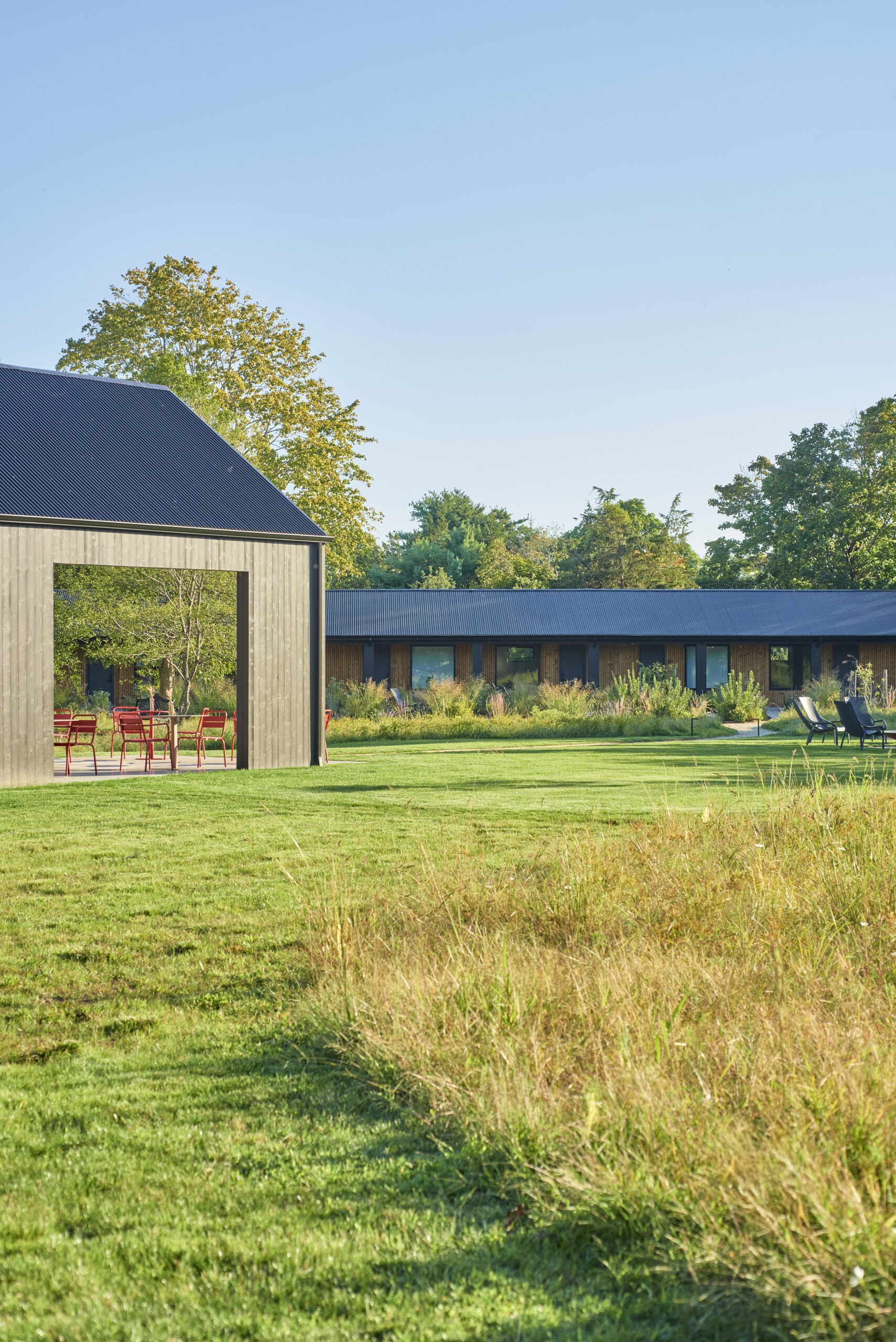
Since Stone is a trained architect, the friends turned business partners worked on design plans for Three Ducks themselves. The hotel’s 1 ½ acre parcel sits on a triangular intersection where Montauk Highway and Seabreeze Avenue meet, so Bakhash and Stone moved the hotel’s entrance from its original busy location to Seabreeze Avenue, which guides guests to a stunning, semi-open air gathering space called the Barn.
A multi-purpose covered structure that functions as a check-in area, lobby, gathering space and breakfast nook (with coffee and pastries supplied by Blue Duck Bakery), the Barn has tables and chairs and a little market stocked with food, drink and other wares of local purveyors.


“This idea of being connected to the land, being part of the land, was inherent in the overall design concept,” says co-owner Randall Stone. (Photos by Doug Young)
The main building’s original motel units were gut-renovated and parking was relocated, creating a buffer of garden space in between. And that’s where things really get interesting.
“The gardens just beyond the rooms are not segmented by hard lines or rectangular shapes,” Bakhash says. “They’re all these very circular shapes that separate each of the gardens. And then similarly, the shape of the lawn mimics that circular pattern, so everything is very organic down to every single detail here.”
If It Quacks Like a Duck
The thing that struck Bakhash, in particular, out of the gate about the property was the wild, albeit overgrown nature of the grounds. Peaceful and breezy, she loved the idea of retaining that spirit in a more thoughtful way with a landscaping plan that brought in native plants and pollinators and also added semi-private gardens outside each room, inviting guests to enjoy the open air and salt-tinged gentle breezes.
To help with this aspect, Bakhash and Stone hired Lauren Barry, owner of the landscape design firm Project Plant in Southold, on the North Fork. They showed Barry a rough schematic of what they were dreaming up for the property: an open grassy area with a firepit to roam and ramble upon and a meadow to catch the seaside breezes.
Barry assessed the grounds with a keen eye toward what could stay and what should go. “We made sure to keep some very cool, mature red cedars onsite,” she says. “They’re the only big, tall, structural [natural] components on the site. Plus, they’re native and provide great habitat.” Barry and her team cleaned up the old cedar growth and tangles of wild vines, spirea, burning bush and other invasive plantings.
“What I pitched to them was that I thought it would be great for each room to have a somewhat private courtyard space,” Barry says. “They had so much land to work with and I saw the potential to do that by means of designing garden ‘rooms’ for each room, essentially.”
While creating the overall landscape design, Barry, with input from Bakhash and Stone, carved out spaces for each room to have a private pathway and small outdoor seating area buffered by taller perennial plantings and grasses and shrubs, as well as garden areas with natural pollinators.
“Randall and Lizzie were really into having this bigger meadow area to walk through,” says Barry, “[but] meadows are hard to establish and take a lot of work — especially wildflower meadows, which can be very annual and look great in the beginning, but less so by August.”


Outdoor spaces, both public — like this communal fire pit — and private, like the individual room gardens shielded by natural elements, create a multitude of al fresco moments at Three Ducks. (Photos by Doug Young)
Instead, Barry advised creating a meadow from grasses that span seasons and require far less work to maintain. “The meadow is Little Blue Stem seed mixed with a few annuals like White Cosmo to make it have something that was flowering that first year before the Little Blue Stem was able to take hold,” Barry says. “Plus, I added Black Eyed Susan for a hint of wildflowers.”
To transition from the meadow and open grassy area to the little winding paths past the old cedar trees that lead to the courtyard gardens outside the rooms, Barry took gallon-sized pots of that same Little Blue Stem grass and scattered them throughout the leading pathways. The result is a slow, natural shift from one space to another.
Closer to the rooms, Barry used panicum virgatum (which can grow up to five feet), bayberry, beach plum, and flowering Amelanchier, also known as shadbush because the flowers tend pop when the shad, a migratory fish, are swimming up the Atlantic coast.
“So if you’re sitting in a chair reading a book, you’re not exposed,” Barry says.
Other smaller perennials, ferns and petite grasses dot the areas as well, all native — an aspect of tantamount importance for Bakhash and Stone.
Even when you’re indoors, the gardens factor prominently. “The windows in the rooms were much smaller before, so we reframed that and opened them to the widest possible space overlooking the gardens, and then we also put these permanent custom window benches in each of the rooms,” says Bakhash. “So you can actually sit there with a book and look out into the garden. And it’s quite peaceful.”
More local natural components can be found indoors, with fresh flowers supplied by Ocean Fog Farm in nearby Eastport adorning each unit.
Since they opened a year ago, Three Ducks has easily nestled into Westhampton. This year, Bakhash and Stone have plans to bring in more local charm and outdoor adventures for visitors, linking the hotel more deeply to the community. They’re supplying free bikes to hop on and beach passes for guests to head to Westhampton’s glorious big-wave coastline. Local guides are also now provided to enhance a visitor’s time in the area. And when you get back to the hotel, that nice firepit (with s’mores kits provided) waits for you to gather ‘round and talk over the day, the sound of those wild grasses rustling in the wind, and just appreciate the great outdoors.
“What Elizabeth talks a lot about — and it’s kind of fundamental to the [Three Ducks] concept — is where you spend your morning and your evenings, but the rest of the time you should be out in the community,” says Stone. “At Lippincott, we were in the experience innovation group and we were both educated and trained and knowledgeable of, like, what goes into making an experience. What are those signature moments? What is that journey that we’re trying to make? It all got to come together in this one project.”