Noyac resident Harold Thiers really likes flying planes.
In fact, it’s one of his great loves. And now, with the formation of his and business partner Tom Mastrianni’s new company, Twin Forks Simulation North America, so is creating life-like imitations of it.
“I’ve been flying flight simulators since 1987, when I was a young lad,” he says, noting his father took him and his brother, also a pilot, to air shows as kids. “It’s just an ingrained thing in our family. It was always a passion.”
For over three decades, Thiers has held a penchant for flying remote control planes, and subsequently crashing them. A lot. That was until 2020, when simulation got exceptionally good, due to the Microsoft Flight Simulator series, which created a digital twin of the Earth using photorealistic satellite imagery and AI to render a 1-to-1 scale, live 3D model of the planet. Because of that digital twin of the entire Earth, he says, “that was something that allowed us to fly around the entire world. So we did, and we added controls to it.”


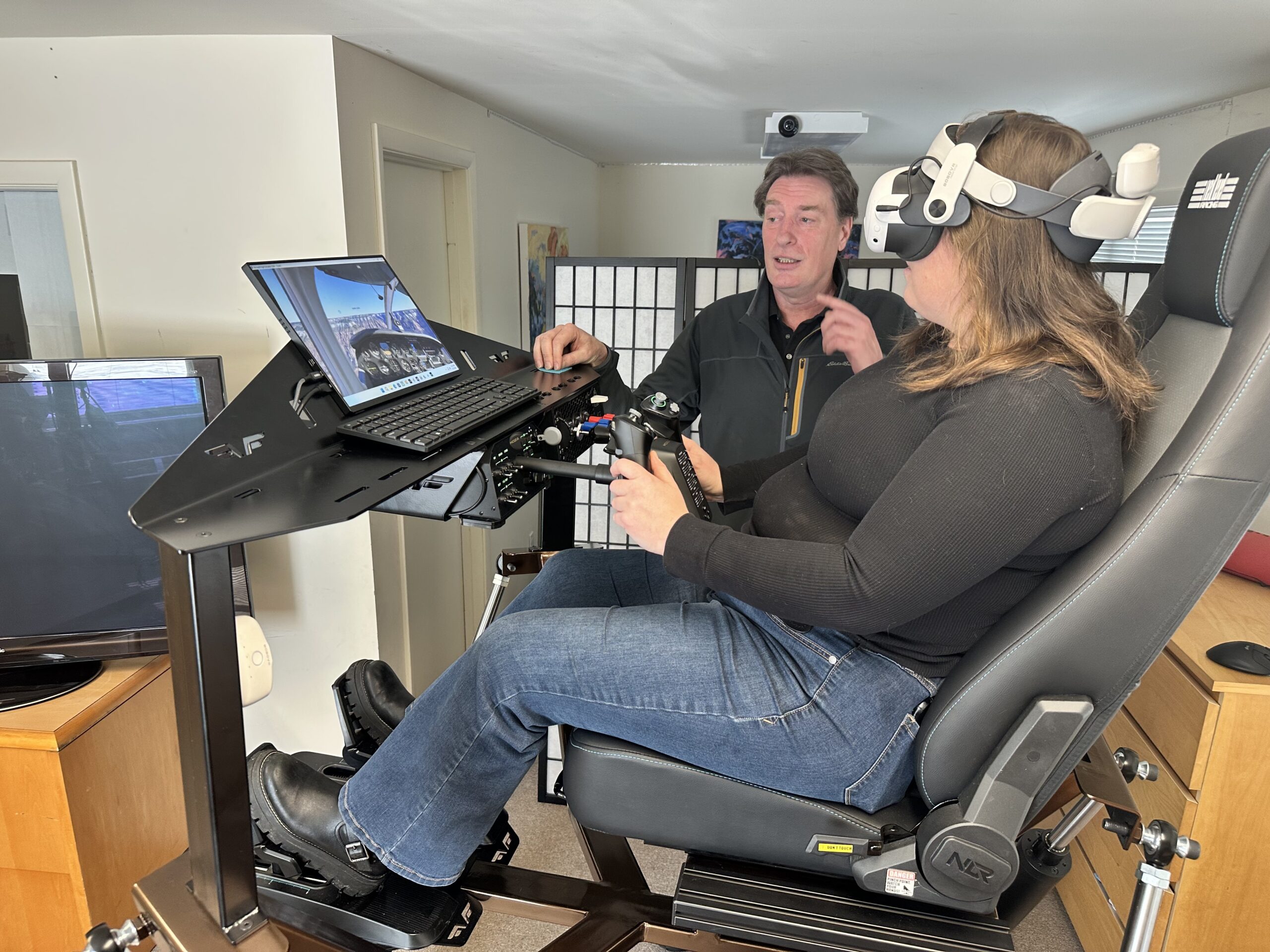
Sag Harbor resident Harold Thiers (standing) and his business partner Tom Mastrianni, founded Twin Forks Simulation about a year ago. (Photo credit: Emily Toy)
Seeking to build a totally immersive experience, Thiers began working on his own state-of-the-art flight simulator, adding replicas of physical controls one would find on a real airplane and adding a virtual reality headset that would allow fliers to travel all around the world while experiencing real-time weather.
The next step was to add motion. In 2023, he started extensively researching how to build his own flight simulator, looking to platforms developed and built by NASA as inspiration.
“I wanted that in my house,” he says of the large box-like flight simulators he was seeing from flight agencies around the world, while building several prototypes in his house and trying to figure out how to scale them down to a manageable size.
Thiers’ hand-made flight simulator is perhaps the closest thing to flying a real plane without actually doing it. It feels and looks very similar to sitting in a cockpit on a plane, especially once the headset is over the rider’s eyes. After a while, he was able to achieve the authentic, lifelike motion he was looking for. “The whole thing lifts you off the ground and it goes up and down about 400 millimeters of travel,” he says, noting it allows the rider to tilt 25 degrees to 30 degrees side to side, forward and backward. “It’s all six degrees of freedom,” he says.
Composed of a Stewart platform (a six-degree-of-freedom parallel manipulator consisting of a top plate connected to a base plate by six independently actuated legs) the bespoke simulators are customizable and, ultimately, all very unique, as they are intentionally built based on the customer’s wants and needs.
An ultra-realistic experience, the technology of the flight simulator can replicate all things associated with flying a plane, such as turbulence, updrafts and downdrafts. “You feel all of those experiences to the point that people who don’t like flying will be nervous in this thing,” he says. “It’s so real.”
And really special, too. So much so that Thiers wanted to share it with others and that’s where Mastrianni comes in. As president, designer and systems integrator at Extreme AVS, a Smithtown-based luxury smart-home company specializing in custom audio/visual automation, specifically within home theaters, Mastrianni was able to alert his clientele of the flight simulator, offering white-glove services to any fellow enthusiasts and hobbyists looking to create their own luxury motion rigs.
“I knew we had to share this with more people,” Thiers says, “and we had to figure out how we can commercialize this product. So, we started defining our standards and dimensions and looking at supply chain and all of these things to figure out how we could build a package that is a turnkey solution.”
Presently, there are only two rigs for people to play with: one at Thiers’s home in Sag Harbor and one at a showroom in Plainview. While deemed an entertaining luxury “toy,” the simulator is also a favorite among pilots, both former and present, from across the area, as it can simulate what it feel like to fly in a more complex aircraft.
“We haven’t given this experience to that many people,” Mastrianni says “We had about 45 or 50 pilots try it out so far, and they all loved it. We’ve got some great engineering behind it. We’ve got a great collaborative group between us all, and it’s really come together.”
“It’s an expensive product and, right now, it goes to people [who] can afford it want something nobody else has,” Thiers says. “But, it’s the ultimate in escapism. That’s really what we built.”
For more information (and to maybe take the rig out for a spin) email [email protected].