
Art is one of those things that you may not think about a whole lot unless it’s right in front of you.
At least that was the case for me, but luckily, my sister, Megan Toy, who studied art history in college and now manages Sag Harbor’s Grenning Gallery, does think about it. She thinks about it a lot, and it’s to my, and my family’s, benefit. She’s the main reason why there’s a lot of art in our home. Most of the walls in our house are adorned with unique original paintings or framed prints of familiar pieces, both of which she herself purchased and put there.
The only exception is this very large piece that hangs in our living room, on the wall space just above our couch. The painting, which just about takes up the whole six-foot wall, is a piece on loan from the gallery that we get to live with until it sells. I see it every day and we sit with it every night. It’s a calming, steady force that somehow both highlights and blends into the heart of our house.
Initially, when I was first in front of it, I thought it was a piece of art that was way too big and it didn’t make sense.
But now, I know if it weren’t there, I would really miss it and would have to figure out how (with Megan’s help) to replace it immediately. How would I do that? I’m glad you asked…
What is art?
The art world is a multi-billion-dollar industry.
According to the 2025 Art Basel and UBS Art Market Report—often considered as the most reliable indicator of the art market’s size and overall health—global market sales reached an estimated $57.5 billion in 2024 alone, with dealers reporting that 44% of their buyers were new to their businesses. The sheer volume of art being sold across the world is far greater now than it’s been at any point in human history, even amidst a challenging economic environment.
The financial reasoning behind buying art is easy to justify.

“Art is an asset class,” says Laura Grenning, owner of Grenning Gallery, and a former equity research analyst at Goldman Sachs. “You can buy equities, you can buy bonds, you can buy property, and you can buy collectibles. Art is considered a collectible, and those are supposed to be 5% [of your financial portfolio] because with the collectibles, their value does not shift or does not respond to the stock market or the bond market. It’s completely unrelated and that makes your wealth much, much more stable.”
That’s sound advice from a wealth management standpoint, but if you’re like most people who have tightly monitored expendable income, let alone the kind that affords the purchase of expensive pieces of art, you may be at a loss for reasons to purchase any art at all.
However, Grenning and a few other locally based art dealers, gallerists and art advisors make the case for buying and collecting art, even if you aren’t wealthy.
Whether it’s for investment, legacy or enrichment, the business of buying art, even here in the securely affluent Hamptons, can be an affordable experience that’s heavily reliant on the very un-commodified resource of human interaction and connectedness.
The act of buying art, and the reasons why to do it, are largely an emotional endeavor. The first and most important reason to buy art is simple, and somewhat obvious: You buy it because you love it.
“The first thing, I would say, is you have to love it,” Toy says. “If you see something and it gets you excited, makes you feel nostalgic, makes you feel at ease, makes you feel hopeful, inspired, whatever that feeling is, if a piece of art touches you, then it may very well be worth buying.”
That’s actually how it started for Grenning herself, who as a child convinced her mother to buy prints of some of her favorite pieces simply because she loved them.
“I made her buy little prints when I was in first and second grade at the National Gallery [of Art, in Washington D.C.] and it turns out it was prints of Goya and Hudson Valley painter Thomas Cole,” she says. “And those little prints I had with me well into adulthood, even when I moved to Hong Kong [as a senior stock analyst] I’ve kept certain pieces of art because they moved me so deeply and I had to have them.”
Finding what you like
Identifying the type of art you might like to invest in may not necessarily be an overwhelmingly visceral experience. For many, even the pros, it takes dedication, research and, in most cases, a bit of time.
“I think the first thing I would tell someone to do is to look constantly, see everything you can see,” says Damien Roman, director of Southampton’s newly opened Slattery Gallery on Jobs Lane. “Go to all the museum exhibitions, go to all the gallery shows, go to as many art fairs as possible. Possibly even spend a full year looking before you buy anything. I think that’s the first good step, because you want to really inform your eye. See what you like. See what starts to hit for you. See what emotionally connects to you, because, as we know, that’s the first thing: You have to love what you buy.”
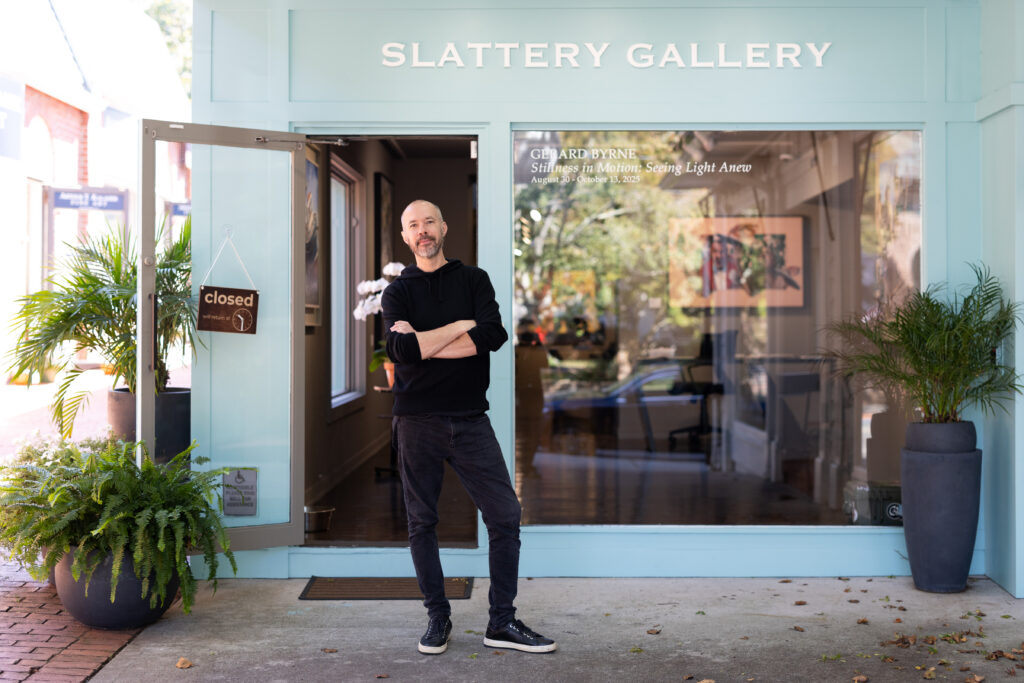
For Roman, the Hamptons is an ideal place to begin such research, as it has a great diversity of art in the artist studios.
“We have so many living artists here, working here,” he says. “There’s a vibrant arts community. Very vibrant.”
Because of this, the Hamptons also proves to be a good location to start building a network of gallerists, dealers and advisors, something of great importance when deciding to buy or to build a collection.
“If you’re passionate about beginning a collection, you can start meeting artists right here,” Roman says, noting most galleries have close working relationships with the artists they represent. “Start going to artist studios. Start talking with other dealers, start speaking with people directly and ask questions to build yourself a community. Find someone you can talk to about art—that’s very, very helpful and relatively easy to do here.”
For Grenning, there are three important benchmarks to consider when deciding on a piece of art.
“I believe good art has these three things: body, mind and soul,” she says. “The body is the craft, the way that it’s created. The materials, the use of the materials. The mind is the conceptual, the concept of the painting. It’s the way that it’s been composed, and the hurt, the reason it was composed as such. And then the soul is that energy, that emotional energy that you feel when you’re standing in front of it.”
How (and where) to buy
When building a network—art dealers, private collectors, gallery owners, fellow art lovers—transparency, particularly about your budget, is key.
“If you walk into a gallery and go, ‘Hey, I have a budget. It’s under $1,000 or it’s under $5,000,’ or whatever it is, then that dealer should be able to tell you whether they can help you or not,” says Toy. “And more often than not, they’ll have an artist that doesn’t have an established market and is selling things for $500 or less. I think if you’re upfront about what you’re willing to spend, then there is lots of opportunity here [in the Hamptons].”
Toy also suggests calling upon year-round events at cultural institutions and museums that host art sales throughout the year, noting that the works sold at these, although typically smaller in size, tend to be available at a more affordable rate.
“The fact that so many artists actually live here, is really beneficial because that opens the opportunity for them to directly submit work to something as simple as the artist’s members show at Ashawagh Hall or the clothesline sale at Guild Hall,” she says. “Those shows can have upwards of 100 artists and all the work is under $1,000.”


“If you’re passionate about beginning a collection, you can start meeting artists right here,” says Damien Roman, director at Southampton’s Slattery Gallery. (Photos by Madison Fender)
Additionally, home good stores located throughout the South Fork also carry artworks for sale for artists not necessarily represented at specific galleries.
“I got prints from the Retreat Boutique for $25 a piece. Van Gogh prints,” Toy says. “It’s not the real deal, but it’s art that I live with and I enjoy it.”
To market, to (digital) market
For Sag Harbor artist and creative marketing consultant Sara DiOrazio, finding and researching art and artists digitally is the way to go.
“You have emerging artists, you have established artists, and then you have extremely unknown artists,” she says. “I think that’s how you can kind of structure it, maybe, because depending on where someone is in their career dictates which outlets they’re going to use. Social media has been a big proponent for a lot of artists, so that’s another avenue that’s huge, from a research and discovery standpoint.”
Up until a couple of years ago, DiOrazio participated in local art fairs and shows, most notably in East Hampton and Montauk.
“I definitely think there’s a tremendous amount of opportunity out here in parallel to a tremendous amount of talent,” she says, “whether people are aware of the talent or not. And that’s where exposure on a digital platform, like Instagram, helps.”
“If you see something and it gets you excited… if a piece of art touches you, then it may very well be worth buying.”
Megan Toy
Grenning, who says as a gallerist, her main job is to manage the demand and to build the demand by talking about the artists, agrees, noting social media is an excellent place to begin.
“There’s a lot of great artists that are posting small works that they’re doing every day on Instagram, and they’re selling them directly,” she says. “There’s plenty of fabulous art that doesn’t have a dealer working on, but that doesn’t mean nobody will know about it.”
Follow the feeling
There are dozens of ways of looking at a piece of art to try to find the meaning behind it. None of them are wrong. While there are certain practices that can facilitate a deeper connection and understanding of the piece, particularly in regard to the context and the method in which it was created, whether or not the art you want to buy has a deeper meaning behind it doesn’t really matter. Once again, the key is how it makes you feel when you’re in front of it.
“I think if the artist was feeling excitement and love and passion towards their subject when they’re making it, that’s how you feel when you stand in front of it,” Grenning says. “And in the end, if the only thing that’s on my gravestone is ‘I taught people to trust their own taste,’ then that would be more than fine.”