The Hamptons International Film Festival boasts a slew of globally produced and focused features and shorts each year. Big name stars like Elizabeth Olsen and Ethan Hawke will take the stage at question-and-answer sessions.
The local lens will also shine during screenings of Thoughts of Infinity sharing the story of a Montauk painter and Arthur Elgort: Models & Muses depicting career of a Southampton-based photographer.
One close-to-home hit will have its world premiere and director Ari Selinger will make his debut, with the film On the End.
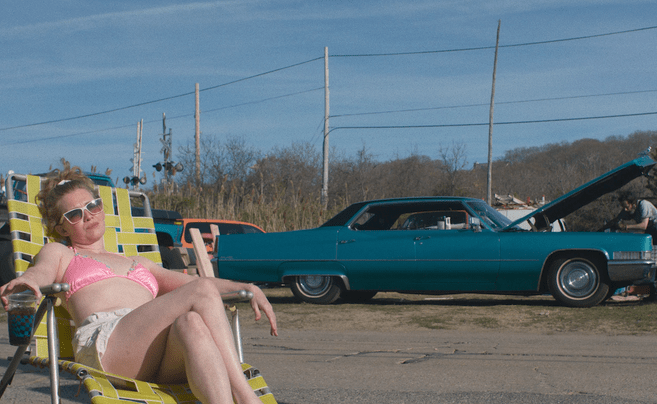
Selinger – in a thoughtfully gut-wrenching yet beautifully displayed way – tells the true tale of Tom Ferreira, played by Tim Blake Nelson, a Montauk mechanic and his girlfriend Freckles, performed by Mireille Enos, navigating the tribulations of life while also battling the town to keep his auto repair shop and home.
While the film screened this past Saturday, Southforker spoke with Selinger, who stumbled upon Ferreira’s story in searching for an autobody shop for another film, about On the End.
Southforker: What was your first impression of Tom?
Ari Selinger: When I met him, literally the first thing I saw was his butt crack, just at the hood of a car. My friend, a production designer, was like, “Let’s stop and ask this guy for help,” and to be honest with you, my first impression was, ‘What are we going to do, talk to his ass?’ We had a 20-minute conversation right in the middle of the road — and since he’s king of the road over there, it was just par for the course. We had this long conversation and I thought ‘I’m talking to a very authentic, genuine person and this will be a nice one-time conversation.’ I didn’t think I was going to invite him to my wedding, which I did.
I thought he was real salt of the earth kind of guy. He reminded me of if your uncle gets dressed up as Santa, but he’s really drunk when he comes over and there’s a charm to it. But he was really smart and there was like a brilliance to him. He knew every nook and cranny of Montauk. I realized later he was like a Montauk historian.
SF: What was it about Tom’s story that really spoke to you?
AS: He was telling me about issues he had with the zoning board and the town of East Hampton, and he kept telling me for maybe 10 years before I actually did anything. It sounded like a little legal thing that he probably was the cause of. I was like, ‘I’m trying to tell silly stories that are kind of Spielbergian and there’s a little magic to them.’ I just was not interested in small town politics. But what drew me to him was his relationship with his girlfriend, Freckles; the way he talked about her. She went to NYU and he’d be like, ‘You guys are gonna get along.’ And then when she died, something in my heart opened up a little bit and I realized that that this guy has lost a part of himself.
I suddenly felt like that’s a story and the backdrop is what’s going on in this town because if you say Hamptons, I don’t think you’re thinking of Tom and Freckles. You’re not thinking of too sickly people on the beach who are struggling. And I think I started realizing that if I want to tell a story that’s going to be very truthful and authentic, this could be the one.
SF: What was your favorite part of working on the film?
AS: My favorite part was shooting two doors down from where he lived, which was miraculous that we were able to do that. I remember the first couple days of shooting, it was the end of April and the flowers were coming out and it was just this gorgeous blue-sky day, even amongst these junky cars, and seeing him standing on his porch watching us tell his life story — that was a trip, because it took years to get to that point and I don’t think either of us really believed it was real until the cameras showed up and we started rolling.
SF: What sort of emotions did learning this story and telling this story invoke in you?
AS: Honestly, it brought out every emotion you could think of at different times, but the one that struck me the most was working through grief and not trying to answer what happens after you lose everything you love, but that there’s a path forward after that. That was a tricky thing to answer, because I really felt the grief of it. It was such a communal effort to tell this story. It just felt so authentic and I had this covenant with this guy [Tom] and that covenant made it impossible for me to stray from the path. I felt like I was a reporter or just giving a testimony to someone’s life and even though it’s just one life and kind of an unusual life, I think that it felt like a noble effort, even though the story is kind of covered in grease.
SF: Being that Tom passed in 2024, did he ever have the opportunity to see the film or portions of it?
AS: I sent the movie when we were in the midst of editing it. It wasn’t cleaned up and everything, I sent it to him about a month before he passed away.
He watched about 10 minutes and he told me his back was hurting and couldn’t sit and watch the whole thing. But I sort of believed that it was a little too much emotionally for him … He sent the rest to his daughter, and I think that was bigger to him than seeing it himself; …showing his daughter what he went through because he was never able to verbalize it and their relationship was really repaired.