
There’s nothing like an old cookbook for a palate-aimed portal to the past. Just ask Briana Rogers Surgan. From the first time she held the hardback copy of “Sweetmeats,” a compendium of jam recipes written by her great-great aunt Eunice, she was drawn to the words within. Cracking the spine and leafing through the once-white pages, now the color of butter pecan ice cream with loopy handwritten notes from her ancestor, Briana found a pantry’s worth of preserves and perfect instructions on how to create them.
So she did.
She had no idea, though, that this family heirloom would point her and her husband, Halsey Surgan, in the direction of a business they would seize, stir and preserve together, 90 years after Eunice Rogers put pen to paper in Westhampton Beach. It’s a sweet story about the joy of jam, but also of a passion for preserving both the fruit of the present and that of the past.
Juicy Fruit
If you haven’t yet run into the Surgans, or at least their jars of preserves, at Olish Farms in Eastport or the Olish’s Westhampton outpost, Fruit King; the Eastport General Store, Sayville Cheese, or at one of the summertime markets or neighborhood festivals, like the Westhampton Beach Spring Fling, you’re in for a treat. Their Hamptons Preserves are unadulterated seasonal joy. Concentrated fresh fruit flavors, so pure and sweet and spoonable straight from the jar, drawn from the good directions of Aunt Eunice’s winning recipes and the Surgans’ own good hand with them.


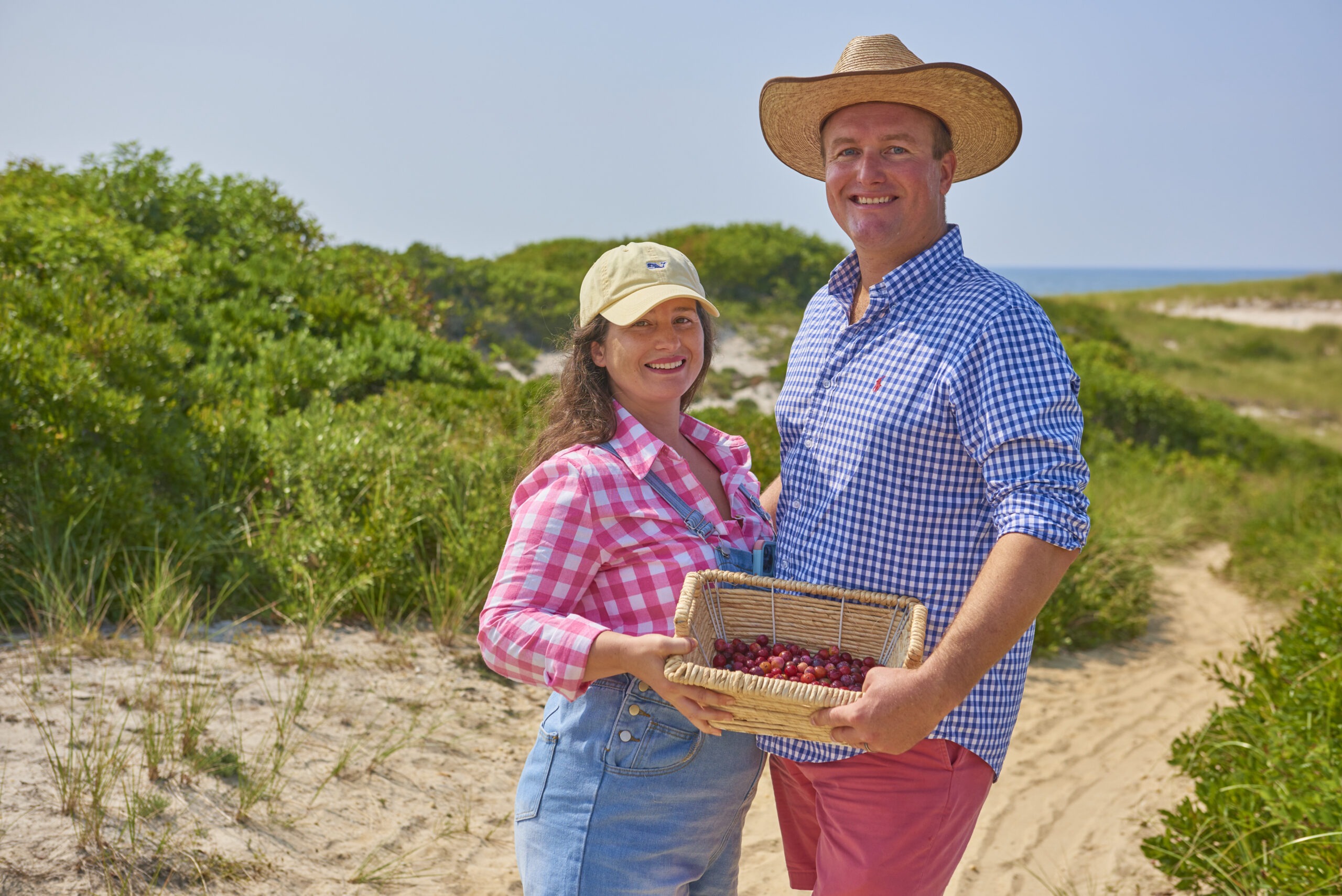
(Top left): Eunice Rogers with her parents in Westhampton in an undated photo; (top right) Eunice’s “Sweetmeats” cookbook; (bottom left) Halsey and Briana picking beach plums on a perfect, last-summer day. (Photos by Doug Young)
“I had never made jams before I discovered the ‘Sweetmeats’ cookbook. As soon as I opened the book it was like finding gold. I was so intrigued and wanted to try the recipes right away,” says Briana. “I felt like I could somewhat go back in the past and taste a jam that my great-aunt made.”
It was in the dark days of the COVID-19 pandemic, while half the planet seemed to be baking sourdough or rediscovering puzzles, that Briana found solace in the sweetness of fruit preserves.
“Cooking brings me comfort, security and a sense of belonging, as I share my meals with the ones I love,” she says. “I had always loved to cook. I think it runs in the family.”
Indeed, great-great aunt Eunice taught Briana’s grandfather, a chief petty officer in charge of the Navy’s culinary systems during World War II, how to can and preserve foods, taking the hard lessons of a post-Depression Era America to heart and home. “He spent a great deal of time with my great-great aunt, who taught him to cook,” says Briana, “especially canning and preserving foods. I think that influenced his role in becoming a CPO in the Navy.”
While she couldn’t learn in a firsthand way like her grandfather, she did embrace the lessons Aunt Eunice put to paper 90 years prior in “Sweetmeats” — and just like her grandfather, Eunice would influence Briana’s life, too.
Stirring the Pot
Halsey and Briana found a business idea and a mutual love of preserves through family history, but it’s how they found each other, too.
“I do genealogy in my free time and run a history group on Facebook called “Westhampton Whatever Happened to.” I was looking for old photos of Westhampton families dating back to the late 1800s, early 1900s,” Briana says. “My Aunt Barbara put me in touch with [Halsey’s] mother because their families knew each other for many generations.”
Halsey got his first name from, yes, that Halsey — one of the original settling families on the East End, dating back generations to 1640 in Southampton. It was his mom, Sandy’s, maiden name and became his first name. Sandy’s fascination and deep interest in East End history led her to join Facebook to find other likeminded history buffs, and that’s how Halsey’s future wife would come to know her future mother-in-law.


“Through jam making I have learned to be patient with myself,” says Briana. “It was frustrating at times but i learned not to give up.” (Photos by Doug Young)
“As my parents are getting older, I tend to keep track of what they do on Facebook and who they’re friends with. I’m not looking over their shoulder or anything,” Halsey laughs, “but if I see my mother made a new friend on Facebook and there’s an age disparity… I just don’t want my mom taken for a ride.”
Briana reached out to get some information on local lore and Sandy invited the young history buff to come by the house to talk. Sandy explained to her son, who was living in El Paso, Tex., for work at the time, who her new young acquaintance was and what she and Briana planned to talk about. As he knew a bit about the topic, Halsey asked for Briana’s number and sent her a text message under the guise of being helpful — but also to make sure Briana was, well, Briana… and not a nefarious predator of online historians.
Instead of rooting out a villainess, he found a kindred spirit.
After months of talking and texting, Halsey came back to Westhampton to visit his family in the summertime and the two met in person. The rest, they both report, was history.
Lone Star Simmer
Briana moved to Texas and the young couple married soon after. Just as their early life together began to gel like sugar and fruit in a pot, Briana introduced Halsey to the charms of jam making and started giving voice to her dream of turning Aunt Eunice’s inspired recipes into a business.
Making jam or marmalade is a slow process that takes no small amount of patience and a little instinct, too — all things they worked out while living in Texas.


Although core flavors like strawberry are always part of Hamptons Preserves lineup, they make up to 30 different types depending on the time of year and what’s ripe and in season. (Photos by Doug Young)
“She had this bug. She wanted to try her hand at the jam and jelly as a business. We looked up some farmers markets in the area, we applied for them and we got in,” says Halsey. “And that gave us the experience to kind of finetune the whole production process and the canning process and what sorts of things we need to bring when we do a market, what our setup is like. So we worked out all the kinks down there.”
During that burgeoning preserve period, Briana became pregnant with their daughter, Emmaline, and they decided to move back to Westhampton to be close to family. Emmaline was born last summer, right smack in the middle of high fruit season — a pretty little plum to add to their family’s fruit basket.
Canning the Future
The first flavor Briana made was strawberry. Little by little, she and Halsey expanded into other fruits and flavors, starting with a few hundred jars a year and now making around 1,000 and up to 30 different types, depending on the time of the year, linking the flavors to the growing seasons and supply.
They sell an 8-oz. jar of Hamptons Preserves for $12, save for special and low-yield fruits like beach plum, which goes for $16. They ship on orders of six jars or more.
“We had this one client who had family in Germany and she ordered, like, two flats at a time, and she would have us send them to Germany!” Halsey laughs. “Hamptons Preserves International!”
Most of the fruit, though, is indeed local, save for things that don’t grow here, like mango, and the couple is working on supplier partnerships with Briermere Farms in Riverhead and Olish Farms in Eastport to keep them in bountiful bushels of high-demand local fruits. Their rhubarb and nearly all their blueberries, however, come right from Halsey’s parents’ home garden. And the beach plums? Well, no beach plum picker in their right mind will divulge their secret spot.
Since resettling back in New York, Hamptons Preserves has been produced from Halsey’s parents’ kitchen in Westhampton Beach, but plans are in the works to lease a commercial kitchen, hire staff and scale up to match demand. Right now, it’s just the two of them working in tandem in the off hours, when Halsey is home from his full-time job as a service manager at Peterbilt in Ronkonoma, and when Brianna has her hands free, with Emmaline tucked in for the night or with her grandparents.
“We’ve kind of got it down to a science. You start one batch, get your jars in the water bath when it’s boiling, and then you can start a [new] batch of jam right when that [first] batch is almost ready to be canned,” says Halsey. “You just kind of rinse, repeat that whole process. We can probably do about four or five flats in a day.” It’s an amount that translates into about 60 8-oz. jars.
But also, the amount produced and the time it takes depends on a few key factors: how much fruit is on hand, the amount of pectin and acid in it (both are needed for a jam to set), the moisture content of the fruit and the age of the fruit.


Currently, the pari is working on supplier partnerships with Briermere Farms in Riverhead and Olish Farms in Eastport. (Photos by Doug Young)
It’s all been a learning process, spurred on by the writings and advice of Aunt Eunice, some of which was a bit dated (references to coal fires, for example), but most of which was spot on and adaptable, like:
“One of the most important factors in making jelly is to use just the right amount of sugar. Too much will result in a thick, gummy jelly, and with too little sugar the juice with not jell [sic] — and do not use overripe fruit as it does not contain enough pectic acid to make jelly.”
But there are other lessons, too. The kind that aren’t in the book, and that are applicable to both canning and life in general.
“Through jam making, I have learned to be patient with myself, as there have been lots of times I had failed in getting jams to set, especially jellies,” says Briana. “It’s a common occurrence in jam and jelly making, as we all want the instant gratification of it setting because otherwise it just winds up being a topping or syrup. It was frustrating at times, but I learned not to give up.”

