This Labor Day weekend marks the Shinnecock Nation’s 80th annual Powwow — a testament of the event’s power in the community and the tenacity of the Shinnecock’s commitment to it. And yet, while many people make a point to attend annually, there are multitudes who haven’t and who also don’t really understand what it represents.
“Powwow is a testament to our resilience and our existence as indigenous people on the East End,” says Bianca Collins, a Shinnecock Nation member and former secretary for the Nation’s board of trustees. “So often, people that live here think about indigenous people, but they don’t think about them as still being in existence on Long Island, on the East Coast of the country.”
It’s part of the reason the powwow is so very important. The word itself dates to the early 1620s and is widely considered to stem from the Algonquian language of the Northeast. “Powwow” most likely came from the Narragansett pau wau, a term that originally stood for a healing ceremony. When translated into English, it becomes more of a concept through which our lens of language means “he or she dreams.” Initially, it was used while referring to the healers, spiritual leaders and medicine men found within the native tribes of the East Coast who often served as dream interpreters for people in their respective communities.


The powwow at Shinnecock is both a gathering as well as a space to demonstrate cultural survival and resilience through dance, song, and community. (Photo credit: Rebekah Phoenix Wise)
In the Canadian Encyclopedia, ethnomusicologist Tara Browner documented that during the 1800s the term was appropriated by European folk healers traveling through North America who are said to have “hired” (it’s hard to say, of course, whether services rendered were compensated for) local indigenous people to dance for the entertainment of potential customers — and it’s here that the association between “powwows” and exhibition dancing finds its modern root. Over time, colonists, settlers and cultural appropriators across the board continued to misuse “powwow” to generally describe the meetings of indigenous medicine men and, not long after, broadened it further to refer to any American Indian gathering altogether.
During the 19th and early 20th centuries, when the United States government implemented aggressive policies of assimilation and forced Native Americans to relocate to reservations, many of their native cultural ceremonies, practices and gatherings were either adapted into social events or outlawed completely.
But for the Shinnecock — the almost 1,600-member group of indigenous people, half of whom inhabit the 1.5-mile peninsula located between the Village of Southampton and the hamlet of Hampton Bays — this was a time of great shift and one that would eventually give their own annual powwow international recognition. For them, what began as an effort to maintain their cultural identity morphed into a way to safeguard their traditions while sharing them with the surrounding community and, ultimately, asserting tribal sovereignty.
“We’re kind of seen as this novelty — like we existed here at one point,” says Collins. “But powwow is a testament that we’re still here, our community is still here, we are still thriving and we’re still celebrating and honoring our culture.”
The birth of a nation’s powwow
Origins of the powwow at Shinnecock trace back to 1912, when a handful of tribal members started hosting small community pageants during the Labor Day holiday on reservation lands.
After World War II, the late Henry F. Bess, a former Riverhead garage operator and Shinnecock Nation member, led the charge, playing a vital role in reviving the Shinnecock Powwow. He was responsible for formalizing (and personally financing) the event as a social one and as a way to foster community and preserve his and his people’s traditions, particularly with regard to the Nation’s perseverance after centuries of marginalization. At the time, it was explicitly illegal for indigenous people to celebrate their culture freely in the United States, a ban that would technically remain in place until the 1978 passage of the American Indian Religious Freedom Act.
Bess became known as Chief Thunder Bird, the revered ceremonial chief and tribal leader of the Shinnecock, and served in the role until his death in 1989.
“In 1946 in the United States, it was illegal for us to freely practice our culture,” says Collins, who is Bess’s great-granddaughter. “What my great-grandfather had was a vision. He had a dream saying this is what he should do and he asked people in the community to support him and do this work with him. It was initially in his front yard as a way to welcome in members of the community, to learn more about who we are and experience some of our culture. Now, 80 years later, it’s turned into one of the largest powwows that’s held across the nation.”
And what an impressive showcase of Native American heritage it is.


An event with international clout, the Shinnecock Powwow draws tens of thousands of people to the East End over the course of its four-day long run. (Photo credit: Rebekah Phoenix Wise)
Considered one of the top powwows on the continent, Shinnecock’s Powwow is more than just a festival. It serves as a living expression of the Nation’s culture, deeply rooted in ceremony and community.
“This is our time to show off to everyone what Shinnecock can do,” says Rebekah Phoenix Wise, a native to Shinnecock who serves as communications director on the powwow committee. “This is our time to show everyone how beautiful our home is. We want people to see; we want people to come. We want people to come and be respectful and listen and learn about our culture and our people and our history and our current days. Yes, it is sacred, but it’s also open to the public, and we really do rely on the public. I think that it’s one of those things where it’s happening because it’s to express and honor what has already happened.”
The heart of the dance is the drum
The late Dr. John A. Strong was a revered professor of history and Native American studies who was also the director of the social science division at Long Island University’s Southampton College long before it became part of Stony Brook University. When interviewed for a 1998 New York Times article by Marcelle S. Fisher, Strong called powwow “the most visible symbol of Indian culture,” noting its prominence across the fields of feasting, trading and commerce. “The Indians wear traditional regalia, display handmade crafts and perform dances along with traditional rituals,” he said. “The drumbeat pounds steadily through for days.”
At the center of the powwow grounds is a circular stage elevated about six feet off the ground. Painted like a drum, it serves as the space where all the traditional dancing happens, with drumming and dance contests, comprised of participants of all ages, occurring prevalently over the course of the four-day cultural celebration. Cash prizes for this year’s drum and dance contests will total over $50,000.


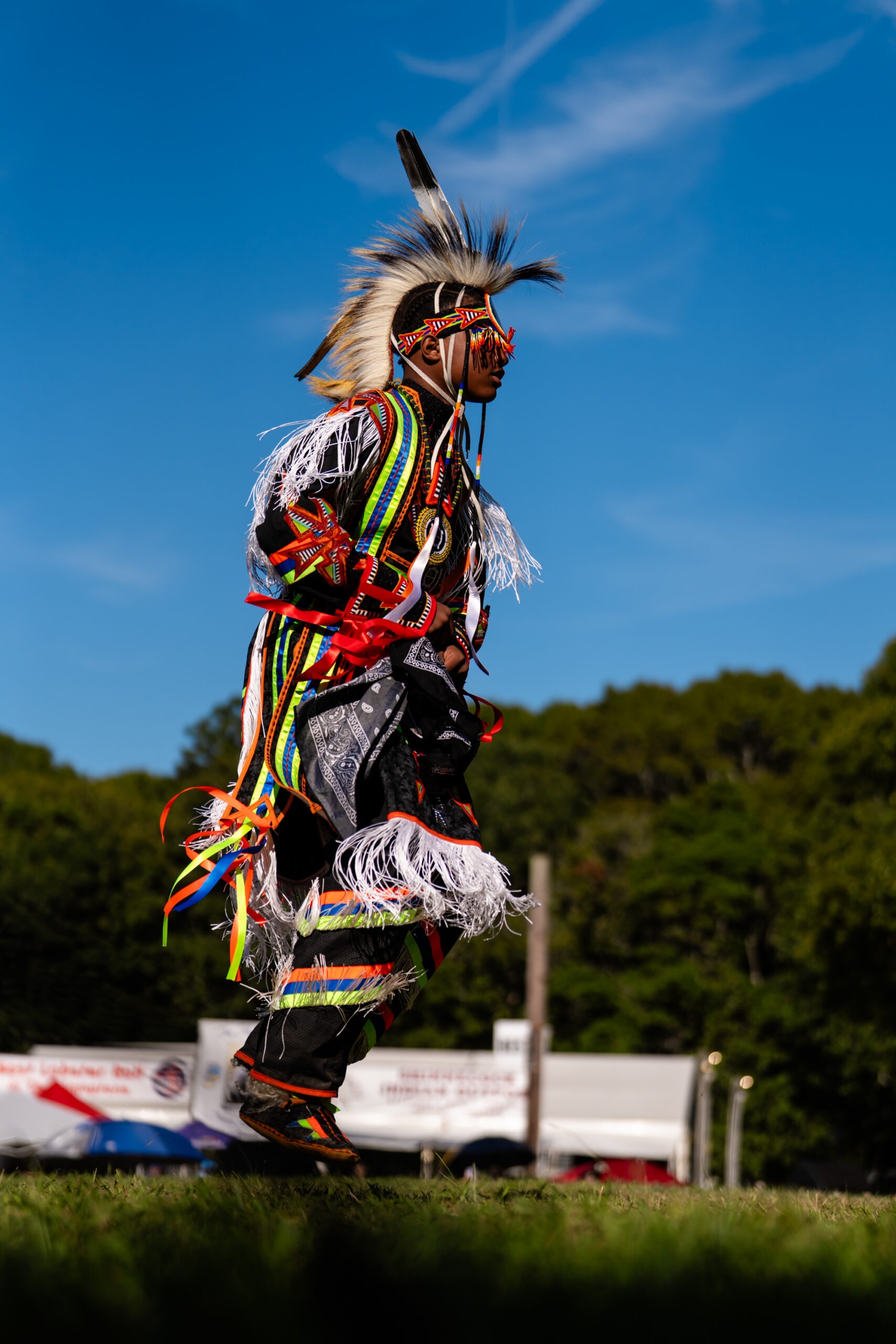
A showcase of vibrant regalia from dozens of tribes found across the world, two activities are central to powwow: dancing and drumming. (Photo credit: Rebekah Phoenix Wise)
“You’ll hear and see traditional music and dancing, you’ll see a lot of drumming. And you get to learn about the dance as it’s happening,” Wise says, noting there are hundreds of dancers participating from well over 50 tribes from all over the world, including sister tribes the Pequot, Wampanoag, Narragansett and Montaukett, as well as Aztecs from Mexico, Taíno from the Caribbean and indigenous peoples from Hawaii, Puerto Rico, Australia and more.
“We have people that travel from across the country, people that are part of what we call the powwow trail throughout the season,” Collins says, “who go from powwow to powwow across the country and either vend or dance, and then usually most of them end their season here on Shinnecock territory on Labor Day weekend.”
It culminates with a grand entry in which dancers in vibrantly colored regalia, veterans and leaders from various tribes enter the arena, serving as a ceremonial beginning while honoring past ancestors and tribal unity.
Throughout the four-day event, there will be two grand entries on Saturday and Sunday — one in the afternoon and one in the evening — giving attendees multiple chances to experience the powerful and moving tradition.
“You feel it in your chest,” Wise says. “The drum is the heartbeat of the powwow, it’s the heartbeat of the nation, it’s the heartbeat of us.”
Over 100 vendors participate, serving and providing for the over 20,000 visitors at the Shinnecock Powwow each year. Myriad food trucks, indigenous artists and artisans showcasing everything from turquoise and silverwork to paintings, a showcase of vibrant regalia from different tribes and communities, and various drum groups all play a pivotal role in the event. This year, host drums will be provided by the Wicozani and Youngblood Singers, with Henu Josephine Tarrant as the featured guest singer and a performance by Wayashti Richardson, a flutist and smoke dance singer.
“Powwow is a very big sense of pride for Shinnecock people, and one thing that’s really nice to see, as the older generations unfortunately do pass, is how many people of the younger generation do step up,” says Wise. “It is a family affair. Shinnecock all comes together to make this happen, and for many people, myself included, it’s our favorite time of year. It’s our favorite holiday. It’s one of our many gatherings. We have a couple ceremonies throughout the year where people come home, but this powwow is the big one.”
The Shinnecock Powwow (located at 100 Montauk Highway, Southampton) opens Friday, Sept. 4 from 3 to 11 p.m.; Saturday, Sept. 5 and Sunday Sept. 6, from 10 a.m. to 11 p.m.; and Monday, Sept. 7 from 10 a.m. to 6 p.m. Grand entry will be at 7 p.m. Friday, Saturday and Sunday, as well as 12:30 p.m. Saturday, Sunday and Monday. A sunset fire lighting will take place Friday, Saturday and Sunday. Tickets are $20 per adult and $10 for children between the ages of 5 and 12, as well as seniors over 65 and military personnel with ID. Admission is free for children under 5. Cash or credit is accepted at the gate for entry. Cash is recommended, as not all vendors accept card payments.