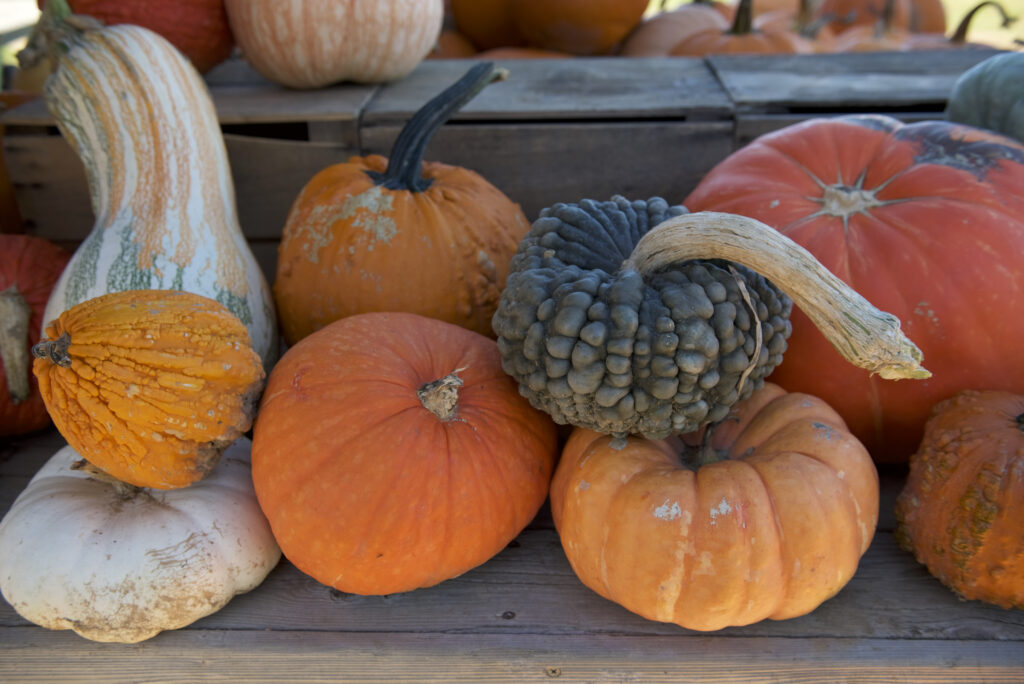
Eighteen fruitful growing seasons have passed since Katie Baldwin and Amanda Merrow started a farm in Amagansett called Amber Waves. The acre of winter wheat they cultivated proved to be catnip to local bakers. It grew like a sourdough starter into a non-profit, diversified, educational farm where nine apprentice farmers are trained each year. The property is also home to a café, busy outdoor community space and a market full of bins and baskets featuring the farm’s homegrown produce, grains, locally sourced meat and dairy, fresh herbs and flowers.
Today, Amber Waves is something rare, and perhaps a bit magical in a region where land intended for farming often falls prey to the high-dollar whims of real estate. Instead, Baldwin and Merrow have found a way to create a non-profit community “food park” — a place to buy, or learn to grow, locally grown produce (along with the trucker hats to prove it) and enjoy it with people you love and people you don’t even know.
“We accidentally built a mega-brand,” Baldwin says. “We’re super proud of that.”
Amagansett’s Happy Place
Long before Amber Waves was born, 367 Main Street is where Pat Struk sold vegetables on a card table in her front yard before it became the Amagansett Farmers Market. The property has a deep history on the East End, and when Baldwin and Merrow started farming there, they heard all about it.
“People love to tell me stories of when they brought their children here, or [how] they had their first kiss with their husband, or they came here when they were in their twenties, when they had a share house in the lanes,” Merrow says. “Katie and I never considered private ownership of this property… The community needed it.”


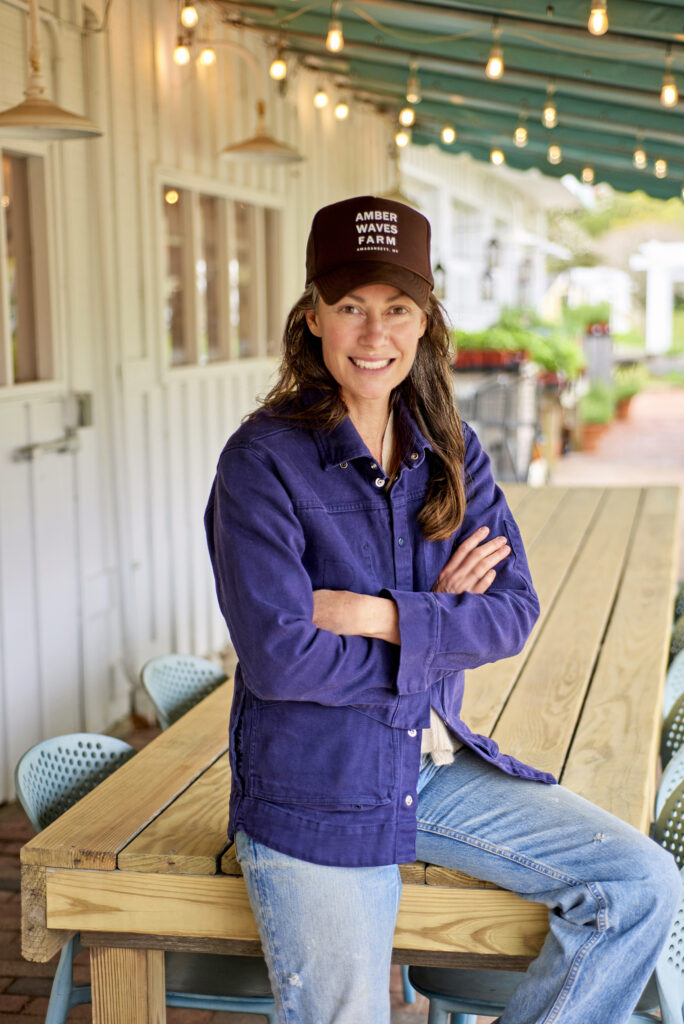
Aside from growing and selling awesome produce, Amber Waves has become a food-centric hub for the Amagansett community and beyond. (Photo credit: Doug Young)
From the beginning of their non-profit farm, their mantra was “This is supposed to be fun.” And it’s clear that Baldwin and Merrow enjoy the place just as much as the droves of people who stop by the oasis on Main Street in Amagansett. Baldwin, always seeing the big picture, loves the farm for its window on the inspiring beauty of the natural world. One recent afternoon, Baldwin sat and watched people walk around the farm. “They were smelling, tasting, using all of their senses,” she says. “We’re just not getting dosed with that enough these days.”
Merrow, the practical side of the team, sees the farm as an idyllic version of Richard Scarry’s illustrated children’s book Busy, Busy Town.
“There’s a farmer on the tractor over here, and an apprentice in the upper classroom, and Fatima’s in the kitchen and Christopher is making espresso and everyone’s just doing things. It’s so lively and fun to be around.”
Idealism Meets Dirt
Baldwin and Merrow met in 2008 during an apprentice program at Quail Hill Farm run by Scott Chaskey, whose influence as a mentor and educator in the world of regenerative farming — agricultural practices that restore the land — is legendary.
Baldwin grew up in Los Angeles, graduated from the University of Southern California, went to work at the Council on Foreign Relations, and thought she’d go into food policy. Someone suggested she get some hands-on farm experience first. Her path was forged from the moment she read Chaskey’s book This Common Ground: Seasons on an Organic Farm, which opened her eyes to the possibility that a person who doesn’t hail from a family with agricultural roots could still learn organic community-based farming.
Merrow, meanwhile, grew up in Vermont on land that was once home to her great-grandfather’s dairy farm. Equipped with a degree in economics and environmental studies from Hamilton College, she was looking to learn some farming before going to work in microfinance for a non-governmental organization overseas.
Merrow arrived at the Quail Hill apprentice program just ahead of Baldwin and was sent to pick her up at the train station. They had coffee together at Mary’s Marvelous, got to Quail Hill, changed into work clothes and marched down to the orchard to prune the fruit trees.
“Then we spent the next 20 years together,” Merrow says.


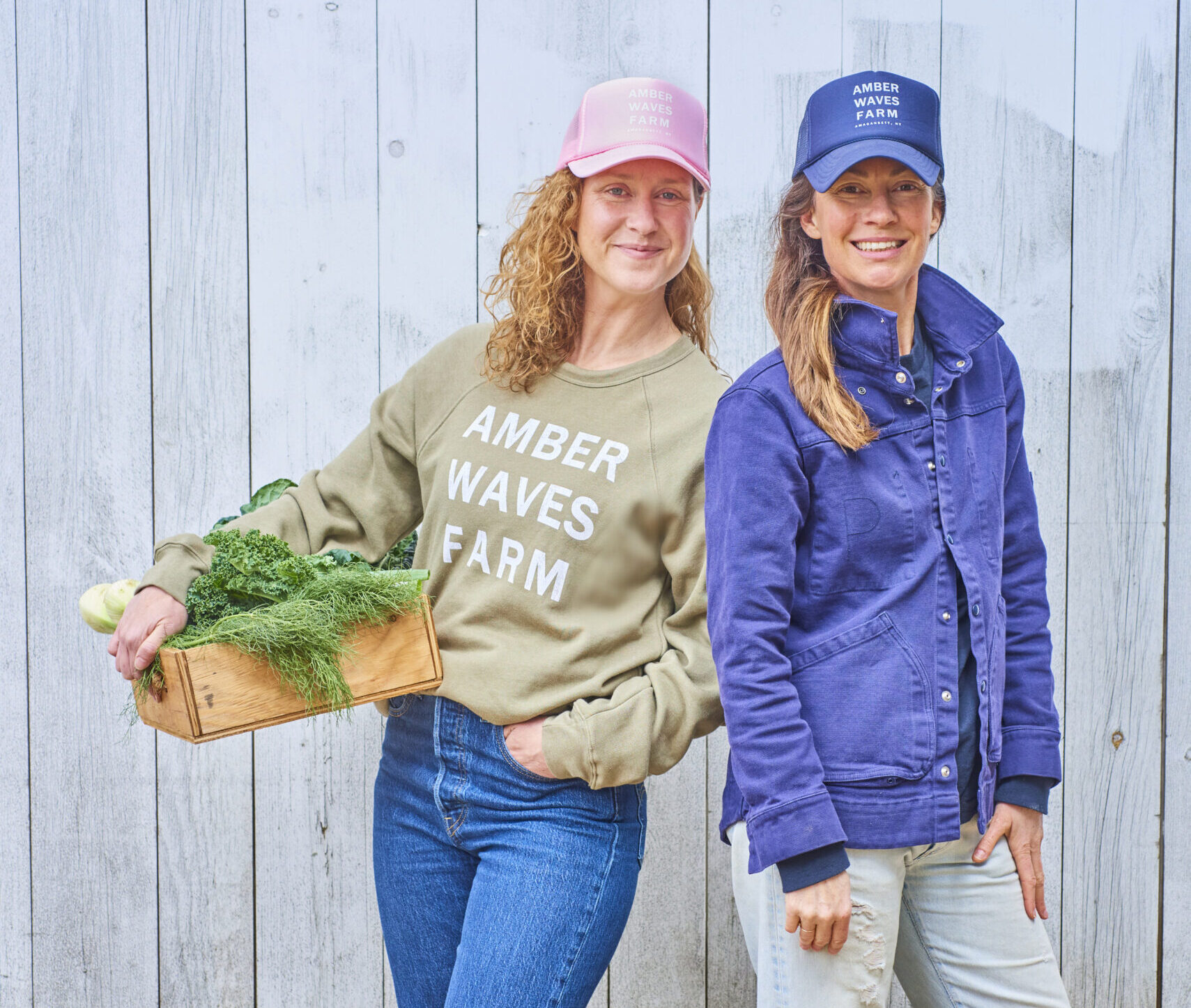
Merrow and Baldwin met through an apprentice program at Quail Hill Farm back in 2008, becoming friends before deciding to farm together. (Photo credit: Doug Young)
How to Farm on Land You Can’t Afford
By the end of the apprentice program, Baldwin and Merrow had decided to continue farming together but there was one rather large hurdle to overcome: They had no land.
Through the Peconic Land Trust and a generous donation of development rights for the Amagansett property, Baldwin and Merrow secured a three-year lease in 2009 to farm the land adjacent to the Amagansett Farmers Market and were able to renew the lease several times.
“Katie and I were starting to talk really seriously about a long-term plan for the security, stewardship, safety and sustainability of this property,” Merrow says. “We approached the landowner and the Peconic Land Trust to see if we could anchor ourselves in perpetuity on the farmland. It was the first enhanced easement in the Town of East Hampton.”
The enhanced easement agreement they signed in 2016 requires that the land be actively farmed, that resale value is capped and that, if sold, the property comes with those restrictions in place. It must also be sold to a bona fide farmer of food: no sod, no viticulture, no nursery stock.
In 2017, they began operating at the structure that had housed the Amagansett Farmers Market, adding a café in 2018. At the end of 2019, the duo replaced the roof of the market building, a first step toward staying open year-round, just before the pandemic hit.
The community’s need for food during lockdown pushed Amber Waves to become a year-round store, Merrow says. “It was such an era of gratitude. Food is a powerful, amazing thing for people. And for a moment, we just felt so appreciated.”
The period made them see the gravity of their endeavor, and its importance to the Amagansett community and beyond, with clear eyes. “The fragility of the food system came front and center during the pandemic,” says Baldwin. “Our grocery stores are just one or two truckloads away from not having food out here. We were able to let people be outside together but not close. It really worked.”
Training the Farmers of the Future
When Baldwin says that Amber Waves is ready to reproduce after 18 years of growth and development, this mother of two children, ages 9 and 6, is talking about nurturing farmers who will in turn establish their own ventures. Merrow and Baldwin, who both keep a worried eye on farming statistics, have been watching a precipitous decline in the number of people going into farming as a generation of farmers retires.
Meanwhile, they see more young people thinking about what they can do with their lives that is meaningful, helpful and offers some job security, as the number of applications to the Amber Waves apprenticeship program doubled for 2026.
“It’s fully baked into our plans for the next decade to scale our workforce training and to really be a leader of regenerative organic farmer training in the country,” says Baldwin. “We can train people and launch them so they can start an Amber Waves model of agriculture in their community.”
New farms by Amber Waves-trained farmers are already sprouting. Apprentices James Burke and Andie Fortier started Sand and Soil Farm in Amagansett in 2020 and Isabel Milligan and Nick Collins went on to establish Feathertop Farm in East Hampton in 2024. And more are certainly germinating, prompting Baldwin to share with Chaskey the happy news:
“Scott, you have grandchildren now.”