Whatever pool comes to mind from nostalgic childhood memory, it’s likely a far cry from the increasingly sleek, luxurious versions that now define a South Fork summer. Today’s high-end pools feature deeper hues to relax the eyes, infinity edges to calm the mind, shallow submerged sun ledges and platforms for cool sunning, cold plunges and spas for health and wellness and, once night falls, custom lights and fire elements for a party-perfect backdrop.
“Everyone wants a pool, even if you have a beautiful bayfront property,” says Jennifer Wilson, a realtor at Saunders & Associates, noting that basic doesn’t cut it anymore. “People want to feel like they are at a resort. And especially at the high end, these pools are true pieces of art.”
With the bar set higher than it’s ever been, buyers and renters alike have gotten more discerning. “It’s pretty much automatic. Very, very rarely will you have someone build a house and not put in a pool,” says John Tortorella, founder of Tortorella Swimming Pools, which has been building luxury pools in the Hamptons for over 40 years.
Experts agree a pool adds considerable value to a home and that it’s always money well spent. A luxury pool costs $100,000 and up (and up and up) to build, but you’ll get your money back when you sell, experts say. “I have a beautiful listing right now in Springs that doesn’t have a pool that’s priced at $2,295,000. If it did have a pool, I would probably price it $200,000 higher,” notes Wilson.
But sellers with an old pool don’t necessarily need to rip it out and install a fancy Gunite version to make a sale, especially at the lower end. “Even just changing an old blue vinyl liner with a dark gray one will elevate the pool and make the water look a deeper shade of blue,” says Wilson.
Too Pool for School
Pools are hardly one size fits all, and custom builds are standard. Builders and pool designers work closely with clients to ascertain their needs and create a pool that fits their lifestyle and vision, whether it’s quiet luxury lounging or boisterous activities with the kids.
Today, contemporary, clean-lined pools are the most in demand, with geometric elements throughout and edges that sit flush with the horizon or ground. Curvy, natural organic shapes have gone out of favor, and not just because they cut into the surface area of the pool and swimmable area.
“If you’re looking at the modern houses that are going up now, you’re going to just see clean, simple lines, and this is reflected in the pool aesthetic,” says East End Pool King manager Jennifer Del Vaglio.
Bluestone pavers and tiles have given way lately to lighter-colored limestone. Slightly less in price, limestone also stays cooler to the touch on bare feet and is highly durable. Other natural, light-skewed hues are floating to the surface, too. “We’re seeing softer beige coming in, like a sand color, creams and warm light tones,” says Del Vaglio, adding that they reflect the warmer-toned home decor hues that have replaced cooler grays.
Other finishes that offer more durability and comfort are gaining ground as well. “We’re doing a lot of pebble finishes now, polishable finishes,” says Tortorella. “Pebble finishes are also stronger and last a lot longer than your typical marble dust.”
To Infinity… and Beyond!
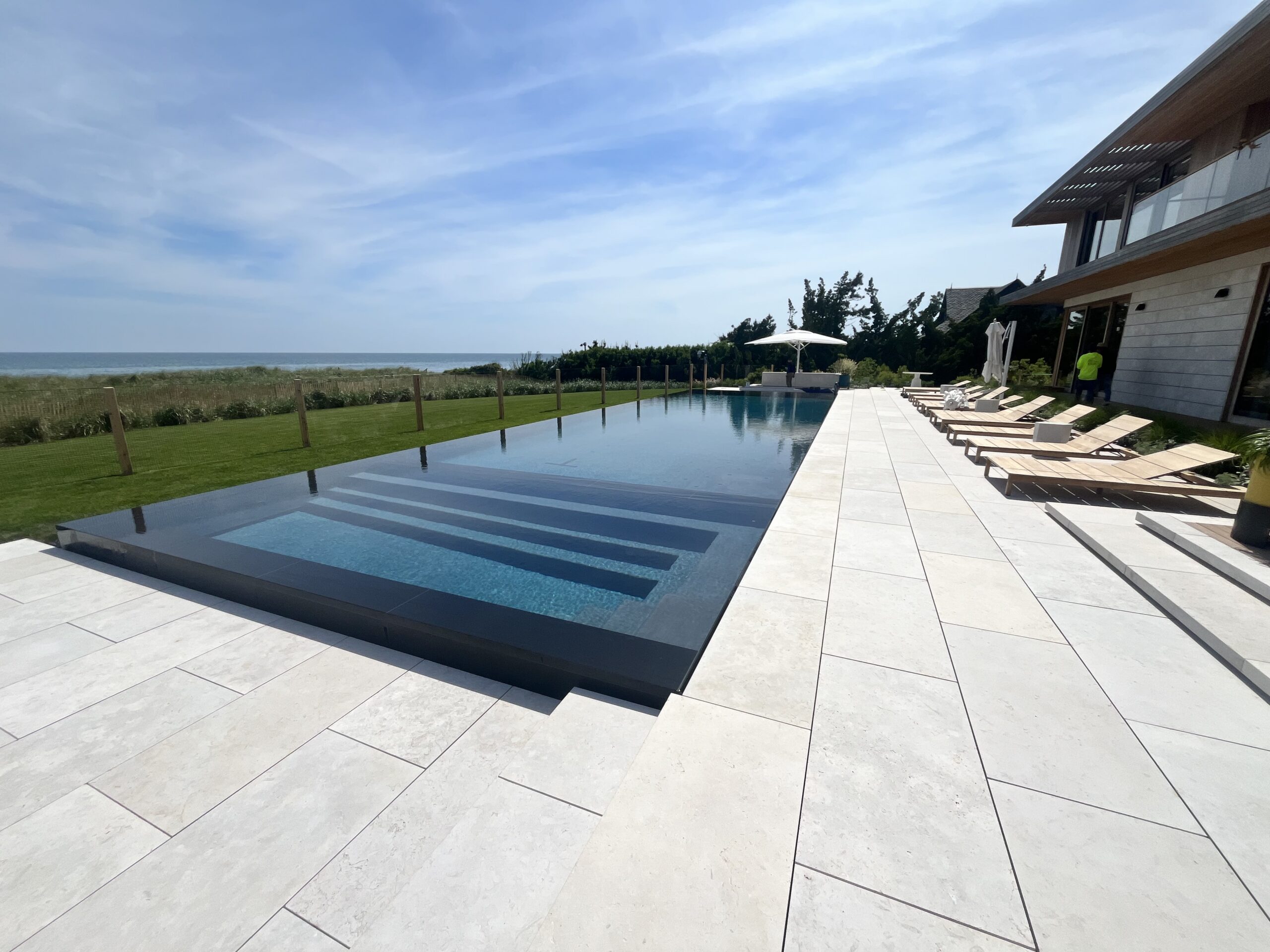
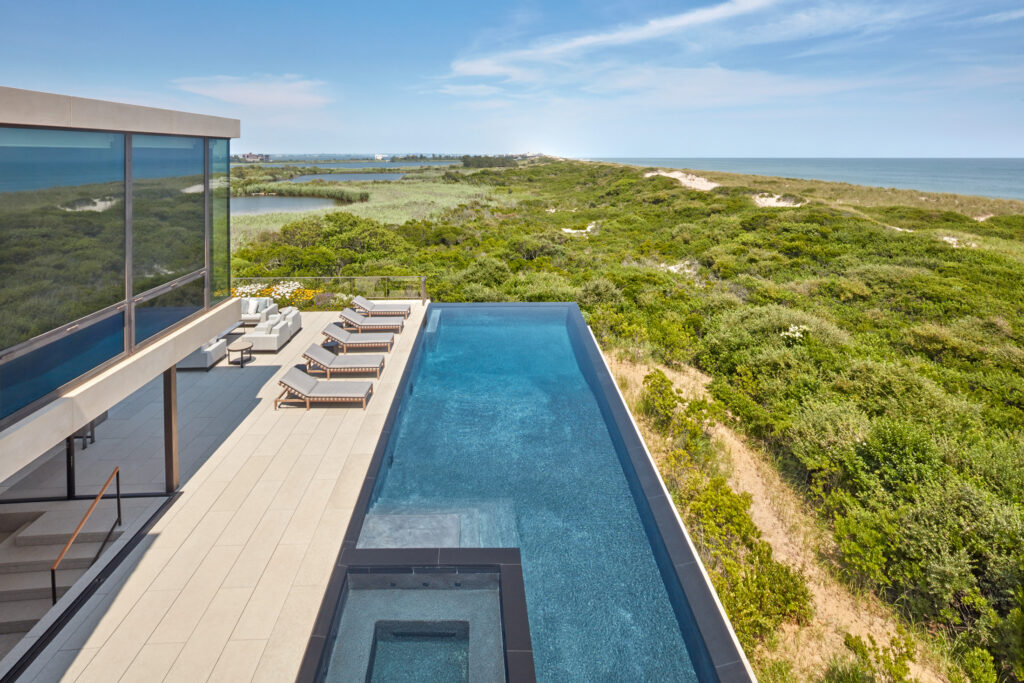
There’s nothing more dramatic than a pool that blends with the horizon. Interchangeably called Infinity Edge, Vanishing Edge, Negative Edge, Zero Edge or Wet Edge, such pools offer an endless “infinity” view, with water overflowing a vertical wall on one side.
The truly fortunate needn’t choose between pool and ocean view, either. “We do a lot of pools on Dune Road or Narrow Lane where people want their pools and terrace raised up to provide a view of the ocean,” says Jim O’Brien, president of Pelican Pools. “We put piles into the ground to support the pool and you can literally walk under it.”
For those who covet a sleek look but don’t have a drop off, a Lautner Edge pool (named after the architect who invented it), also known as a Perimeter Overflow pool or Knife Edge, produces a mirror-like, highly reflective surface that sits virtually flush with the patio or grass. It’s achieved by hidden gutters on all four sides that water spills into. While they look like pieces of art when not in use, keep in mind that excessive splashing or jumping will cause water to spill onto the patio.
Cocktail Hour
As tiny houses have been having a moment, so too have tiny pools. Termed “cocktail pools” and measuring as small as 12’ x 24’, they’re particularly functional for homes in the villages or those with smaller yards. Cocktail pools are perfect for anyone who wants the ability to cool off on a hot day but doesn’t necessarily need to swim laps or entertain large groups. A smaller pool also means less water to heat and treat.
“A lot of people are moving away from that 20’ x 40’ or 16’ by 32’ pool, thinking, ‘We don’t need all that. We just want a place to hang out, get wet, dangle our feet in, read a book, maybe have a cocktail, let the kids splash around a little bit,’” says Del Vaglio. “Sometimes less is more. Plus, it won’t take up the whole backyard and you’ll still have lots of grass for that cornhole, badminton or fire pit.”
The Shallows
Diving boards have also been reduced to childhood memory, foregone over risks, regulation and liability (especially when renters factor into the equation). Today’s pools might opt for a constant shallower depth, say five feet deep, that lets people walk the entire pool, play standing water games, do a water workout, and still be able to swim safely alone. Stadium steps — rows of built-in steps that run the entire long length of a pool — offer easy entering and exiting at any spot, as well as a lovely visual illusion of water that appears darker with each step.
Customized pools also have a variety of features closer to the surface. Taking a cue from luxury resorts, sun ledges, Baja shelves and in-water seating are larger flat areas submerged in just 6” to 8” of water, keeping people cool without having to get fully wet, whether they sit directly in the water or position lounge chairs in it. Tables and umbrellas, whether standalone or built into the pool’s structure, offer a place to park a drink and a book while keeping UV rays (and deep water) at bay.
Wet and Wellness
Beyond just swimming for exercise, pool owners are increasingly seeking out a pool’s health and wellness benefits as part of a larger lifestyle trend. In-pool spas offer water therapy treatments, such as thermal temps and water jets, along with a seamless look that can be customized to sit flush with the pool or raised with features like waterfalls and stones. While in-pool spas can be used in the winter when the pool is closed, they need to be designed for such usage with separate plumbing, heating and pump. Another option is a freestanding hot tub or jacuzzi.


Infinity? Lap? Cocktails? There’s a pool type for every personality (and all your guests, too)
On the opposite temperature spectrum are cold plunges, a hot trend that’s been gaining traction since the COVID-19 pandemic. Many people have tried them at a gym or spa and now want to add one to their home wellness regimen.
“I’d say for probably 95% of the projects we’re working on, if we’re building a pool and a spa, there’s a cold plunge now,” says Eric Hudgens, CEO of Tortorella Swimming Pools, adding that clients will typically set a cold plunge close to the spa to go directly from 102° or 105° F water and then jump into 52°F water to “shock the system.”
For those who want a little more athleticism to their water-centric regimen, “swim against” systems, which create a continuous flow of water for resistance swimming, are another option, although they’re often installed indoors. Akin to a treadmill for runners, these systems allow users to swim in place year-round.
Bells and Whistles
From waterfalls and gently trickling water walls to decorative fire, creative lighting systems and underwater sound systems — plus apps and cameras to monitor it all — modern pools have taken on their own kind of bling.
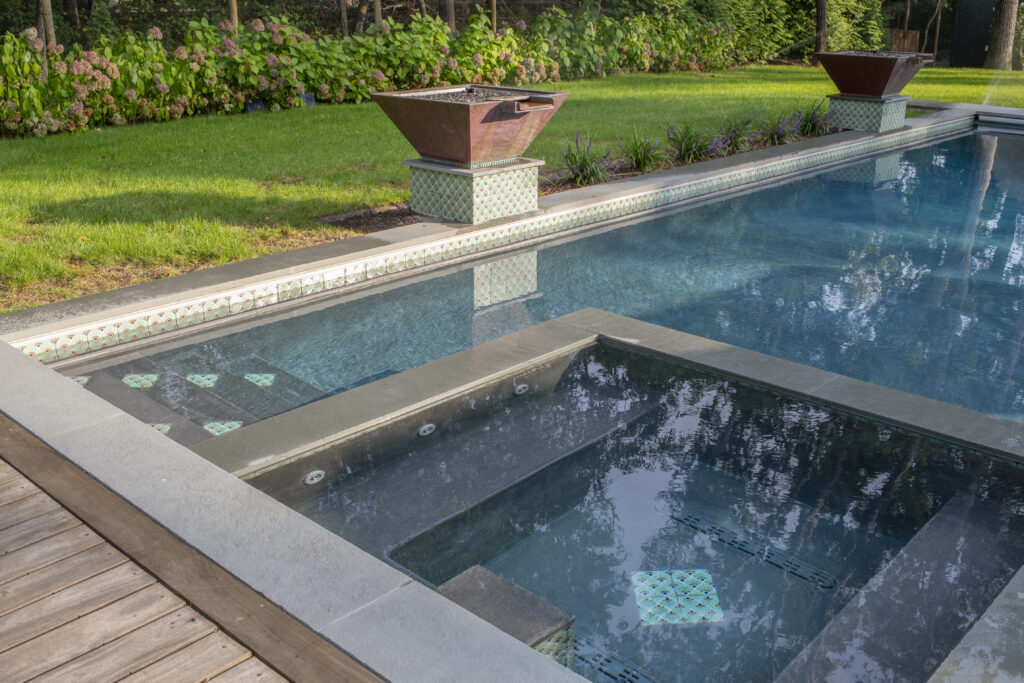
“There are so many fun and unique ideas,” says Del Vaglio. “There are beautiful fire pits with water features included in them. You can do something with a simple, long sheer descent, or a beautiful bowl in copper or acrylic in colors. It all depends on what you’re looking for.”
It can come with a price — both on your wallet and potentially your serenity. The higher the water feature and the more distance it takes to hit the pool, the louder the splash will be when it does, Del Vaglio cautions.


Today’s pool-seekers are looking to dialed-in features that fit into their lifestyle. Cold plunges and ‘swim against’ systems are two in-demand options that appeal to those looking to add more of a focused wellness component to their investment. “I’d say for probably 95% of the projects we’re working on, if we’re building a pool and a spa, there’s a cold plunge right now,” says CEO of Tortorella Swiming Pools Eric Hudgens.
Technology has long been a part of pools, with remote operations a standard. Want to turn the spa on as you’re driving out for the weekend for a perfect temperature upon arrival? Want the fire to turn on when the sun goes down? Want to play a particular song and sync the lights to the beat? An app can do that, too. And the tunes needn’t stop when you’re below the surface. “Speakers that are above and below water are amazing,” says O’Brien. “You can be listening to music, dive in and start swimming laps and not miss a beat.”
Before You Dive In
There’s lots to know before you build your pool. Pool companies and builders will be able to assist and answer specifics, but here are the basics.
- Permits: Hamptons pools require a building permit from the town municipality. This ensures compliance with structural, setback and safety requirements.
- Setbacks: In Southampton, pools usually require a minimum 12-foot setback from side property lines and 15 feet from the rear. Front yard setbacks are determined by the primary building envelope. In East Hampton, side and rear setbacks are typically 10 feet, and front yard setbacks are 20 feet.
- Fencing: Pools must be enclosed by a climb-resistant fence at least 48 inches high with self-closing and self-latching gates. Local variations exist, but compliance with these standards is required statewide.
- Alarms: New York State law mandates audible alarms for pools to alert homeowners to unauthorized access, enhancing safety, especially for children and pets.
- Drainage: Pools must have compliant on-site drainage systems, such as dry wells sized to handle full pool volumes. Stormwater managements practices, including permeable paving, rain gardens, bioswales and sediment traps, are also required to protect wetlands and groundwater.