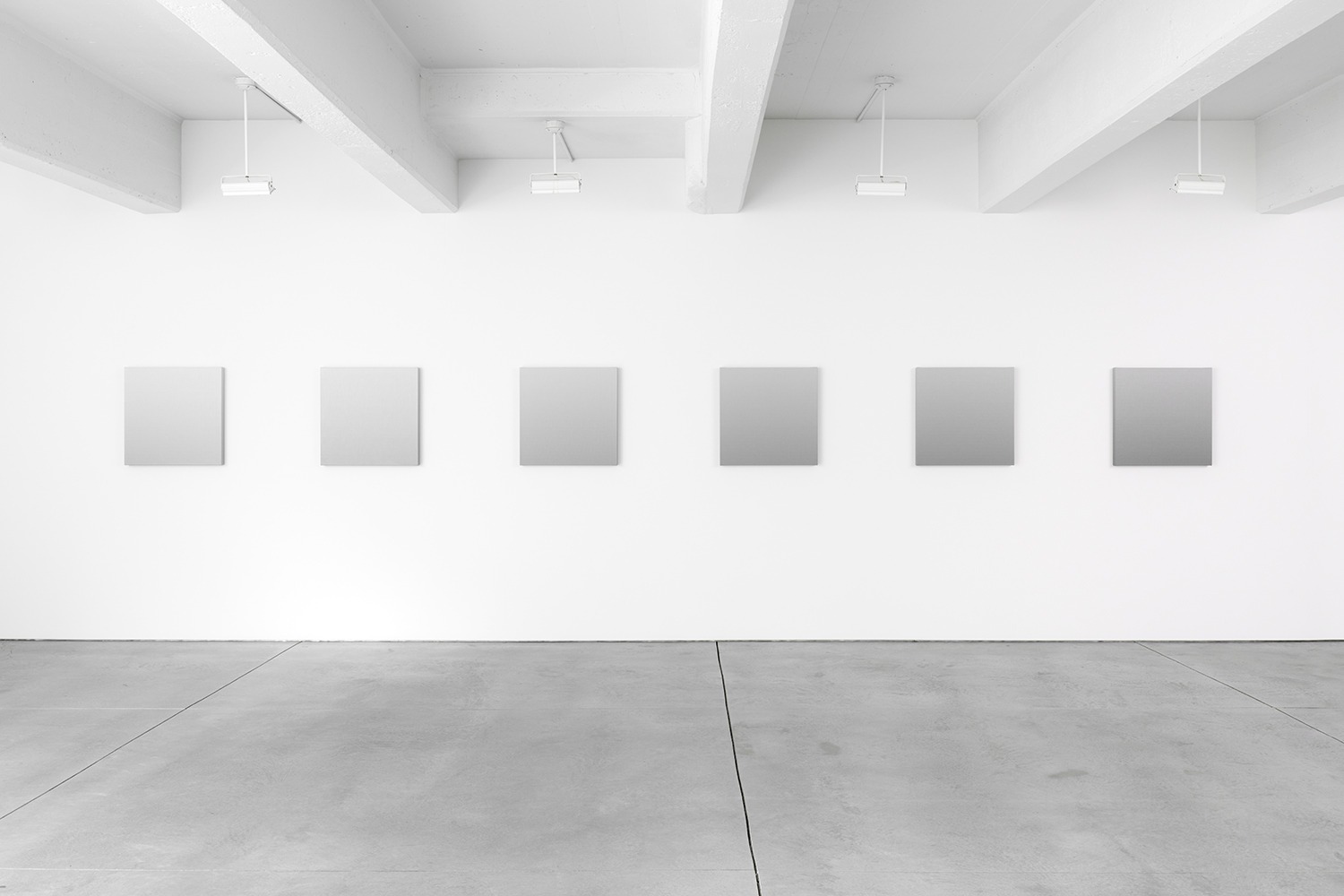
To the untrained eye, the paintings of James Howell, an American minimalist artist who lived the last eight years of his life in Montauk, might resemble those paper swatches of color you take home from the paint store to figure out which shade looks best in your living room.
But the truth is so much more complex, as explored in the retrospective exhibit “Endless Limits: The Work of James Howell (1935-2014)” at the Parrish Art Museum in Water Mill, offering art lovers a glimpse into the life of an artist who worked in meticulous, mathematical ways to explore the color gray.
“This is a great big moment for Jim,” said his widow, Joy Howell, at Friday night’s preview of the exhibit, adding special kudos to the Parrish’s curatorial team of Scout Hutchinson and Kaitlin Halloran for unearthing “treasures I had not even seen.”
James Howell “was a very private person, and that’s maybe why you didn’t know about his work,” said Laura Bardier, executive director of the James Howell Foundation, at the talk that accompanied the gallery opening on Friday. The Parrish show represents the first time Howell’s work has been exhibited at length on Long Island, where the light, water and fog served as inspiration for his later paintings.
The Parrish museum, according to its curators, is a particularly fitting venue for this retrospective. That’s because of Howell’s friendship that began in the early 1960s with the artist Fairfield Porter, a portion of whose work was gifted to the Parrish in 1980. In fact, Halloran said, their correspondence revealed that Porter was the one who suggested Howell use acrylics in his work. Prior to that, Howell had used oils and pastels, but with the move to acrylics he found the nuance of color and depth that he craved, according to Hutchinson and Halloran .
His early 1960s paintings, as showcased in the exhibit, did include color applied in bold, blocky ways to human subjects. But by the 1980s, Howell had entirely cut out other colors and was exclusively using three pigments to create his nearly 12,000 distinct shades of gray. (“We counted,” Bardier noted.)
“Every single article of clothing he owned was gray. Even the cat was gray. He lived it, but it wasn’t about gray. It was about light. It was about truth. He was living his truth.”
Jason Mesiarik, nephew of James Howell
He would use titanium white, ivory black, and raw umber in various amounts, using a computer, scale and viscometer to calculate exactly how much of each he’d need to mix together to achieve his intended result. The Parrish show includes many of the tools he used to accomplish this, including wood-handled whisks, a semicircular ruler, sea shells, brushes, metal bowls and containers of various sizes, and even a Rubbermaid kitchen spatula.
“The precision is insane,” Halloran observed.
In addition to a selection of Howell’s paintings, a number of photographs on display illustrate his painting process and show his various studios over the years. In the studio he maintained on San Juan Island prior to his move in 1995 to New York, floor-to-ceiling windows let in the light and views of nature that inspired him. The desire to immerse himself in those elements ultimately led him to set up a studio in Montauk in 2006.
The exhibition even gets a bit interactive, challenging visitors to match stickers in corresponding shades of gray onto a print of one of Howell’s paintings. (It’s a lot harder than it looks.)
Howell didn’t just paint in gray — he lived in it, too. His wife tells a story about a suit he bought while visiting London. The shade could have resembled an overcast sky above London itself, but when he returned to America, Joy Howell said, he told her, “I can’t wear this. It’s too green.”


Artist James Howell, who spent many years in Montauk, spent a lifetime seeking and working in the color gray. (Photos courtesy of the Parrish Art Museum and the James Howell Foundation)
“Every single article of clothing he owned was gray,” said Howell’s nephew, Jason Mesiarik of Chester County, Penn., following the Parrish talk on Friday. “Even the cat was gray. He lived it, but it wasn’t about gray. It was about light. It was about truth. He was living his truth.”
In an era where everything feels politically polarized — black versus white, left versus right — “the reality is we all live in the gray,” Mesiarik said.
It wouldn’t be a Parrish exhibition without a companion show presented “in dialogue” with the Howell retrospective. “Time Exposed: Hiroshi Sugimoto’s Seascapes” is an homage to another artist who influenced Howell. Sugimoto is a Japanese photographer and architect who explored the sea-sky horizon in shades of — maybe you guessed it — gray. Hutchinson, the co-curator of the Howell exhibition, described Sugimoto’s work as reflecting “an infinite array of atmospheric conditions.”
A documentary film capturing Howell’s life, titled “Thoughts of Infinity” and produced by the acclaimed German filmmaker Halina Dyrschka, will be screened at the Sag Harbor Cinema on Sunday, Oct. 5, at 2 p.m. as part of the Hamptons International Film Festival lineup.
“Endless Limits: The Work of James Howell (1935-2014)” can be viewed during regular museum hours (closed Tuesdays and Wednesdays). Admission is free for Parrish members and $12 for guests of members; regular admission is $20 for adults, and $14 for seniors. Admission is also free for military personnel, enrolled Shinnecock Nation tribal members, youth under 18 years old, students with ID, SNAP recipients and residents and employees of the Tuckahoe and Southampton school districts. The website for more information is parrishart.org.