

Whether you’re a new homeowner with a to-do list or someone who has invested in the major projects and is now looking for the finishing touch, landscape lighting is a low-intervention amenity that can use existing assets such as trees, plantings and architectural elements to enhance your property.
And, what’s more, it brings joy, according to The National Association of Realtors.
In a 2023 survey, the association asked more than 2,600 consumers about outdoor home remodeling projects, including popularity, satisfaction and return on investment. Landscape lighting and in-ground swimming pools were the only two projects to score 10 out of 10 on the survey’s “joy factor” question. Specifically, 61% of respondents said they have a “greater desire to be home” and 55% reported “an increased sense of enjoyment when they are at home” after completing lighting projects.
Local experts agree, saying investing in lighting gives homeowners an added dimension outside the four walls of their home — especially out on the East End, where proper lighting of a yard is not only aesthetically exciting, but adds to the safety factor and ups the chances you’ll use your property at all hours, not just in daylight.

“That warmth that you feel inside, you can bring to your outdoor space and you have cohesion between the inside and the outside,” says Vanessa Kordich, senior lighting designer at Hamptons Landscape Lighting, based in Southampton.
Kordich says that’s become an increasingly prevalent concept as “there’s a lot of opportunity to entertain outside now — like game nights and movie nights that really turn the outdoor space into a living space.”
Shane O’Keeffe, founder of LandLux in Southampton, goes even further, adding that lighting is critical for people who entertain at night.
“If you don’t have light, the landscape you’ve invested in disappears.” He and his team take a minimalist approach. “We do it in a soft and subtle way – we want people to see the effect and not the source.” He adds that the most common request he gets from clients is: Don’t make this look like Yankee Stadium.
Safe and sound
Aside from aesthetics, “there’s a security aspect,” says Geoff Singer, sales and marketing manager at Revco Lighting & Electrical Supply in Southampton. It’s one of the main reasons people invest in lighting, he says, noting that illumination helps make a home look occupied and cared for, and less likely to be vandalized. “People don’t run up to the lit-up house — they run up to the dark house,” Singer says.
Professionally designed lighting systems, he says, can help secure your home without making it look like a prison surveillance tower. Good designs leverage the property’s natural contours and existing architectural features such as soffits, pergolas, fountains or art installations. Strategically placed spotlights, trigged by motion sensors, can work in concert with the other lighting features on the property so that the home, yards, driveway and perimeter present a harmonious tableau without screaming “Guard!”
Another preventative measure is lighting pathways and dark areas to avoid falls and injury. For people who entertain a lot, the latter is an important factor says Kordich.

“There’s a liability aspect of having people over who don’t know your property or how to navigate at night if they’re at a party or around the pool and they don’t know their footing,” she says. “We want to eliminate dark corners so people aren’t tripping or stumbling.”
For the sheer pleasure of it
Having a light show in your back yard can optimize your natural surroundings, says O’Keeffe. He started LandLux in 2024 after a dozen years as a horticulturist with Summerhill Landscapes. That experience informed his approach, putting trees and other flora and fauna first.
“All our technicians have a horticulture background so they are very focused on the care and protection of the landscape — not drilling into trees or stomping on ground cover,” he says.
At LandLux, the shared expertise helps provide seamless project design and longevity of the installation because all members of the team understand and prioritize plant health. “We like to choose individually dimmable lighting because every tree is different,” O’Keeffe explains. “For example, in woodland lighting, some trees are more conducive to being lit, healthwise, while certain evergreens like their darkness.”
They also select specific fixtures and attachments that won’t corrode into the trees over time, and can be adjusted periodically to allow for tree growth.
Like O’Keeffe, Kordich pays attention to the natural surroundings, and before she digs into a design plan, queries clients about significant spots in their yards and gardens. It could be something as obvious as a pergola or a pool or a signature specimen tree. When a client has a specific tree in mind, she asks if it has a particular importance.
“Sometimes I find out that that tree is very meaningful—maybe a memorial planted for a loved one and I always ask about that,” she explains. “It may not always be a beautiful tree, but it could be [one] that has a deep meaning for a client and can be illuminated in a special way.”
Hire a pro
Forget the DIY solar-powered pathway stakes and the Edison-bulb-styled string lights, and hire a pro —not only to lessen the risk of injury and error, but for the expertise they bring in knowing the equipment that will properly deliver light, and where, and how it works in harmony with other lighting and architectural features.
Singer says, “Different lights do different things” based on placement and purpose. Revco’s Southampton design team can map out a plan according to customer timing and budget. They can work with clients for whom the sky is limit, or those who want to take a conservative approach and build out their lighting as their needs change.
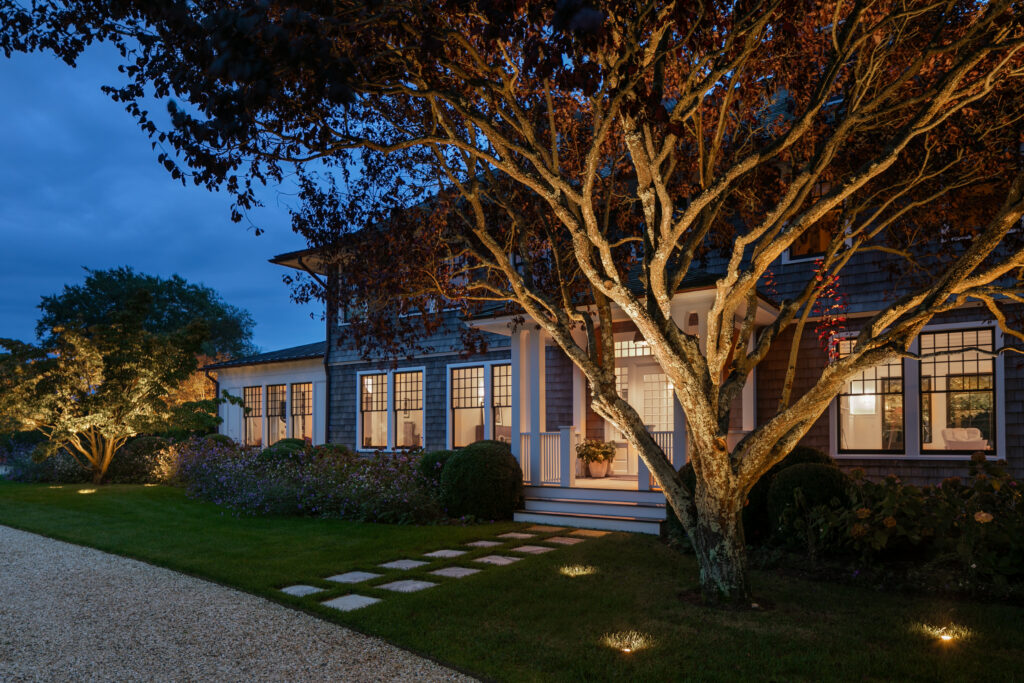
“We can build out in phases or create a full plan with full scope,” Rob Rossi, Revco’s lighting manager, says, noting that even a $500 investment can get a client started with the basics. “A lot of people think they need a ton, but honestly, less is more.”
But for those who do want something flashy, there are options, such as Colorscaping, a smart lighting system that can change the color temperature and brightness of objects or be used along driveways and pathways. Some clients request permanent lighting on the house soffits with the ability to program colors that change with the season, or to root for their favorite sports franchise by projecting team colors during a significant game.
“It can be gimmicky, but people love it,” Rossi says. “For the most part, that’s a very small percentage who want that.”
Another reason to hire a pro: Designers with advanced credentials, such as O’Keeffe and Kordich, both of whom are Certified Outdoor Lighting Designers, can tap into that organization’s resources and knowledge base to stay on top of product and design trends, which they can share with their clients. That training focuses on responsible lighting design, which includes not only sensitivity to plantings, energy efficiency and the environment, but also to neighbors.
“We work on preventing glare and light trespass, aiming the fixtures so they don’t drift over to the neighbor’s property and shield for glare, so neighbors are not offended by the light — we want them to be happy, too,” O’Keeffe says.
Kordich says her expertise in the industry has allowed her to develop relationships with vendors who can point her to innovative products and solutions.
“When you use a designer, you are tapping the expertise of someone who understands products and has worked hard with manufacturers to get a good warranty for the duration of the product,” she explains. “People can come to me with a basic idea and then we can expand on that together and I can draw out some of the things that maybe they’re not thinking of.”
Value in voltage
The national realtor’s report revealed that along with other landscape projects, lighting is a good investment, with a 59% cost recovery. Other industry estimates place the return as high as 75%, depending on the scope and sophistication of the project.
“Landscape lighting can indeed add significant value to your home,” says Douglas Prexta, landscape sales manager for Hinkley, a lighting specialist in Ohio that supplies local vendors such as Revco. He says a well-designed landscape lighting system can increase home value 5-10%. System design, complexity and product quality and durability are factors in those estimates.
But there’s no price you can put on the wow factor when a project is completed.
“I have been involved in many designs and installations, and on almost every project we have more than exceeded the customer’s expectations when we flipped the switch on showcasing their landscape lighting at night,” Prexta says.
The right stuff
Dave Girgenti of Innovative Technologies in East Quogue is especially keen on materials, procuring most of his equipment from Coastal Source, a family-owned-and-operated manufacturer in the Florida Keys. In its state-of-the-art, dedicated R&D lab, prototypes undergo tests in various simulated climate conditions.
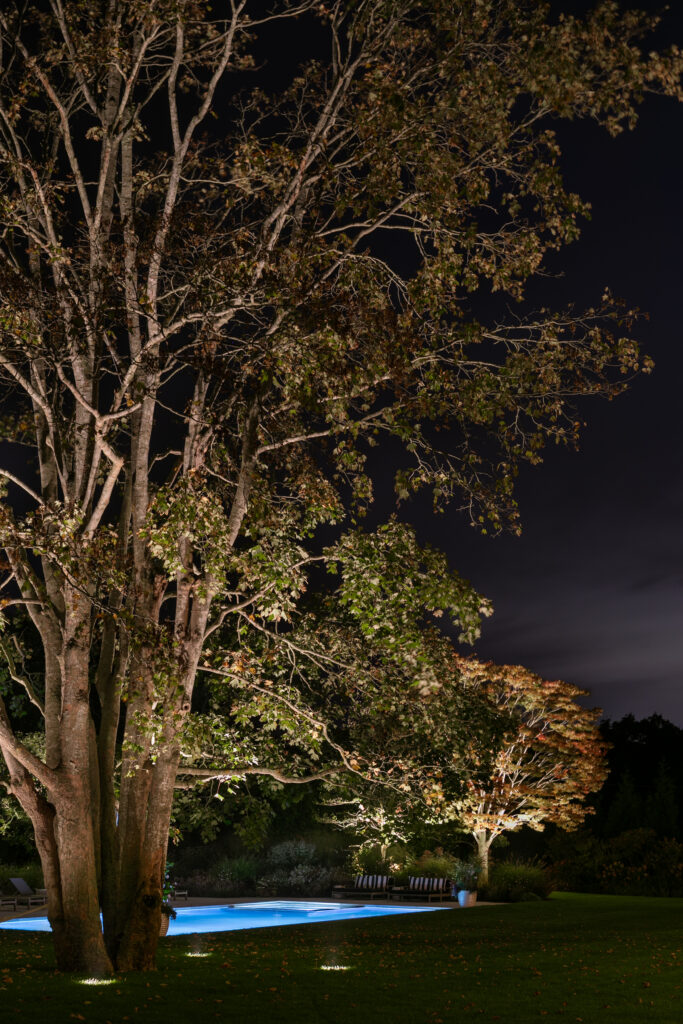
“They expose their fixtures to everything — salt, hot water, lights,” Girgenti says, adding that all his technicians were trained on-site in Florida and the company makes everything on site “so the customer knows exactly what they’re getting.” To drive that further home, Girgenti’s team will install a live, temporary presentation on-site, complete with a transformer and light setup.
“We can leave it overnight so customers can experience it, really digest and get a feel for what they’re looking for,” he says.
“Can you DIY? Sure,” Girgenti says. “The stuff is out there and people do it, but will you get the same effect as us? Absolutely not.”

