
North Fork
Ready to Set Sail: Become a seasoned sailor with help from the pros
by Emily Toy
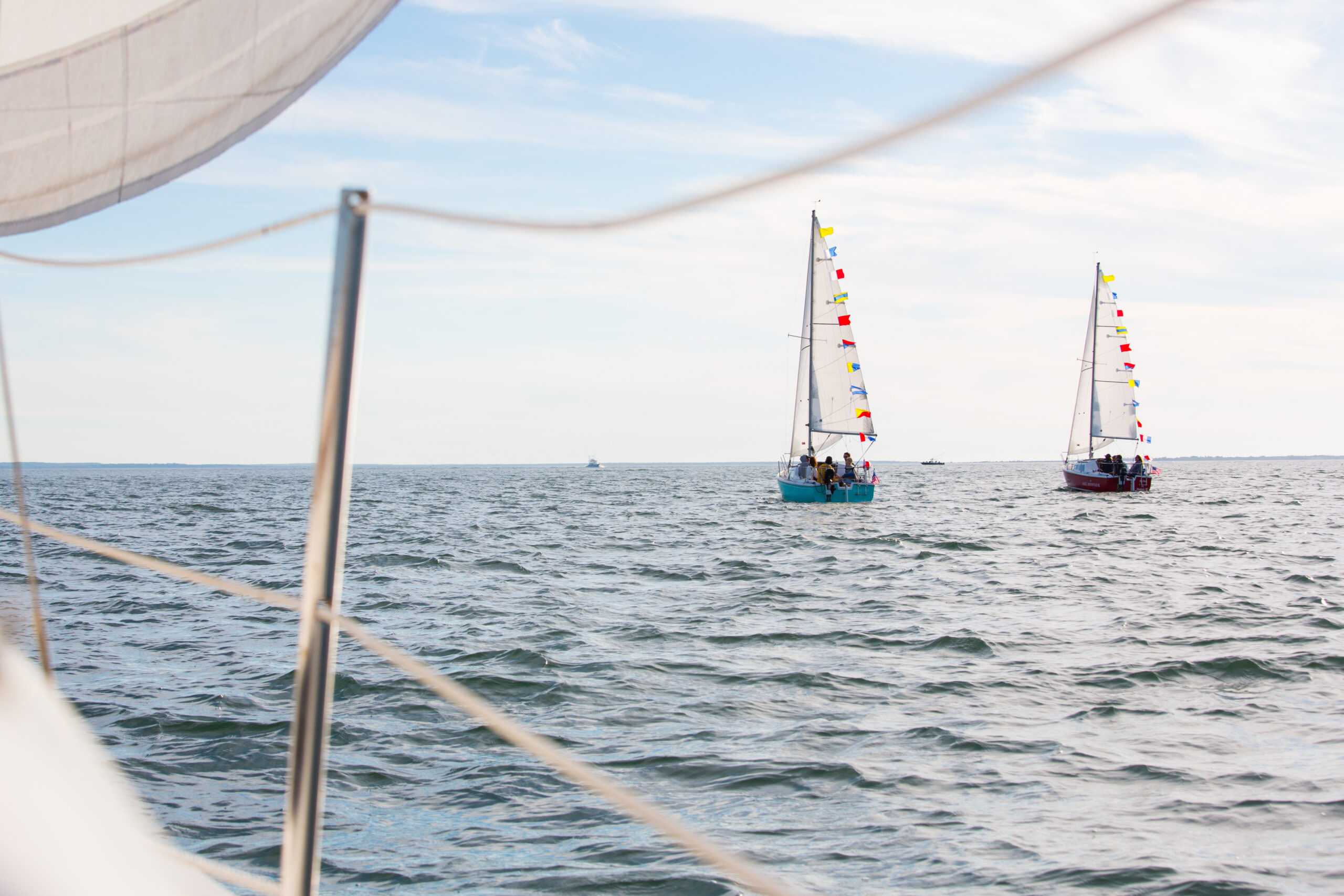
The East End has a long history with sailing.
A main means of travel for millennia, sailboats were an integral part of the fleet utilized for long trips at sea during eastern Long Island’s flourishing whaling industry chapter from as early as the 17th century. Some whaleships clocked in at over 300 tons, boasting three masts and helmed by a crew of about 40 men. Recreational sailing started to gain popularity on the East End in the 1880s, continuing well into the 20th century. Nowadays, it’s grown to something beyond a hobby. It’s a way of life, and a highly coveted one at that.
My father, Jerome Toy, is a sailor at heart. Back in the late 1970s, before I was born, he and his business partner and friend — the late, great Bruce Tait — owned a small surfing shop in Sag Harbor called the Sail and Pedal Company, where K Pasa restaurant is today. The pair rented and sold windsurfing gear, plus bicycles and small boats, using Windmill Beach (located across the street, at the foot of the Sag Harbor bridge) as both an extra retail space and a launch area for short lessons and demonstrations. Together, they helped formulate Southampton Town Youth Bureau’s first-ever sailing program, and initiated Wednesday-night sailing races in Sag Harbor.


From Orient to Montauk, sailing lessons — from lingo to working with the wind — are available to teach you the ways of the water. (Left photo courtesy of Ally Manzo; right photo courtesy of Sail Montauk)
Those races still take place every summer and are hosted by Breakwater Yacht Club (51 Bay St., Sag Harbor, 631-725-4604), of which Bruce was a founder. When, in the early 80s, my dad went into construction and Bruce started his yacht brokerage business, they both remained avid sailing enthusiasts, even as boating became a more “push button” endeavor. My father still sails to this day and sometimes takes me along for the ride.
“It draws a certain interest to a certain type of person,” he says of his favorite pastime. “I think sailors are, or at least they used to be, very clever people, because when you’re sailing, usually something breaks or you go out with the intention of doing one thing and, because of the conditions, you end up doing something else. It’s never a straight line.”
Learning how to sail, however, isn’t too complicated. While most sailing instruction here on the East End is geared toward children, there are a few institutions scattered about where adult sailing lessons not only exist but are widely encouraged.
“It’s just the willingness to try something new,” says Alexandra Ali, owner of Sail Montauk (478 W. Lake Drive, Montauk, 631-522-5183). “The people that we see are a little bit more adventurous. They want to try new things. They’re open to new ideas. They’re receptive to learning. For me personally, I love it, because I don’t need to go get fuel. I could get by with just my sails in the wind, and that’s all I need — which is pretty beautiful, if you think about it.”
Learning the Language
Sailing is one of those things that engages both body and mind.
Offering the dual benefits of physical exercise and cognitive thought, sailing is a holistic affair. It is directly dependent on, among many other things, wind and weather, while also heavily contingent on mindfulness. The need to stay aware of one’s surroundings and the ability to make quick decisions is paramount. And maybe, above all else, sailing requires a lot of patience.
While Ali agrees patience is important, so is knowing sailing terminology and how to use it correctly.
Last year, when I was out sailing with Dad and my sister, he, our ever-intrepid skipper, gave me a command to “fall off” — a fundamental directional adjustment that means to turn the boat’s bow away from the wind, shifting the course downwind. I was controlling the tiller (that wooden, stick-like thing found toward the back of the boat that’s attached to the top of the rudder underneath), which meant I was in charge of which direction the boat was moving toward.


Many factors go into a successful sail, from actively controlling the sail trim to that all-powerful factor: the weather. (Left photo courtesy of Sail Montauk; right photo courtesy of Ally Manzo)
In that slight moment of panic, I realized I was driving something I knew nothing about and that his commands would be lost on me. It was a mild, quiet day on Sag Harbor Bay, so when I frantically replied, “Left or right?” it wasn’t the end of the world. But I quickly understood that wouldn’t always be the case and that every single thing on the boat I was controlling, plus communicating about how to steer it, had specific and unique language attached to it.
“The hard thing is the terminology,” Ali agrees. “It’s extremely important, though, because when you’re communicating on a boat things happen quickly, so you need to be able to properly communicate what you need or what you want. Communication is huge on boats.”
Ali and her team at Sail Montauk teach adults of all ages from May through September. Accredited by the American Sailing Association, the school offers introductory classes about knot tying, on-the-water practice, and terminology, which includes going over the parts of the boat as well as the ins and outs of sailing jargon. Additionally, in the basic sailing package Sail Montauk students are taught the rules of navigation, safety gear and procedures, and boat handling. One-on-one lessons are taught in five three-hour increments.
“There’s other schools you could go to that will do it all in a weekend, but we’ve kind of found that if you spread it out a little, you retain the knowledge better,” Ali says. “And also, you get to sail in different conditions every day, where if you’re just doing it in two days, maybe you have no wind, right?”
Weathering the Tides
Another time I went sailing with my dad, I was told we were “coming about” or “tacking,” which meant we were turning the bow of the boat through the wind, changing its direction, thus moving the sails from one side to the other. That meant the boom (the pole attached to the bottom end of the mast that holds the sails of the boat) would swiftly move from one side to the other overhead. Keeping your head low was vital, and so was switching your seat to maintain balance and control as the wind direction shifted, because that meant the boat was shifting, too — abruptly. It was just one of the many reminders that when you’re on a sailboat, you’re always moving.
“That’s one of the things that we try to emphasize from the beginning,” says Ally Manzo, a longtime sailing instructor at Breakwater Yacht Club in Sag Harbor. “We’re just not driving you around the harbor. You’re participating in a class. Everybody is changing positions on the boat and we’re learning how to do it from A to Z. You’re actively doing something the entire time, from start to finish.”
I think sailors are, or at least they used to be, very cleaver people, because when you’re sailing, usually something breaks or you go out with the intention of doing one thing and, because of the conditions, you end up doing something else. It’s never a straight line.
Jerome Toy
For Manzo, a Sag Harbor native who for the past four years has helped nurture and develop a highly attended women’s sailing program, preparedness is next to godliness in the sailing world.
“First, you’ve got to know what kind of weather conditions are out there,” she says. “You never want to get on the boat without knowing what’s out there, at least the best you can.” Second, Manzo says, is being familiar with how different things on the boat work. Before heading out on the water, she spends an hour or so going over terminology so that students can become familiar with what to expect and, specifically, what commands to execute.
Having a successful sail is all about sail trim, which refers to the way the sails are used and shaped. Easing (letting out) and trimming (pulling in) the sails will determine how things go. When sailing upwind, you want the sails tight or flat. When sailing downwind, you want them curved so they can catch as much air (in this case, wind) as possible.
Students learn on boats ranging from 15, 22 or 24 feet. Ideally, there are three students and one instructor in each boat. While in motion, the sails act as both your accelerator and your break. Holding the ropes, or “sheets,” controls the angle of a sail relative to the wind, allowing sailors to adjust the sail’s position and shape for optimal performance.
“When learning how to turn the boat, ‘tack’ the boat (turning the bow into the wind) or ‘jibe’ the boat (turning the stern into the wind),” Manzo says, “there’s a full set of commands that you have to say if you’re the skipper and then the crew has to respond back to you. So, you’re not going to have a boom swinging close to people’s heads randomly without discussing what’s happening.”
During her introductory sessions, Manzo also covers everything from navigation and wind direction to proper sailing attire. “I’ll talk a little bit about proper things to wear on the water, improper things to wear on the dock. ‘Hey, you came here in flip flops today? Awesome. Please don’t wear those next class.’ It’s about being thorough and it’s about staying safe.”
Keeping the Sport Alive and Well
Among the oldest established sailing spots on the East End, Orient Yacht Club (2100 Village Lane, Orient, 631-323-9767), founded in 1933, ranks among the only North Fork clubs with an adult sailing clinic. Dubbed a social club first, a junior sailing club second and a yacht club third, the locale hosts three sailing clinics for adults each summer. All are welcome and students are grouped by skill level.

Twenty minutes down the road, Southold Yacht Club, founded in 1938, maintains a thriving junior sailing program that is keeping the sport alive and well.
“We want to help keep sailing affordable and accessible for the North Fork,” says Celeste Flick, the club’s treasurer. Presently, private sailing lessons for adults can be arranged with instructors and are based on availability. “We’re in the middle of a soft launch, working to further develop our adult learn-to sail-program,” she says.
In the meantime, the learning season at Southold Yacht Club is June 30 through Aug. 22, with dozens of children and teens attending each year. “It’s more than a camp; we’re a community,” Flick says.
For Manzo, who has been sailing at Breakwater since she was seven years old, the sport, and the people doing it, have created a palpable sense of community she’s experienced well into adulthood.
“A lot of the women, a lot of these people, have made friends here,” she says. “When you’re on a boat with somebody, you’re immediately putting some sort of trust in that person. I’ve watched a lot of camaraderie come out of it.”
