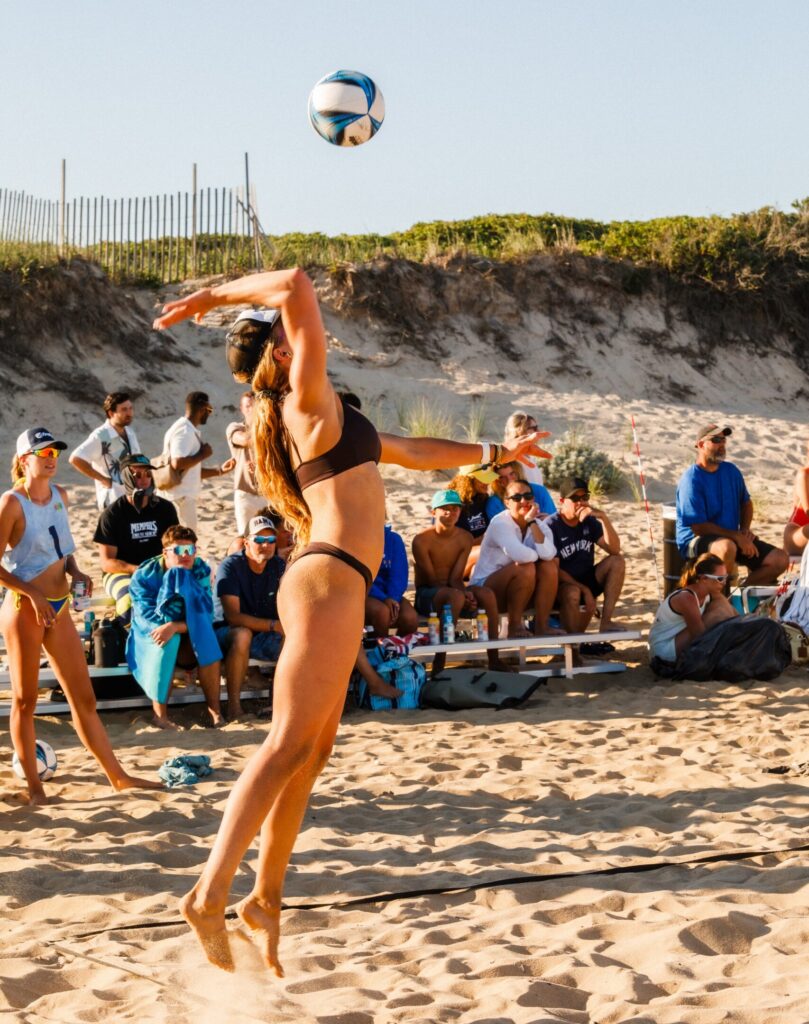
Picture a perfect Hamptons beach day: a cloudless sky, a pleasant breeze, the sand soft but almost too hot under your feet. Your skin is slathered in SPF 50, if you know what’s good for you. Seagulls eye your lobster roll. Waves beckon.
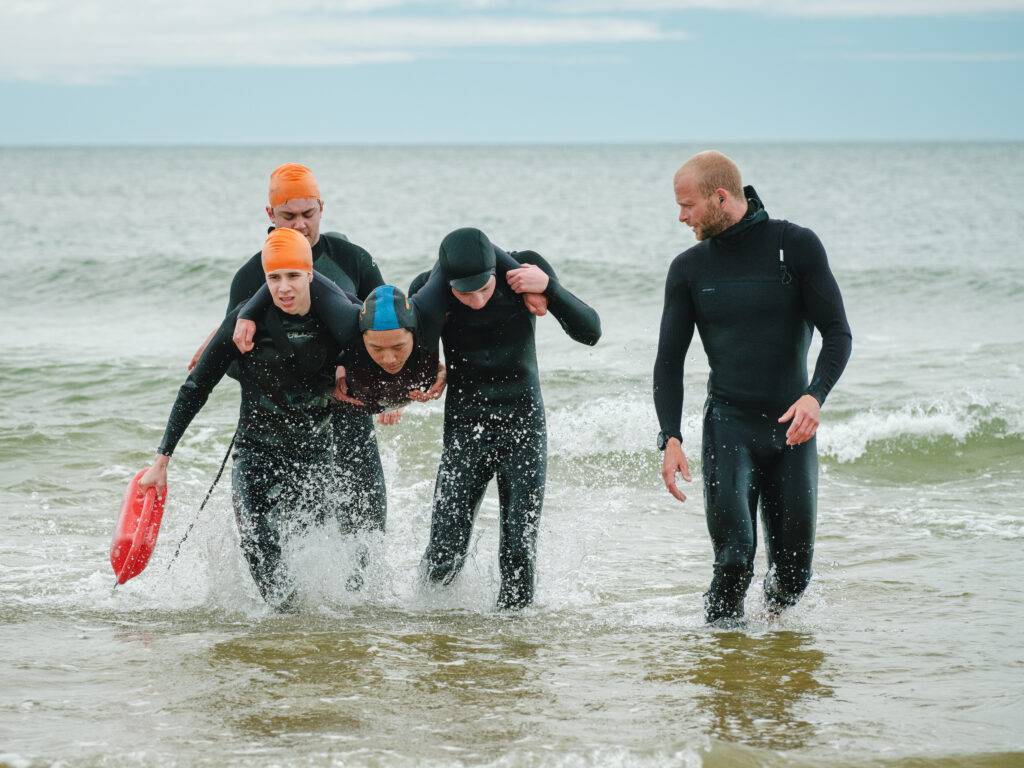
It can’t get any better than this, but it can get worse. On any given day on a South Fork ocean beach, Hamptons lifeguards are prepared for anything — pulling a distressed swimmer from a rip current, aiding a tired paddler who’s gone out too far, picking up a disoriented kid knocked over by a wave — and it’s no accident.
“It has the stigma of being a summer job, but if you’re in a beach community like the Hamptons it’s imperative to keep up on your game,” Drew Smith, chief of the East Hampton Village lifeguard crew, says one cool morning on Georgica Beach. “Your real-time thinking and actions have to be finetuned because you have seconds to make decisions that could vastly change the outcome.”
Ann Naughton, chief of the Southampton Town lifeguard squad, sums it up this way: “You’re going in the water from five times to 20 times, in and out, assisting somebody, or feeling a situation out, or guiding somebody. When something happens, you put your head down and make things happen to respond. You have to have that mental toughness and that fitness level and knowledge of the water to do this job.”


A significant number of the paid lifeguards are also volunteer first responders with groups like East Hampton Volunteer Ocean Rescue (EHVOR), the East Hampton Village Surf Rescue Response Team, the Westhampton Ambulance Volunteer Water Rescue, or the Southampton Village Ocean Rescue (SVOR). (Photo credit: Jeremy Garretson)
What It Takes
To become an ocean lifeguard, a person must be at least 16 years old, take a 40-hour training course and pass a rigorous test that entails timed distance swims and skills such as rescue-line operation and side-swimming while holding a weight that simulates that of a rescue victim. There are also first aid and CPR requirements, plus additional training for anyone who intends to use a jet ski or other rescue vehicle.
But to become an ocean lifeguard in the Hamptons, there’s a certain level of expectation and training. Even if you’ve passed the ocean certification test before, you’ll need to retake it either every year, if you plan to work in East Hampton Village, or every two to three years, depending on the town or village you’re working in, with crews practicing constantly all season.
East Hampton Town is now accredited by New York State to offer training and administer both ocean and still-water certification tests. But once upon a time, there weren’t any standard training courses and the lifeguard test fell under the auspices of the Suffolk County Department of Civil Service at Smith Point Beach. And it was hard to pass — really hard. Joe Dooley, who oversaw the testing, set the tone.
“There was no training,” says Johnny Ryan Jr., who oversees all the lifeguards in East Hampton Town. “You just showed up for a date that they were offering the test and hoped you passed it.”
The test is still referred to as the Joe Dooley test, and it continues to be administered the same way in East Hampton. “We know what we’re getting out of it, the type of guard,” Ryan says. “It’s a difficult test that deals with cold water and endurance.”
When Dooley died in 1999, the New York Daily News wrote in his obituary that he’d certified some 25,000 lifeguards over his 40-year career. More than a quarter-century after his death, his legacy continues to be one of preparation, precision and setting the bar high.
“He was tough. It was extremely demanding,” recalls Naughton, who lives in East Quogue and is also a volunteer firefighter there. “You really had to earn your stripes for him to pass you, so getting through that and keeping that going, that standard, is, to me, very important.”


Junior lifeguarding programs for older kids and teens foster future lifeguards, as do programs like Nipper Guards for kids as young as six. (Photos by Jeremy Garretson)
Hero worship being what it is, a lot of people have a misconception that guards make dramatic, headline-worthy saves all the time.
“The heroics of running down the beach and saving a life is actually a very rare part of the job,” says lifeguard Jimmy Minardi. “Mostly you’re managing bathers in little flash rips. There are a lot of assists. I have over 400 rescues in my life, and I would say maybe a dozen of them were life-threatening.”
Often, the work lifeguards perform happens before a rescue ever takes place. They’re always scouting for weak swimmers and watching the rip currents move. They’re enforcing the rules of the beach (including telling parents to not allow their kids to dig super-deep holes near the water, which can impede rescues and cause hazards of their own).
“To me, the nectar of lifeguarding is not the beach heroics or the competitions,” Minardi says. “Preventative lifeguards are pros.”
Lifeguard Lifers
Amanda Calabrese’s entry into lifeguarding began at age seven while tagging along with older kids before the Nipper Guards, a program that whets kids’ appetites for lifeguarding when they’re as young as six, was even a thing.
“I’d run around in the shallow water and play beach flags with the older kids,” says the nine-time United States Lifesaving Association champion from East Hampton. “My mom said if you want to learn how to surf and go surfing with your dad, you have to be in the junior lifeguard program.”
Calabrese, who now lives in San Francisco, was 12 when she joined. Five years later, she was working as a fully certified lifeguard at Indian Wells and Ditch Plains.


John Ryan Jr. and John Ryan Sr. make lifeguarding a family affair here on the East End, which has a deep history with keeping local shores safe. (Photos by Jeremy Garretson)
“There was nothing stronger in my life than the lifeguard community,” she recalls. “It’s a very unique experience to have something you’re a part of your entire life. Spending that much time and achieving that much depth in a community is really rare. Coming of age with this, I was learning very real-life skills while having an unusual level of responsibility for someone that age.”
Calabrese’s father, T.J. Calabrese, is an optometrist by profession, but he’s a lifeguard, too. Unlike many of his colleagues and friends in the lifeguarding community, though, he waited tables at restaurants in the summers of his youth. He didn’t begin training until he was in his mid-forties.
“I had a pretty crazy experience in Puerto Rico in my early forties,” he says. “I was out surfing in some really big waves and broke my leash on my board. I had to swim in over a mile to get back, and I was freaking out. I realized I needed to become a better swimmer.”
Now, T.J. is a certified ocean guard who volunteers with East Hampton Volunteer Ocean Rescue and was its chief for two years. He serves as vice president of the Hampton Lifeguard Association, a nonprofit group that raises awareness and money to support lifeguarding programs, training and equipment locally. And he’s teaching kids how to swim, too.
“With all my years of experience in the ocean, I thought it was something I could give back to the community, so 17 years later, I am still a junior lifeguard instructor,” he says.
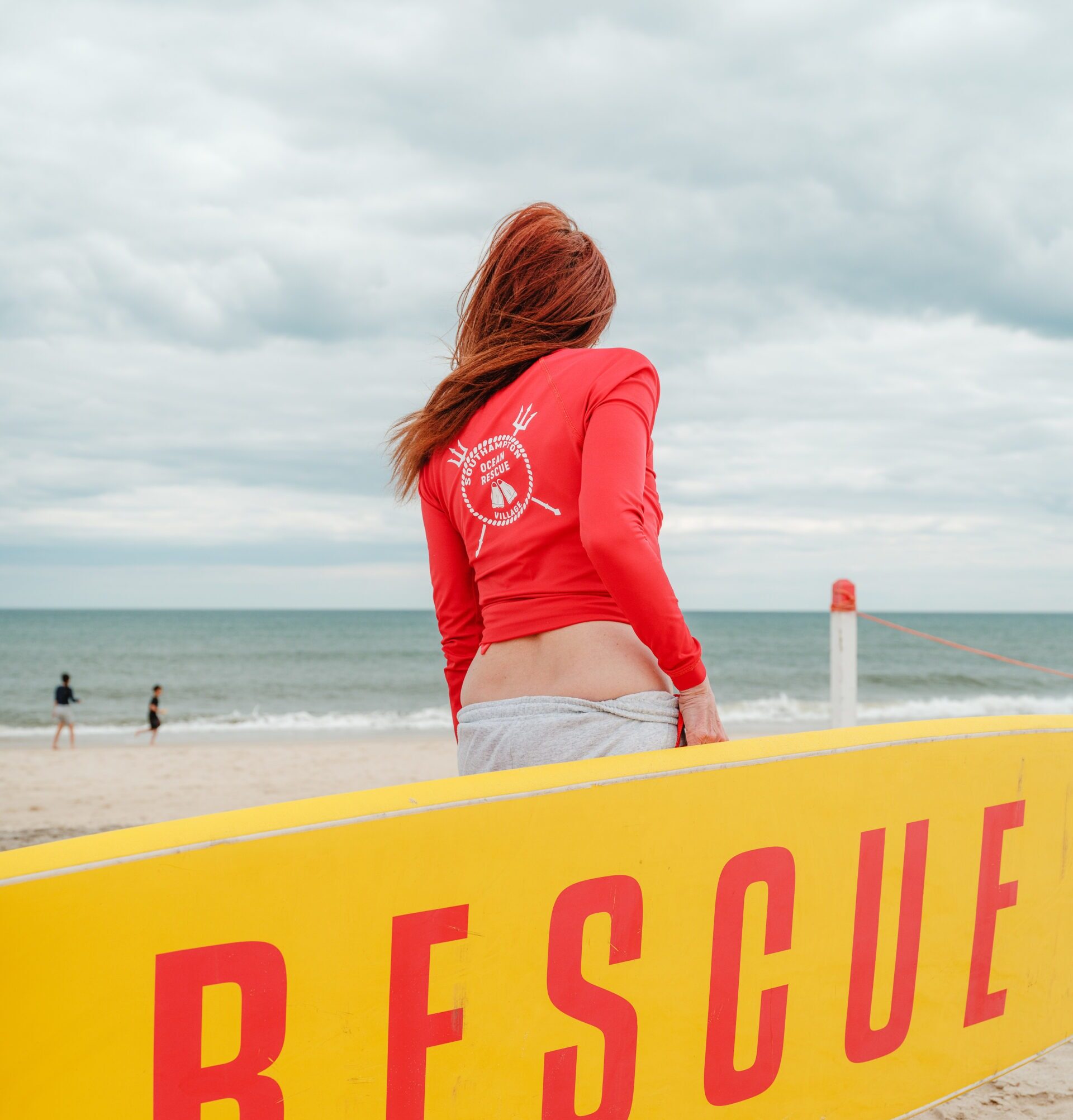
A significant number of the paid lifeguards are also volunteer first responders with groups like the East Hampton Volunteer Ocean Rescue, the East Hampton Village Surf Rescue Response Team, the Westhampton Ambulance Volunteer Water Rescue and the Southampton Village Ocean Rescue. These are the folks who answer the call when there’s an after-hours emergency or a situation at an unguarded beach.
Alex King of Sagaponack, who’s in her third year as chief of SVOR, trained for and passed the lifeguard test in 2016. “It started out as something I wanted to do to be more fit and get better skills, but it became more meaningful. Once you save somebody’s life, it changes you,” she says. “There’s not a better feeling to know that you can be there to save a person and spare the pain of family and a community.”
King was part of a team that saved four kids in one day at Cooper’s Beach last year. Two of them were 17, including the captain of a high school basketball team — someone much bigger and taller than King. None of them were strong swimmers.


Eight of John Ryan Sr.’s nine children walked in their dad’s footsteps and also became lifeguards, like John Jr. (right). (Photos by Jeremy Garretson)
“It takes a lot of physicality and you have to be really fit. The only time when training is burdensome is when it’s cold and windy,” King says. “But then you see the people who stick with it and get it done, even in that weather. One of my mentors, Steve McMahon from Bridgehampton, the First Assistant Chief in EHVOR, I learned almost everything I know from him. He always says, ‘If it ain’t raining, it’s not training.’”
When Tragedy Strikes
Along with training, watching and rescuing, lifeguards must also confront the fragility of life.
In summer 1996, Naughton was stationed on Tiana Beach in Hampton Bays. On July 17 that year, she was working when TWA Flight 800 went down in the Atlantic off East Moriches.
“We were picking up parts of the plane on the beach for many, many days and weeks after that,” she recalls. “That was pretty intense.”
Chris Cinque was on Indian Wells Beach in Amagansett in June 2018 when a sudden and powerful storm rolled in and a small plane went down over the water. That crash killed Ben and Bonnie Krupinski, who were regarded as pillars of the community, along with their pilot and their 22-year-old grandson.
Cinque recalls jumping into the search-and-rescue effort on a jet ski, the annual training for which he’d only just completed earlier in the day. One of the slides in the training presentation addressed plane crashes.
“Jeff [Thompson, chief of the Amagansett lifeguard squad] says, ‘Just so you can see it is something that can happen,’” Cinque recalls. “And then we go to the water that day, start working and a crazy storm comes in. Wouldn’t you know, we just showed that PowerPoint slide and we got a call about a plane. They lost contact.”
Every so often, despite the guards’ best efforts, someone loses their life in the ocean. Three off-duty lifeguards were doing some after-hours surfing at Ditch Plains Beach when 31-year-old Zane Kitburi of Montauk ran into trouble in the water amid yellow-flag conditions on July 19, 2022. He was unconscious when lifeguards pulled him from the water and couldn’t be resuscitated.
That day, Johnny Ryan Jr. told The East Hampton Star that “all three guards are pretty shaken up… It’s part of the job.”
All in the Family
Johnny Jr. is one of Pat and John Ryan Sr.’s nine children. Eight of them became lifeguards, and so did many of their children. Big John, as Johnny Jr.’s dad is called, learned how to certify lifeguards under Dooley. He also established one of the first training courses ever to be offered on Long Island.
“My father knew the standards of what they were looking for,” Johnny Jr. recalls. “So my father took it upon himself to train individuals to successfully pass the test, on his own. People would show up.”
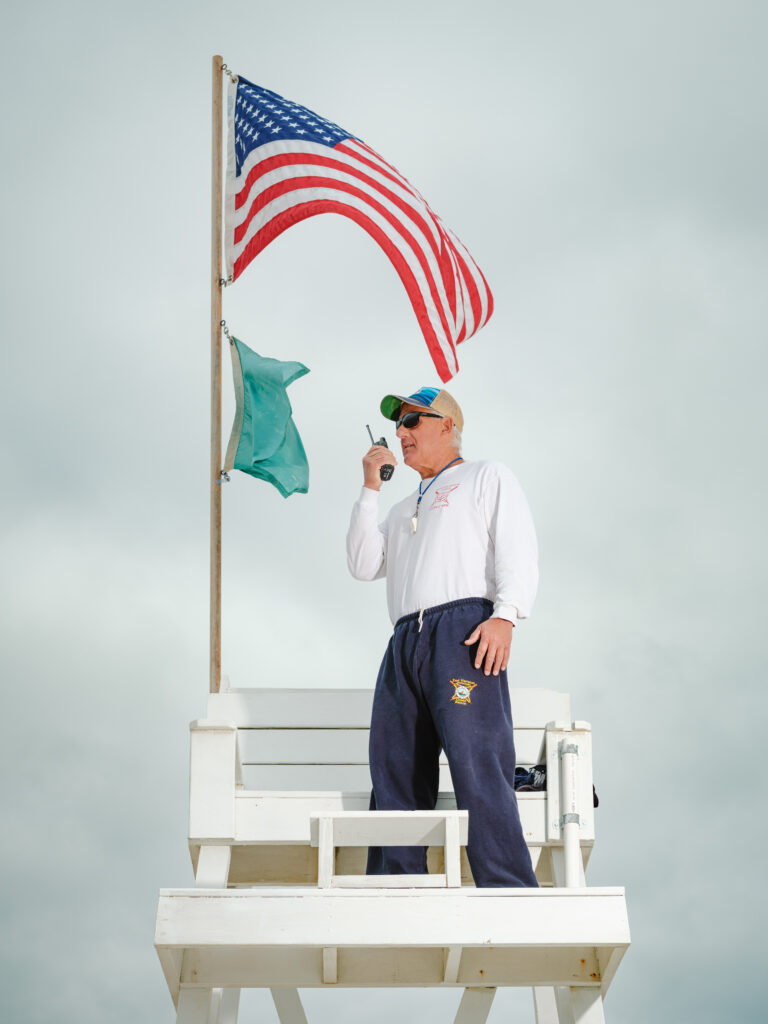
Big John, a former math teacher who is in his 28th year on the East Hampton School Board, recently turned 90. He was thrown a surprise party where a not-insignificant percentage of guests either were or had been lifeguards at some point in their lives. And he’s still involved in the lifeguarding scene, particularly when it comes to where so much of it starts — swimming lessons at the YMCA East Hampton RECenter.
Minardi has been lifeguarding in East Hampton since 1977. His brother, Chris, an East Hampton Village trustee, is a lifeguard, just as their father, Anthony, was. Minardi’s 16-year-old son, Pax, is a lifeguard, too.
You might wonder if there’s something in their genetics — or in the water — that acts as a a siren call to the job. Certainly, there’s a specific kind of person who feels the urge to serve and support their community, and there are countless examples of similarities and intersections between lifeguarding and other lifesaving volunteer callings. But for some, that family bond starts at the dinner table and travels to local shores.
“I looked up to my father, sitting in that lifeguard chair and running into the water pulling people out of rip currents,” says Minardi, who founded East Hampton Village Surf Rescue Response Team last summer.
It’s the kind of breeding, though, that extends beyond blood ties. Each guard who passes the test — whether open-water on the ocean or still-water on the bay — earns entry not just into a profession but a family.
“Once you join, it’s hard to get out of it,” Johnny Jr. says. “You’re a lifeguard for life.”
That sense of family is important to Cinque, a new dad who happens to be married to the former Haley Ryan, also a lifeguard following in the footsteps of her grandfather, Big John.
“It is definitely a big family,” Cinque says. “One that you’ll have forever.”