At Cardaro’s Buttercup Design Group, open minds create beautiful open landscapes.
There are certain creators who have somehow coined a look or feel that can’t be wholly described yet you know when you see it, like an Annie Leibovitz photo or Wes Anderson movie set.
The same can be said for a garden designed by Vickie Cardaro, founder of Buttercup Design Group on Shelter Island. But don’t ask her for her design process, because the self-taught horticulturist and designer pretty much plays it by ear. Or in this case, by eye, with no two projects alike or cookie-cutter in their creation and process.
“People have said to me that they always know when it’s one of my designs,” says Cardaro. “I don’t know what that is, but I suppose there’s just something about it that evokes a sensibility.”
That sensibility was not informed by much of Cardaro’s pre-horticulture life. In fact, she says, “Less than zero of what I experienced in childhood informed my interest as a landscape designer.”
Life as a nomad
“From the minute I popped out of the womb, I think I was fixated on words and language,” Cardaro says. “Then I read a book on Marie Curie and Louis Pasteur when I was eight and was convinced I was going to Johns Hopkins to be a biochemist, which never happened.”
What did happen was a life of travel and free-form study. The daughter of a rocket engineer who worked on the Gemini, Mercury and all 11 Apollo missions, Cardaro lived on numerous missile bases, including the Kennedy Space Center in Cape Canaveral. She traveled up and down the Eastern Seaboard and around California and meandered through various academic programs, studying journalism, film theory, American studies and philosophy.
Her longtime goal was to get to New York City and, when she finally did, it was again a potpourri of experiences — from working in the fine-art world (the Paula Cooper Gallery and then with artist Jennifer Bartlett) to an executive creative role in a film production company — that kept her there. But in the late 1980s, Cardaro found respite on Shelter Island. In 1999, a decade after her initial visit, she went back to the island for a sabbatical from the city.
And she stayed.
Cardaro’s first enterprise was an act of kismet. She and her business partner at the time, Marissa Mandel, started Buttercup Farm and Garden, a garden center on Shelter Island that did well but taught her that retail was not her jam. She began designing and installing small gardens and, she says, “Once I got the bug, there was no turning back. I’d become obsessed.”
She found not having an education in horticulture or design more freeing than inhibiting.
“I think when you don’t have the formal training and you have to invent how to do it, you get very creative,” she says. “But I went into it headfirst and, 26 years later, am still going at it.”
Cardaro focuses on residential projects and, though she has worked regionally, is most at home on her adopted island, where she’s honed an expertise in waterfront landscape design. It’s a specialty that has its challenges, considering Shelter Island’s climate, single aquifer, the restrictions on irrigation and intense deer pressure placed on most gardens. Cardaro has become an expert in drought- and deer-resistant plantings and in designing hardscapes that leverage the environmentally friendly aspects of stones, gravel and other hard materials.


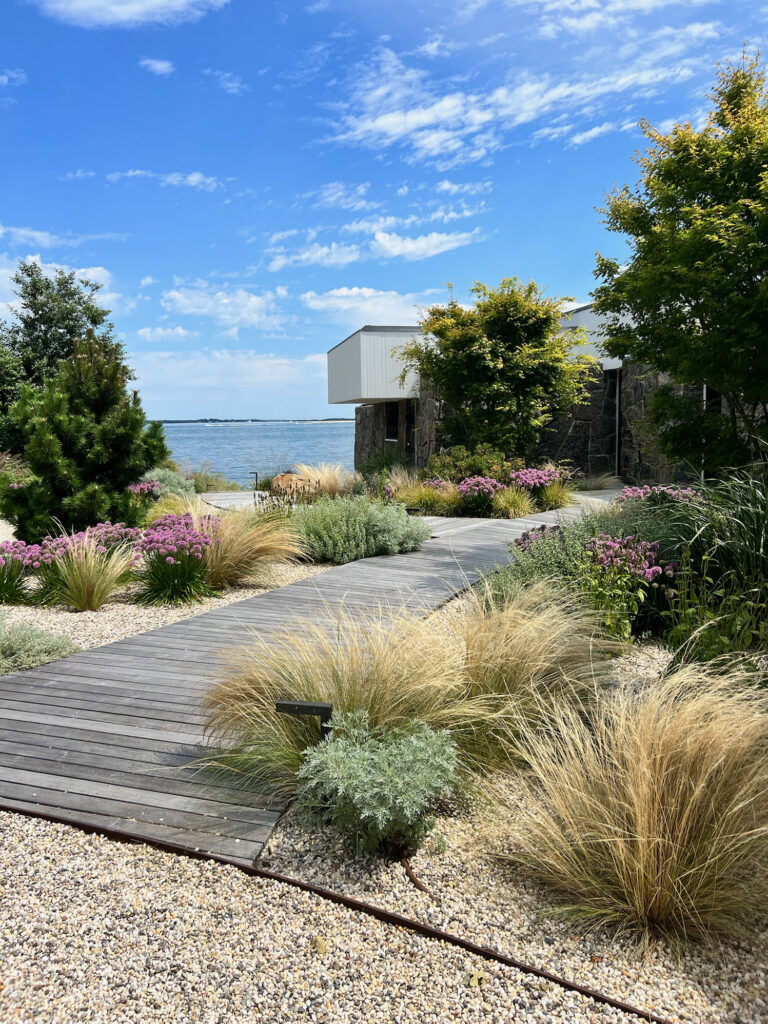
Caradaro utilizes pre-existing elements as well as drought and deer-resistant plantings to revamp outdoor spaces. (Photos by Vickie Cardaro)
“I’m a big fan of gravel gardens and I tried to push that as much as possible because a rainfall percolates down, so you’re replenishing the aquifer and it is a very clean item,” she says.
That preference was informed by landscape architects such as Lawrence Halprin and Thomas Church. They were influential in the mid-century “California Style,” a modernist, unified approach to garden composition that breaks the boundaries of formal and forced European design and is more in harmony with natural terrains, materials and forms.
“It’s a more minimalist and naturalistic style that came up in mid-century Los Angeles,” Cardaro says. “You didn’t see a lot of that out here decades ago and that was something that I just naturally gravitated toward after spending a lot of time in California.”
She finds that more clients on the East End are leaning into the aesthetic, too. Most notably, she transformed an exterior space for creative couple Jonathan Adler and Simon Doonan, who instructed her to remove every blade of grass. Cardaro swapped the greenery for gravel and the result—much-published in home-design magazines—helped establish a signature aesthetic.
A modernist garden rehab
For a home on Dawn Lane, Cardaro was called to help rehab the exterior grounds of a house designed by modernist architect Norman Jaffe that had fallen into neglect. She turned a broken bluestone patio into a gravel garden, removed a decrepit tennis court and chain-link fencing and, at the client’s request, created a roller-skating pad. Channeling the English’s penchant for walled gardens, she created one, serendipitously acquiring the material from the very same source that supplied Jaffe with the original.
Wooden boardwalks and feathery tufts of grass provide a soft visual relief to the gravel and the brutalist stone of the house. Elsewhere, graceful native plants of varying heights and textures form small scenarios or pops of color on the property. Paths made from various materials crisscross and lead into each other, or to tree and plant circles.
“Here, the plants soften the edges and create movement and flow, and integrate these curves into the hardscape recto-linear masonry of the house,” Cardaro explains. “You have all these different kinds of journeys… so many different moments in less than two acres.”
A stucco home, reimagined
Cardaro’s client for a project at Pleasant Circle called the stucco and concrete home the “Taco Bell House.” When she arrived, Cardaro found the site in an advanced state of disrepair, with overgrown gardens and foul Koi ponds.
“It was beyond Grey Gardens,” she says. But at the center of all the chaos was a mature Weeping Blue Atlas Cedar that would become a focal point for a newly constructed open-air courtyard, evoking both Savannah a la “Midnight in the Garden of Good and Evil” and a quiet Japanese garden.
Cardaro added flowering shrubs — Oakleaf hydrangea and Aucuba — in planters as the backdrop of the shady spot and oversized round steppingstones of her own design. Italian amber-hued lights were hung from the tree to create a soft, fairylike glow.


“I think when you don’t have the formal training and you have to invent how you do it, you get very creative,” says Cardaro. (Photos by Vickie Cardaro)
“The whole effect with the lights and the texture of the plants give it a very magical way of entering the house,” Cardaro says. While the tree isn’t among her favorite species, she goes on, “It’s extraordinary and it was a wonderful thing to inherit and work with.”
Going (naturally) incognito
For a home on Mashomuck Drive in Sag Harbor, the challenge was how to create a sense of privacy in a house with a two-story curtain wall that faced the street. The owners wanted the glass wall free of window treatments, but also wanted to be shielded from passersby. The property once had a yard of trees, many of which were removed and lost during a major renovation. Cardaro decided a large canopy tree would help fill the empty space and provide a natural screen for the window.
“We found a 35-foot ginkgo tree that completely privatized them from the road but allowed the sun in and with no window treatment,” she says. A bonus: Cardaro was able to save a lone flowering dogwood from the original yard, which she had kept alive with its own drip irrigation system. Without competition from other trees, the once underperforming tree, she says, is now “on fire with flowers.” Instead of feeling cluttered by trees, a more restrained lawn is bordered by tufts of natural grasses and flowers.
Back to the garden
In her own garden, Cardaro says, “It’s a tiny bit of the proverbial ‘Shoemaker’s children have no shoes.’ ”
“It’s a constant laboratory, experimenting with various plants all the time, and an orphanage/hospital for found/donated/inherited trees and shrubs,” she says. “I built a forest here and am constantly adding and removing, just playing around and having fun.”
It’s a passion project Cardaro may have more time for in the future as she contemplates her work commitments. She says she’s been fortunate to have most of her projects on Shelter Island the last couple of years, minimizing her commute. And while she isn’t ready to answer a question about what lies ahead, she says “There’s definitely a change afoot.”
“I love what I do and I get really excited by these projects, so I’m not ready to fold it, but I think I want to just do it a little bit differently in the future — take a couple of big projects per year.”